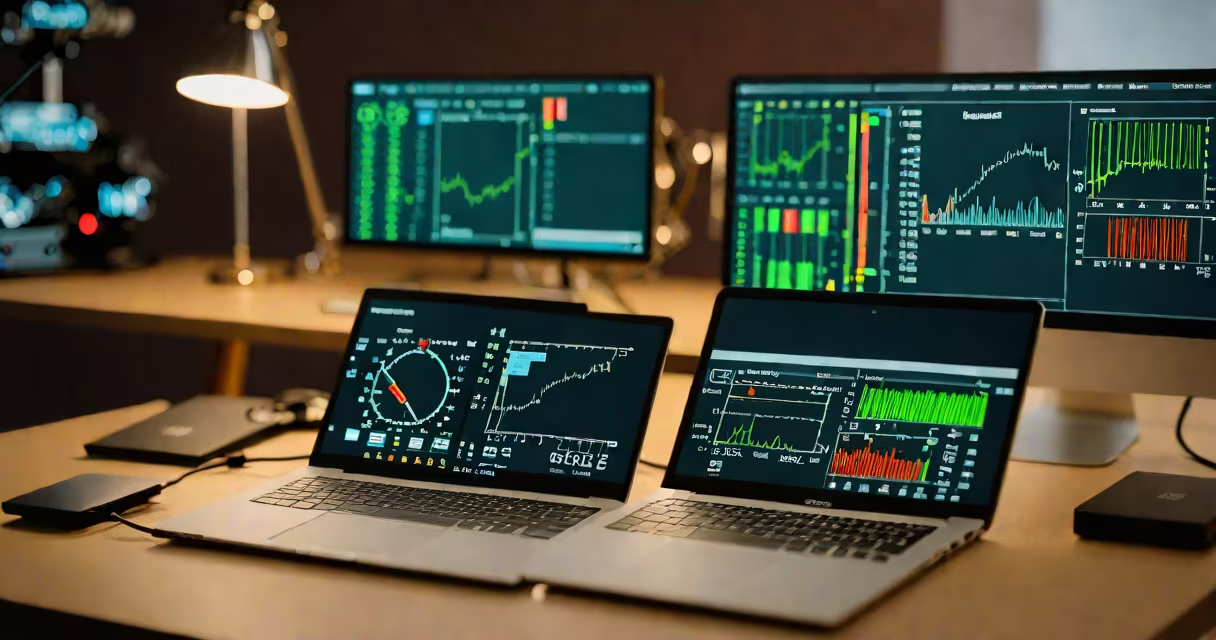
A general-purpose operating system (OS) manages hardware resources and runs multiple applications with variable response times, while a real-time operating system (RTOS) guarantees task execution within precise time constraints, essential for safety-critical systems.
Operating systems like Windows, Linux, and macOS handle diverse workloads-web browsing, file management, multimedia-by scheduling processes dynamically. They aim for high throughput and efficient resource sharing. An RTOS, in contrast, prioritizes determinism: every task completes within a known, bounded timeframe. This distinction defines their use cases.
The core difference lies in timing behavior. A standard OS may delay a process for minutes due to system load or priority scheduling. An RTOS, however, ensures a task finishes within microseconds-even under peak load. This makes RTOS ideal for environments where missed deadlines cause failure or danger.
An OS uses preemptive multitasking to switch between processes rapidly. The kernel allocates CPU time based on priority, fairness, and availability. Scheduling algorithms like CFS (Completely Fair Scheduler) in Linux balance responsiveness and efficiency. However, delays are unpredictable-latency can spike during heavy I/O or memory pressure.
An RTOS operates on a fixed-priority scheduler. Tasks are assigned priorities, and the highest-priority runnable task executes immediately. Preemption is instantaneous. For example, in a robotic arm controller using FreeRTOS, a sensor read triggers a motor command within 10 microseconds-no matter what else is running.
Memory management differs too. General-purpose OSes use virtual memory with paging and swapping. RTOS typically avoids this: memory is allocated statically at compile time or via fixed pools. This eliminates runtime allocation delays, which could violate timing requirements.
General-purpose operating systems fall into three categories: desktop (Windows, macOS), server (Linux distributions), and mobile (Android, iOS). They support complex GUIs, networking stacks, and third-party software.
RTOS types include hard real-time and soft real-time. Hard RTOS guarantees completion within a deadline-failure is unacceptable. Soft RTOS allows occasional misses, acceptable in less critical systems like audio processing.
| Feature | General-Purpose OS | Real-Time OS (RTOS) |
|---|---|---|
| Primary goal | Efficient multitasking and user interaction | Deterministic task timing |
| Latency | Variable, often milliseconds | Fixed, typically microseconds |
| Memory model | Virtual memory with paging | Static allocation or fixed pools |
| Use case | Desktop computing, web servers | Medical devices, automotive control, aerospace |
Examples of RTOS include FreeRTOS, VxWorks, and Zephyr. FreeRTOS powers over 1 billion devices annually, including IoT sensors and wearable health monitors. VxWorks runs NASA's Mars rovers and Airbus aircraft systems. These are not optional-they're required by safety standards like ISO 26262 for automotive and IEC 62304 for medical software.
Standard OSes dominate consumer electronics: smartphones, laptops, cloud servers. They manage large numbers of apps, drivers, and user sessions. Their flexibility supports evolving software ecosystems.
RTOS is used where timing matters. In a pacemaker, an RTOS ensures the device delivers electrical pulses at exact intervals-missing one could be fatal. In a factory robot, a 1-millisecond delay in stopping motion could cause injury or damage. In autonomous vehicles, RTOS handles sensor fusion and braking decisions with sub-millisecond precision.
Industrial automation relies heavily on RTOS. A programmable logic controller (PLC) using Allen-Bradley's ControlLogix platform runs on a custom RTOS variant. It reads inputs from 100 sensors every 10 milliseconds and adjusts actuators accordingly-any jitter would disrupt production lines.
Many assume RTOS means "faster." That's incorrect. RTOS isn't faster-it's more predictable. A Raspberry Pi running Linux may respond quicker to a button press than an RTOS on a slower microcontroller, but the RTOS response time is consistent. The Linux system might take 100ms one time and 5ms another-unacceptable in real-time control.
Another misconception: RTOS requires specialized hardware. While many RTOS run on microcontrollers (ARM Cortex-M series), they also operate on larger processors. QNX, used in Tesla's infotainment and braking systems, runs on x86 and ARM architectures. It achieves sub-microsecond context switches on multi-core processors.
Some believe RTOS can't run graphical interfaces. Modern RTOS like Zephyr support GUI frameworks such as LVGL. A smart thermostat using Zephyr displays temperature graphs and settings menus with responsive touch input-all while maintaining timing integrity for heating cycle control.
In 2018, a hospital in Boston reported a patient death linked to a ventilator malfunction. The device used a modified Linux OS. During a network update, the system delayed a breath-cycle signal by 1.2 seconds-beyond safe limits. Post-incident analysis showed the OS couldn't guarantee timing. The manufacturer later replaced the OS with a certified RTOS (VxWorks) and passed FDA validation.
This case illustrates a key point: safety-critical systems demand deterministic behavior. Linux, despite being useful, cannot provide worst-case execution time guarantees without extensive modification. RTOS is designed from the ground up for this purpose.
I once debugged a drone flight controller using FreeRTOS. The drone would suddenly lose altitude during video transmission. After profiling, we found the WiFi driver caused a 300-microsecond delay in the motor control loop. We moved the driver to a lower-priority task and added a watchdog timer. The system stabilized within hours. That experience confirmed: RTOS isn't just about speed-it's about reliability under stress.
The difference between OS and RTOS is not about capability but intent. A general-purpose OS serves users and applications with flexible, adaptive performance. An RTOS serves systems where timing is life-or-death. Choosing one depends on whether you need flexibility or certainty.
When building systems that interact with the physical world-medical devices, industrial machines, transportation-choose an RTOS. When managing user workflows, documents, and internet services, a general-purpose OS suffices. The right tool depends on the consequence of delay.