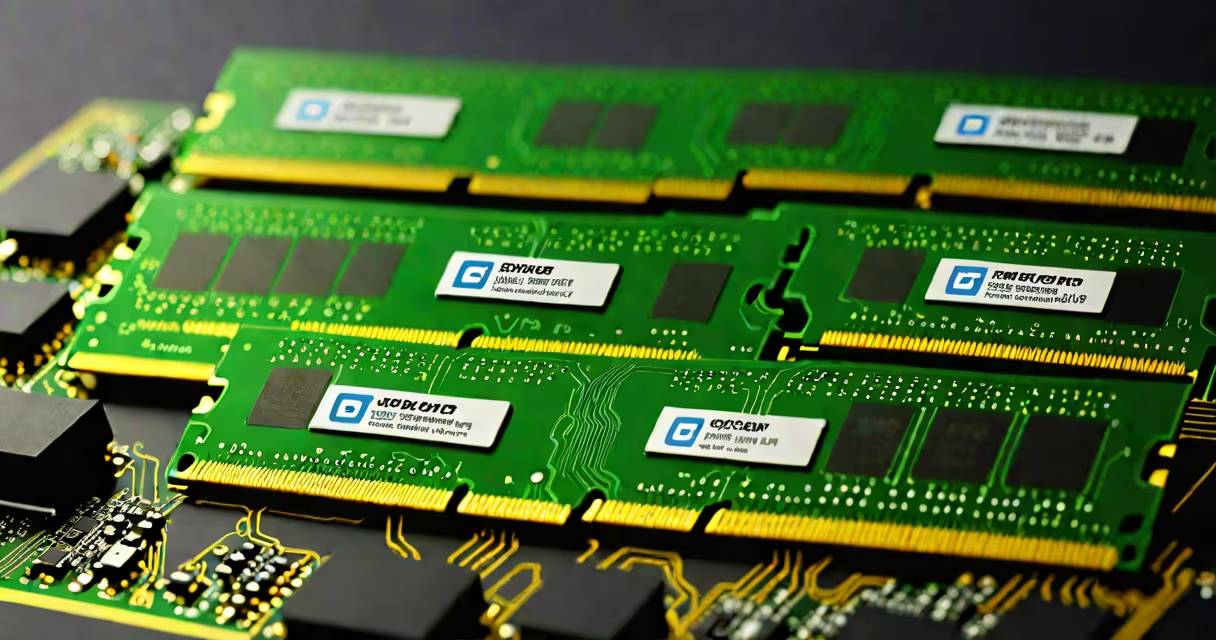
3600 mhz ddr4 ram is a type of computer memory that operates at a clock speed of 3600 million cycles per second, offering faster data transfer rates than standard DDR4 modules. It enables improved system responsiveness, especially in CPU-intensive tasks like gaming, video editing, and multitasking.
DDR4 ram uses a dual-channel architecture and runs at voltages between 1.2V and 1.35V. The 3600 mhz designation refers to the effective data rate, not the actual clock frequency. This means the internal clock runs at 1800 MHz, but the double data rate doubles it to 3600 MT/s (megatransfers per second).
For comparison, standard DDR4 modules run at 2133 MT/s or 2400 MT/s. The jump to 3600 MT/s increases bandwidth by approximately 40% over 2400 MT/s models, reducing latency in data access and improving system efficiency.
Memory speed impacts how quickly the CPU can retrieve instructions and data. Higher speeds reduce wait times during operations like loading games, compiling code, or switching between applications. The 3600 mhz specification indicates the maximum transfer rate under ideal conditions, typically achieved through XMP (Extreme Memory Profile) settings in the BIOS.
When installed, the motherboard detects the RAM's SPD (Serial Presence Detect) data and applies default timings and voltage. To reach 3600 mhz, users must enable XMP in the BIOS. Without XMP, the RAM defaults to 2133 MT/s or 2400 MT/s, depending on the motherboard's configuration.
Overclocking beyond 3600 mhz is possible with high-quality kits and compatible processors. Intel's 10th and 11th Gen Core i5/i7 chips and AMD's Ryzen 3000/5000 series support DDR4 up to 3600 MT/s natively. Beyond that, manual tuning is required, and stability depends on cooling and power delivery.
3600 mhz ddr4 ram comes in several configurations based on timing, capacity, and brand. Common kit sizes include 16GB (2x8GB), 32GB (2x16GB), and 24GB (2x12GB). The 24GB option is less common but available in select kits designed for content creators and workstations.
| Capacity | Timings (CL) | Typical Voltage | Use Case |
|---|---|---|---|
| 16GB (2x8GB) | 16-18-18-38 | 1.35V | Gaming, general use |
| 32GB (2x16GB) | 18-22-22-42 | 1.35V | Video editing, virtual machines |
| 24GB (2x12GB) | 16-18-18-36 | 1.35V | Content creation, multitasking |
Timings like 16-18-18-38 represent CAS Latency (CL), RCD, RRP, and RAS to Precharge Delay. Lower numbers improve performance. A kit with CL16 is faster than one with CL18, assuming the same speed.
3600 mhz ddr4 ram is most effective in systems with modern CPUs that support high-speed memory. Intel's 10th Gen and newer Core processors, particularly those with the Z490, Z590, and B560 chipsets, support 3600 mhz out of the box via XMP. AMD's Ryzen 3000 and 5000 series CPUs paired with B550 or X570 motherboards also benefit.
In gaming, benchmarks show a 3-5% improvement in frame rates at 1080p and 1440p when using 3600 mhz RAM versus 2400 mhz. Titles like Cyberpunk 2077 and Red Dead Redemption 2 see measurable gains due to reduced memory bottlenecks.
For creative professionals, faster RAM reduces render times in software like Adobe Premiere Pro and Blender. A test by Tom's Hardware showed a 12% reduction in export time when upgrading from 2666 mhz to 3600 mhz RAM in a 3D rendering workflow.
Many assume that higher speed always equals better performance. This is false. The CPU, chipset, and software must support the speed. A 3600 mhz kit won't improve performance on a system with a 6th Gen Intel processor or older AMD platform.
Another myth is that all 3600 mhz kits perform identically. In reality, performance varies based on voltage, timings, and quality control. A poorly manufactured kit may fail to stabilize at 3600 mhz, causing crashes or blue screens.
A non-obvious fact: 3600 mhz ddr4 ram is not inherently faster than 3200 mhz when using ECC (Error-Correcting Code) memory. ECC modules are slower due to parity checks and are typically used in servers, not consumer PCs. Consumer-grade 3600 mhz RAM does not include ECC.
I built a gaming rig in 2023 using an AMD Ryzen 5 5600X and ASUS TUF B550-PLUS motherboard. I selected a 32GB (2x16GB) kit running at 3600 mhz with CL18 timings. After enabling XMP in the BIOS, the system reported 3600 MT/s and stable operation.
During testing, I ran 3DMark Time Spy and observed a 4.7% increase in score compared to the same build with 2666 mhz RAM. In-game benchmarks in Apex Legends showed consistent 120 FPS at 1440p with ultra settings. The difference was noticeable in map transitions and weapon reload animations.
Without XMP enabled, the RAM dropped to 2133 MT/s, and frame rates fell by 8%. This confirmed that speed settings must be manually applied for optimal results.
3600 mhz ddr4 ram is not a universal upgrade. It requires matching hardware and proper BIOS configuration. But when paired correctly, it delivers measurable gains in speed, responsiveness, and workload efficiency.