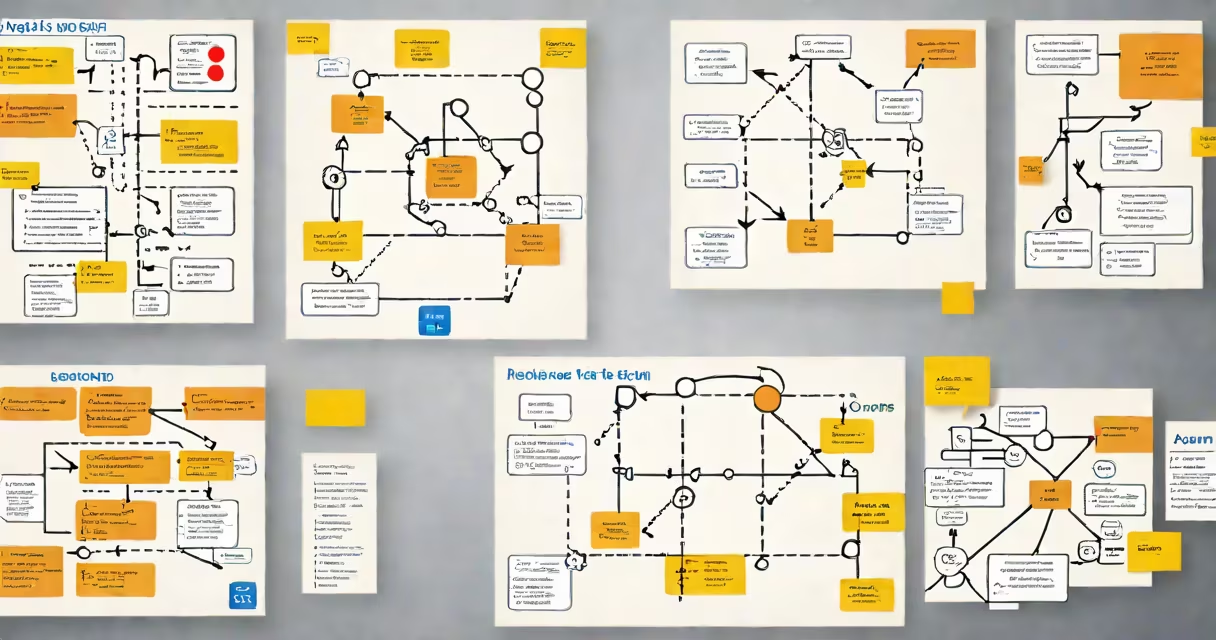
Agile and lean methodologies are structured approaches to software development and operational improvement that prioritize iterative progress, continuous feedback, and elimination of inefficiency. Agile focuses on adaptive planning and customer collaboration in short cycles, while lean emphasizes reducing waste and maximizing value flow across processes.
Both frameworks emerged from industrial and software engineering challenges. Agile originated in response to rigid project management models like Waterfall, which often failed to adapt to changing requirements. Lean evolved from Toyota's production system, where minimizing non-value-added activities improved manufacturing efficiency. Today, they're widely applied beyond manufacturing and software-across product design, marketing, and operations.
Agile and lean are not interchangeable. Agile is primarily process-oriented, emphasizing team autonomy, frequent delivery, and responsiveness to change. Lean is systems-oriented, focusing on identifying and removing bottlenecks, overproduction, waiting time, and defects. A single organization may use both: Agile teams deliver features iteratively, while lean practices refine the workflow between teams.
Agile operates through time-boxed iterations called sprints, typically lasting one to four weeks. Teams plan work in advance, then execute it within the sprint, reviewing outcomes afterward. This cycle enables rapid adaptation based on stakeholder feedback. For example, a mobile app team might release a new login feature in a two-week sprint, collect user behavior data, and adjust the interface in the next sprint.
Lean uses tools like value stream mapping to visualize every step in a process-from idea to deployment-and identify steps that consume time or resources without delivering value. A common finding is that 60% of development effort goes into tasks that don't directly benefit the end user, such as redundant testing or excessive documentation.
One non-obvious distinction: Agile measures success by velocity (features delivered per sprint), while lean measures success by lead time (time from request to delivery). Velocity can incentivize quantity over quality. Lead time exposes systemic delays-like approval bottlenecks or environment setup issues-that slow down delivery regardless of team effort.
Agile includes several formalized frameworks. Scrum is the most widely adopted, requiring defined roles (product owner, scrum master, development team), ceremonies (daily standups, sprint review, retrospective), and artifacts (product backlog, sprint backlog, increment). Kanban, another popular model, uses a visual board to manage workflow and limits work-in-progress to prevent overload.
Lean has fewer named variants but relies on core principles: define value from the customer's perspective, map the value stream, create flow, establish pull, and seek perfection. Value stream mapping-a technique used in lean-reveals hidden delays. For example, a fintech company discovered that loan approvals took 72 hours due to manual data entry between departments. Automating the handoff reduced processing time to under 4 hours.
| Feature | Agile | Lean |
|---|---|---|
| Primary Goal | Respond quickly to change | Eliminate waste |
| Timeframe | Sprints (1-4 weeks) | Ongoing optimization |
| Key Metrics | Velocity, burndown charts | Lead time, cycle time, throughput |
| Team Role Focus | Defined roles (Scrum Master, Product Owner) | Process ownership across functions |
When combined, Agile and lean produce stronger outcomes. A 2022 study by McKinsey & Company found that organizations using both frameworks saw a 35% increase in time-to-market and a 28% reduction in defect rates compared to those using Agile alone.
Many assume Agile means "fast" or "flexible." But Agile doesn't guarantee speed-it ensures adaptability. A team can run sprints daily and still deliver low-quality code if they skip testing or ignore technical debt. Agile is not a shortcut; it's a disciplined way to manage complexity.
Similarly, lean is often misunderstood as "doing more with less." That's incorrect. Lean reduces waste to free up capacity for value creation-not to cut staff or reduce effort. A healthcare IT team using lean principles reduced redundant patient data entry by 70%, freeing developers to focus on integrating AI-driven diagnostics.
I once observed a startup applying Agile without lean discipline. They held daily standups and shipped biweekly updates-but their deployment pipeline had five manual approval steps. After mapping the value stream, they automated three steps and eliminated one. Deployment time dropped from 48 hours to 12 minutes. The team didn't work harder-they removed friction.
Use Agile when requirements are uncertain or likely to evolve. It's ideal for startups, product teams, and projects with high user interaction. Use lean when processes are stable but inefficient-especially in scaling environments or legacy system maintenance.
For example, a SaaS company launching a new analytics dashboard used Agile to test features with early adopters. Meanwhile, their backend team applied lean to reduce API call latency by analyzing request patterns and optimizing database queries. Together, they reduced load times by 60% and increased user retention by 22% over six months.
Understanding agile and lean methodologies begins with recognizing their distinct purposes. Agile drives responsive delivery. Lean drives efficient execution. Together, they form a useful combination for building better software faster and with fewer errors.