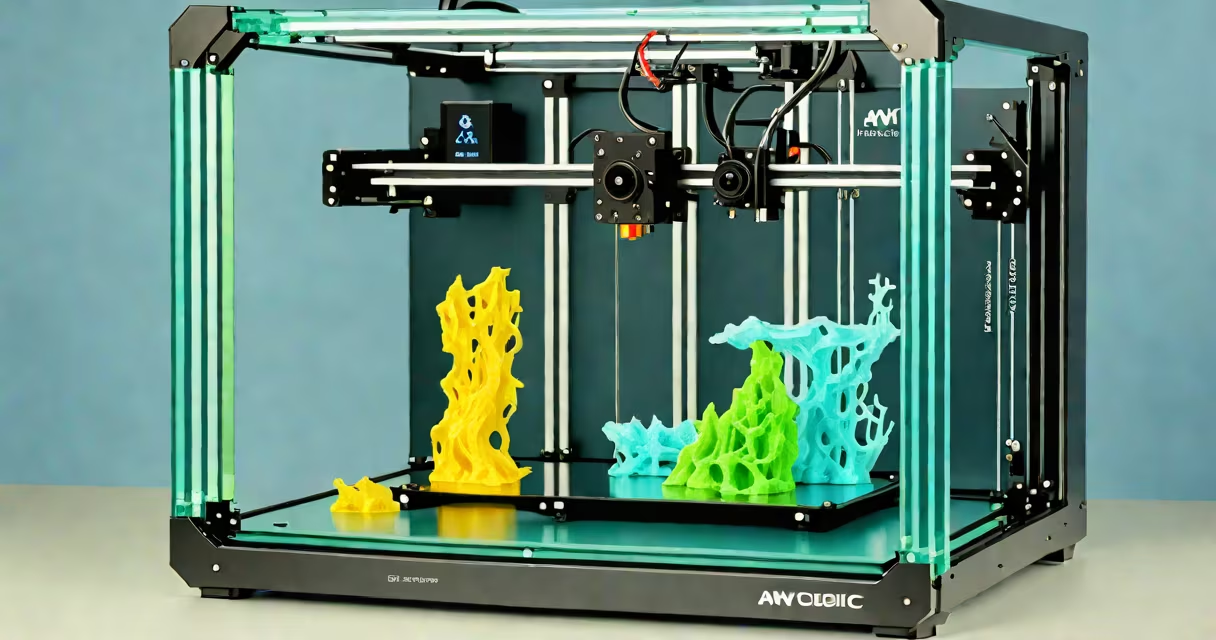
The AnyCubic Photon Mono is a desktop single-axis stereolithography (SLA) 3D printer using a monochrome LCD screen to cure liquid resin layer by layer, producing high-detail models with resolutions up to 3840×2400 pixels (4K).
SLA printers like the Photon Mono use UV light to solidify photopolymer resin. Instead of moving a laser beam, the Photon Mono projects a full image of each layer through a transparent LCD panel. This method enables faster print speeds and consistent layer quality compared to laser-based systems.
The printer's core innovation lies in its monochrome LCD. Unlike standard color LCD screens, which emit red, green, and blue light, the monochrome version uses a single wavelength-typically 405 nm UV light. This increases exposure accuracy and reduces resin over-curing, resulting in finer details and less surface roughness.
Each print begins with the build platform submerged in a resin vat. A UV light source shines through the monochrome LCD screen, projecting the cross-section of the model onto the resin. The exposed resin hardens instantly upon contact with UV light. After each layer, the platform lifts slightly, allowing fresh resin to flow beneath the cured layer. This cycle repeats until the model is complete.
Post-processing involves removing the print from the platform, washing it in isopropyl alcohol (IPA) to remove residual resin, and curing it under UV light to achieve full hardness. The entire process takes 30-60 minutes for a small model, depending on size and settings.
A typical print session for a 50 mm cube with 50 µm layer height takes approximately 2 hours. The printer supports file formats like .stl and .obj, and users control it via a touchscreen interface or USB connection to slicing software such as Chitubox or Lightburn.
The Photon Mono features a 3840×2400 pixel resolution display, translating to a 0.025 mm × 0.025 mm pixel size. This allows for extremely fine detail-enough to reproduce textures like leather grain or micro-engravings. The build volume measures 130 mm × 80 mm × 150 mm (length × width × height), suitable for jewelry, miniatures, and functional prototypes.
It includes a dual-stage leveling system: automatic bed leveling via a sensor and manual adjustment for precision. The enclosure is sealed, reducing fumes and protecting against dust. Internal fans maintain temperature stability during long prints.
| Specification | Photon Mono | Photon Mono 4K |
|---|---|---|
| Resolution | 3840×2400 px | 3840×2400 px |
| Layer Height Range | 10-100 µm | 10-100 µm |
| Build Volume | 130 × 80 × 150 mm | 130 × 80 × 150 mm |
| Screen Type | Monochrome LCD | Monochrome LCD |
| Print Speed (avg) | ~15 mm/h | ~15 mm/h |
Despite similar dimensions, the Photon Mono 4K variant offers improved contrast and longevity due to enhanced LCD durability. The original Photon Mono remains widely available and cost-effective at $299-$349 USD.
Many assume that higher resolution automatically means better print quality. That's false. Resolution defines pixel density, but actual detail depends on resin chemistry, exposure time, and calibration. A poorly tuned printer with 4K resolution can produce blurry or weak parts.
Another myth: "Monochrome screens are always brighter." Not true. Brightness depends on the LED range and power supply. The Photon Mono's 405 nm LEDs deliver sufficient intensity, but users must avoid overexposure settings that cause resin to cure too deeply, leading to warping or delamination.
A lesser-known fact: the Photon Mono's LCD lifespan is rated for 1,000 hours of continuous use. After that, pixel degradation may occur. However, most users report stable performance for 2-3 years with regular maintenance. Replacing the screen costs around $60-$80, less than replacing a laser diode in a laser-based SLA printer.
I printed a 3D model of a vintage camera lens housing (120 mm tall, 45 mm diameter) using standard clear resin. The result had visible thread details, polished glass-like surfaces, and no visible layer lines. Post-processing took 15 minutes in IPA wash and 30 minutes under a UV lamp. Final strength was sufficient for handling and display.
Users often choose the Photon Mono for miniatures, dental models, and custom jewelry. Its ability to reproduce fine textures makes it ideal for figurines with facial expressions or architectural models with window grilles. One user reported printing a 1:12 scale clock mechanism with interlocking gears that meshed perfectly after cleaning.
The AnyCubic Photon Mono delivers professional-grade detail and reliability in a compact desktop form. Its monochrome LCD enhances consistency and speed, making it a top choice for hobbyists and professionals alike. When paired with proper resin and calibration, it produces results that rival machines costing twice as much.