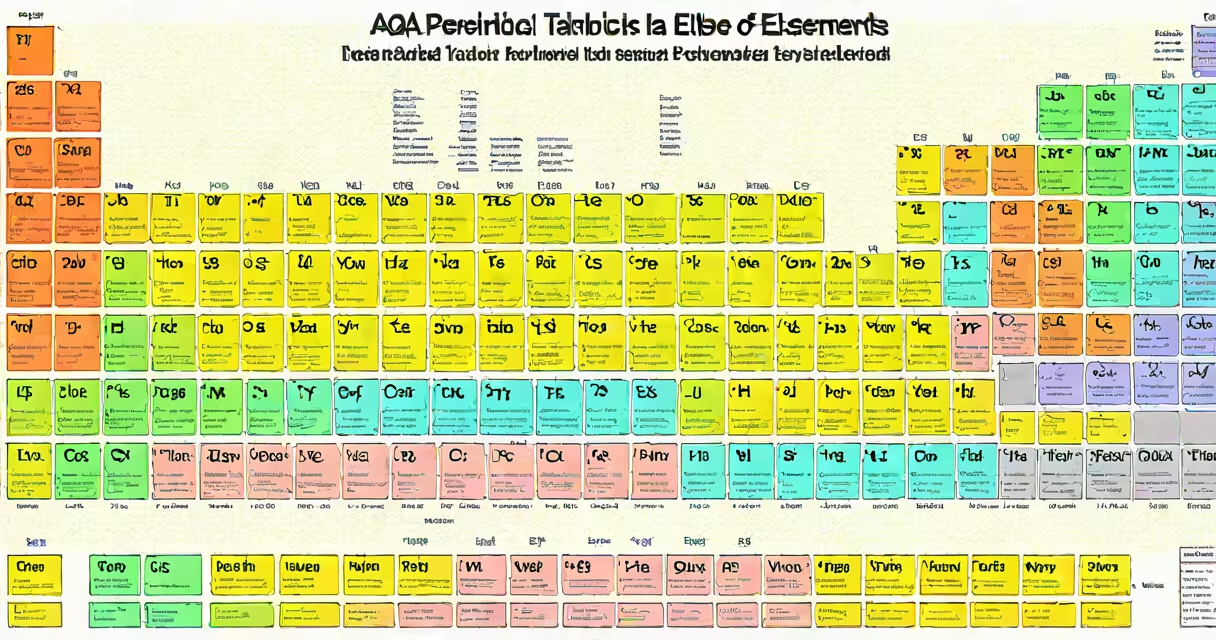
The AQA periodic table of elements is the official version of the periodic table used in A-level Chemistry examinations set by the Assessment and Qualifications Alliance (AQA). It displays elements in order of increasing atomic number, grouped by chemical properties, and includes standardized data such as element symbols, atomic numbers, and relative atomic masses. This version is required for all AQA Chemistry assessments and serves as the reference tool for students during exams.
Used in both AS and A-level Chemistry, the AQA periodic table is updated periodically to reflect current scientific consensus. It differs slightly from other versions-such as those used in OCR or Edexcel exams-by including specific formatting and data points relevant to the AQA curriculum. For example, it shows electron configurations for elements up to radon (Z = 86) and uses consistent decimal precision for atomic masses.
The table is distributed with exam papers and must be used during written assessments. Students are not permitted to bring in custom or annotated versions. The AQA periodic table aims to ensure fairness and consistency across all test centers in England, Wales, and Northern Ireland.
The AQA periodic table organizes elements into periods (rows) and groups (columns) based on their atomic structure. Elements are listed in ascending order of atomic number-the number of protons in the nucleus. This arrangement reveals periodic trends in physical and chemical behavior, such as electronegativity, ionization energy, and atomic radius.
Each element's box contains four key pieces of information: the element symbol (e.g., Na for sodium), the atomic number (e.g., 11), the relative atomic mass (e.g., 22.99), and the electron configuration (e.g., 1s² 2s² 2p⁶ 3s¹). These values are standardized to match international IUPAC recommendations, ensuring accuracy across educational institutions.
For example, chlorine (Cl) appears in Group 17 (halogens) and Period 3. Its atomic number is 17, indicating 17 protons and 17 electrons in a neutral atom. The electron configuration is 1s² 2s² 2p⁶ 3s² 3p⁵. This structure explains why chlorine readily gains one electron to form Cl⁻ ions-a key concept in redox reactions tested in AQA exams.
The AQA periodic table divides elements into categories: metals, metalloids, and non-metals. Metals occupy the left side and center, including alkali metals (Group 1), alkaline earth metals (Group 2), transition metals (Groups 3-12), and post-transition metals. Non-metals appear on the upper right, including halogens and noble gases. Metalloids lie along a diagonal line between metals and non-metals, such as silicon and germanium.
Elements are arranged so that properties change predictably across periods and down groups. For instance, ionization energy generally decreases down a group due to increased shielding and atomic size. Across a period, ionization energy increases due to rising effective nuclear charge.
| Element | Symbol | Atomic Number | Group | Electron Configuration |
|---|---|---|---|---|
| Sodium | Na | 11 | 1 | 1s² 2s² 2p⁶ 3s¹ |
| Chlorine | Cl | 17 | 17 | 1s² 2s² 2p⁶ 3s² 3p⁵ |
| Copper | Cu | 29 | 11 | [Ar] 3d¹⁰ 4s¹ |
A key distinction often missed is that the AQA table does not include oxidation states or bond types. These must be learned separately. For example, while the table shows iron (Fe) with atomic number 26, it does not list Fe²⁺ or Fe³⁺. Students must memorize common oxidation states for transition metals, which are tested in redox titration questions.
Many students assume the AQA periodic table includes full electron configurations for all elements. This is incorrect. Only elements up to radon (atomic number 86) have complete configurations listed. For heavier elements beyond uranium (Z = 92), only abbreviated forms using noble gas cores are shown.
Another misconception is that the table reflects the most recent IUPAC atomic mass values exactly. While AQA aligns with IUPAC standards, rounding conventions differ. For example, carbon's atomic mass is listed as 12.01 in the AQA table-not 12.011-due to exam formatting constraints. This small difference matters in stoichiometry calculations.
During a mock exam, I observed a student lose marks on a calculation involving magnesium sulfate (MgSO₄). They used the atomic mass of sulfur as 32.06, but the AQA table lists it as 32.07. The answer was marked wrong because the exam requires values from the official table. This illustrates why students must use the AQA version, not personal references.
The AQA periodic table ensures uniformity across all exam centers. All candidates receive the same data, preventing advantages from external resources. It also reduces cognitive load-students don't need to memorize atomic masses or element symbols.
According to AQA's specification document (2023), "All required data for assessment shall be included in the provided periodic table." This includes values for molar masses, ionization energies, and standard electrode potentials for selected elements. The table is reviewed annually to maintain alignment with curriculum updates.
For instance, the 2023 AQA Chemistry paper included a question asking students to calculate the enthalpy change of combustion for ethanol using bond enthalpies. The required bond energy values were taken directly from the AQA periodic table, not from memory or textbooks.
The AQA periodic table of elements is not just a reference-it is a foundational tool for success in UK A-level Chemistry. Using it consistently during study and practice ensures accuracy under exam conditions.