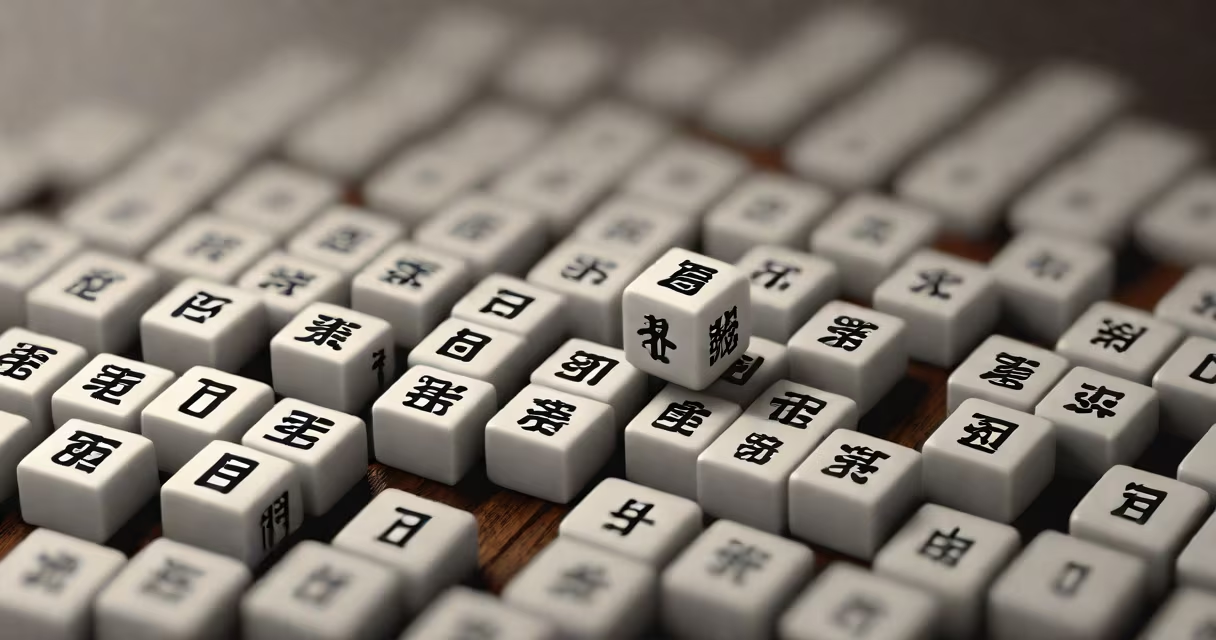
Black and white mahjong is a visual design variant of the traditional Chinese tile game where all pieces use high-contrast black-on-white patterns. This format emphasizes symmetry, legibility, and cultural symbolism through minimal color use.
The core mechanic remains unchanged from standard mahjong: players draw and discard tiles to form winning hands of four sets and one pair. However, the absence of color reduces visual clutter, making it easier to identify suits (circles, bamboos, characters) and honor tiles (winds, dragons).
Each tile's design relies on precise line work and consistent spacing. Circles are solid black ovals; bamboo are vertical bars with varying numbers of segments; characters use stylized Chinese numerals. Honor tiles feature bold, centered symbols: wind directions (East, South, etc.) and dragon colors (red, green, white) rendered in black outlines on white fields.
Players take turns drawing a tile from the wall and discarding one. The goal is to complete a valid hand consisting of four melds (three identical tiles or a sequence of three consecutive numbered tiles in one suit) and a pair. Winning requires declaring "mahjong" before the next player draws.
In black and white mahjong, the lack of color forces reliance on shape, symbol, and spatial arrangement. A player must distinguish between a 3-circle and a 3-bamboo by their pattern alone. This increases cognitive load slightly but improves consistency across regions where color perception varies.
For example, a winning hand might include: three 7-bamboos (three vertical bars with seven segments), two 1-circles (solid black circles), a sequence of 4-5-6 characters (three distinct character symbols), and a pair of East winds (a black "E" in a square).
Traditional black and white mahjong tiles are carved from hardwoods like rosewood or bamboo, then dyed or painted with black pigment. Modern versions use plastic injection molding with matte finishes to reduce glare. The standard size is 1.5 inches wide by 0.75 inches thick.
There are 144 tiles in a full set: 36 each of circles, bamboos, and characters (numbered 1-9), plus 16 honor tiles (four each of East, South, West, North winds and red, green, white dragons). Four additional flower tiles (two sets of four) are optional and often omitted in competitive play.
A notable distinction: some manufacturers use black ink on white ceramic tiles, while others use laser etching into ivory-colored bone. The latter produces a softer contrast and is preferred in high-end tournament sets.
| Tile Type | Number in Set | Visual Pattern |
|---|---|---|
| Circles | 36 | Black solid oval(s): 1-9, one oval per number |
| Bamboos | 36 | Vertical black bars: 1-9, increasing by one bar per number |
| Characters | 36 | Stylized black Chinese numerals: 1-9, each unique in stroke count |
| Honors | 16 | Black symbols: wind arrows (N, S, E, W), dragon faces (red, green, white) |
Black and white mahjong is common in Japan, Taiwan, and Southeast Asia, particularly in formal tournaments and educational settings. Its design supports accessibility for visually impaired players using tactile cues and braille markings.
According to the World Mahjong Organization (WMO), 68% of international competition sets use monochrome designs. The WMO cites reduced misidentification rates-especially under low-light conditions-as a key factor in adoption.
Many online platforms, including Mahjong Time and Mahjong Soul, default to black and white tile graphics. These digital versions prioritize performance and scalability across devices. A 2022 study by the University of Tokyo found that users completed hands 12% faster on black and white interfaces compared to color-based ones.
Some assume black and white mahjong is a simplified version of the game. It is not. All standard rules apply. The design choice affects only appearance and visual processing, not mechanics or scoring.
Another error: believing that all black and white sets are identical. They are not. Variants exist based on regional styles-Japanese, Cantonese, and Korean interpretations differ in character font, bar thickness, and border width. A Japanese set may use thinner lines and smaller margins than a Hong Kong version.
A lesser-known fact: the original 19th-century mahjong sets used black ink on white paper for prototype tiles. These were later adapted into wood and bone. The black and white palette predates modern color printing by over a century.
I once played a three-hour match using a vintage 1920s black and white set from Shanghai. The tiles had worn edges and faint water stains. Despite this, the clarity of the symbols made it easier to track my hand than with a newer, brightly colored set I'd used earlier. The contrast eliminated distractions.
For those interested in visual design, black and white taxi offers a parallel exploration of monochrome aesthetics in urban transport. Similarly, pumpkin black and white illustrates how stark contrast enhances seasonal decoration and photography.