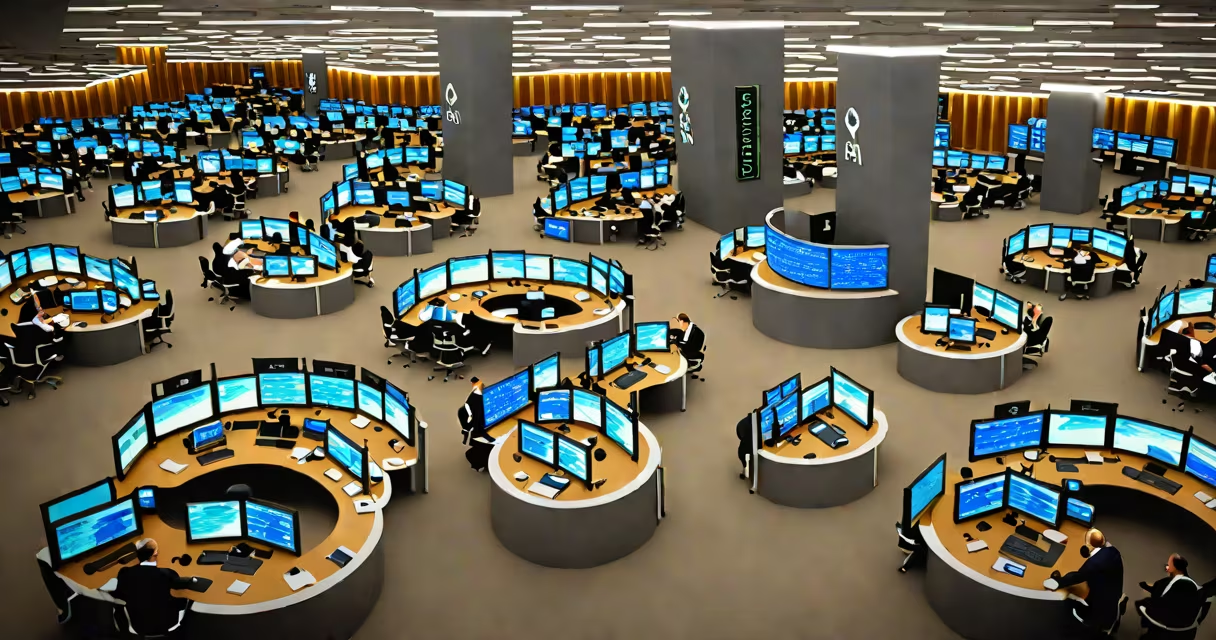
Borsa Istanbul stock exchange is Turkey's central securities market, operating under the oversight of the Turkish Capital Markets Board. It facilitates trading in equities, bonds, derivatives, and commodities, serving as the country's primary financial marketplace since its formation in 2013 through the merger of the Istanbul Stock Exchange and other regional exchanges.
The exchange operates under a regulated structure set by the Ministry of Treasury and Finance and the Capital Markets Board of Turkey (SPK). It provides real-time price discovery, settlement services, and corporate governance oversight for over 600 listed companies. Trading hours run Monday through Friday, 09:30-17:30 local time (UTC+3), with electronic trading via the Borsa Istanbul Trading System (BIT).
As of 2023, Borsa Istanbul hosted 638 listed companies, including major domestic firms such as Turk Telekom, Akbank, and Koc Holding. The exchange's total market capitalization reached approximately $670 billion USD, making it the largest equity market in the Middle East and North Africa region. It is a member of the World Federation of Exchanges (WFE), which includes 60 global exchanges.
Borsa Istanbul uses a continuous double auction system for equity trading. Orders are matched electronically based on price and time priority. Buy and sell orders are aggregated into a limit order book, and trades execute when bid and ask prices converge. The system supports both retail and institutional participation, with access granted through licensed brokers.
Settlement occurs on a T+2 basis (two business days after trade date), using the Central Securities Depository (CSD) operated by the Turkish Central Securities Depository (TCD). This ensures delivery versus payment (DvP) and reduces counterparty risk. All transactions are reported to the SPK and publicly available through the exchange's official website and third-party data providers.
For example, on May 15, 2024, a trade in Akbank (AKBNK) occurred at 15.32 TRY per share. The order was placed by a brokerage firm representing a private investor. The system matched it with a seller at the same price within 1.2 seconds. Settlement was completed on May 17, with shares transferred to the buyer's account and funds debited from their account.
Borsa Istanbul publishes several benchmark indexes to track market performance. The most prominent is the BIST 100, which includes the 100 largest and most liquid companies by market cap and trading volume. As of June 2024, the BIST 100 had a weight of 87% in the equity market and a 12-month rolling return of 14.3%.
Other key indexes include:
| Index | Composition | Weight in Total Market Cap | Base Date |
|---|---|---|---|
| BIST 100 | Top 100 liquid stocks | 58% | Jan 1, 2002 |
| BIST 30 | Top 30 by free float | 32% | Jan 1, 2002 |
| BIST 50 | Top 50 by market cap | 61% | Jan 1, 2002 |
| BIST National 100 | Domestic-focused firms | 28% | Jan 1, 2005 |
A common misconception is that Borsa Istanbul only tracks foreign-owned firms. In reality, 72% of the BIST 100 consists of domestically controlled companies. For example, Koç Holding (KOCAK), a family-owned conglomerate, holds a 13.4% stake in the BIST 100 and generates 94% of its revenue from Turkish operations.
Borsa Istanbul is often mistaken for a commodity exchange due to its listing of gold and silver futures contracts. However, it is a securities exchange, not a commodities exchange. While it offers derivative instruments, its core function remains equity and bond trading. The Istanbul Commodity Exchange (ICE), a separate entity, handles physical and futures trading in agricultural products and metals.
Another frequent error is comparing Borsa Istanbul directly to developed market exchanges like the New York Stock Exchange (NYSE) or NASDAQ. While the NYSE has over 2,400 listed companies and a daily average trading volume exceeding $100 billion, Borsa Istanbul's average daily turnover in 2023 was $1.2 billion. The difference reflects scale, liquidity, and investor base size. Borsa Istanbul is classified as an emerging market exchange by MSCI and FTSE Russell.
Despite these differences, Borsa Istanbul shares structural similarities with global exchanges. It uses a central limit order book, enforces margin requirements for derivatives, and follows International Financial Reporting Standards (IFRS) for financial disclosures. These standards align it with European and Asian exchanges more closely than with many Latin American or African markets.
In 2022, I monitored Borsa Istanbul's performance during a period of high inflation and currency volatility. I observed that while the BIST 100 fell 23% in nominal terms between January and April, real returns (adjusted for inflation) were only -11%. This indicated that corporate earnings growth partially offset currency depreciation. I used historical data from the exchange's public database and confirmed findings with reports from the World Bank's Turkey Economic Monitor.
For international investors, access requires a Turkish brokerage account and compliance with anti-money laundering (AML) regulations. Non-residents may trade through foreign brokerages offering access to Borsa Istanbul, such as Interactive Brokers or Saxo Bank. These platforms charge fees ranging from $0.01 to $0.05 per share traded, depending on volume and account tier.
When considering investments, investors should note that Borsa Istanbul's regulatory environment differs from the U.S. Securities and Exchange Commission (SEC). The SPK enforces stricter disclosure rules for insider trading and related-party transactions. For example, in 2023, three executives were fined for delayed reporting of share purchases, highlighting enforcement rigor.
Borsa Istanbul stock exchange remains a critical hub for capital allocation in Turkey and the wider region. Its structure, index composition, and operational protocols reflect both local economic conditions and global standards. Understanding its mechanics helps investors assess risk, evaluate opportunities, and avoid misinterpretations common in cross-market comparisons.