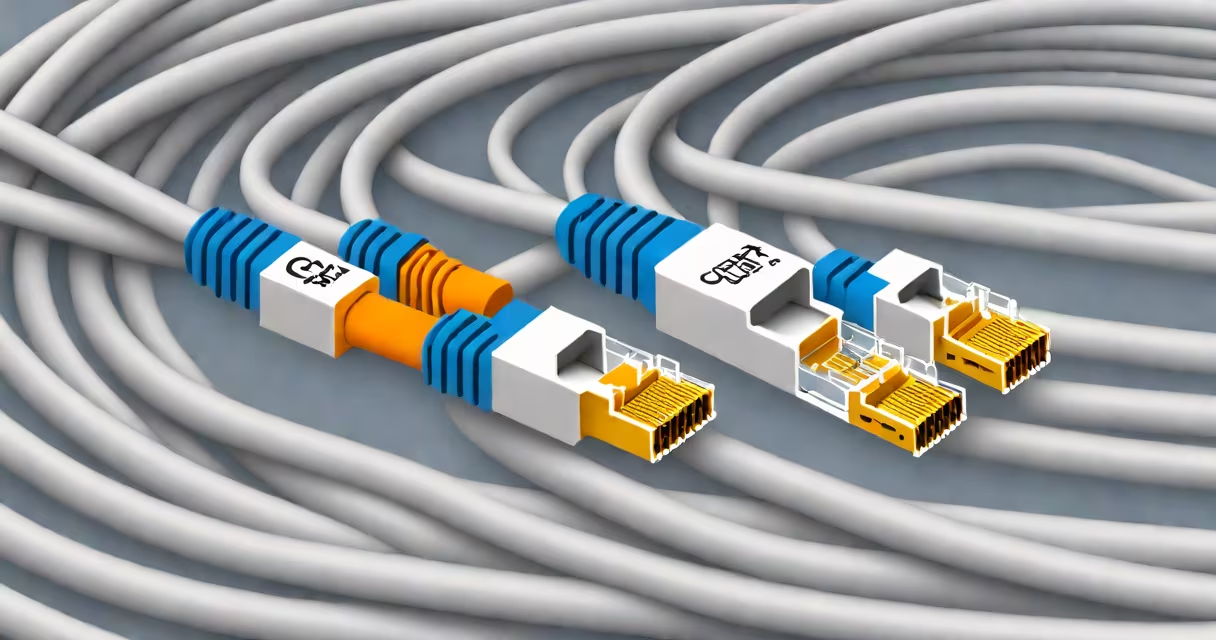
cat 6 utp is a type of unshielded twisted pair cable designed for high-speed data transmission in Ethernet networks, capable of supporting 10 gigabit per second speeds over distances up to 55 meters.
It uses four pairs of individually twisted copper wires enclosed in a single jacket. The twisting reduces electromagnetic interference and crosstalk between pairs, improving signal integrity. The cable is rated for frequencies up to 250 MHz, allowing reliable performance in environments with moderate electrical noise.
Unlike shielded variants, cat 6 utp lacks a foil or braided shield around the wire pairs. This makes it lighter, easier to install, and less expensive. However, it's more susceptible to external interference in electrically noisy settings such as industrial facilities or near power lines.
Each of the four twisted pairs in cat 6 utp operates independently to carry differential signals. Data is transmitted using balanced signaling-two wires in a pair carry opposite voltage levels. A receiver detects the difference between the two, which cancels out common-mode noise.
The cable's performance depends on consistent twist rates and tight pair separation. The standard specifies minimum twist counts per meter to reduce crosstalk-interference from adjacent pairs. For example, the innermost pair must have at least 14 twists per meter, while outer pairs require fewer.
When connected to compatible network hardware-such as Gigabit Ethernet switches or 10Gbps routers-cat 6 utp enables low-latency communication. It supports protocols like TCP/IP and VLAN tagging, making it essential for enterprise and home office setups.
cat 6 utp follows international standards set by the Telecommunications Industry Association (TIA) and the International Organization for Standardization (ISO). The TIA-568-C.2 standard defines performance requirements, including attenuation, crosstalk, and return loss.
| Standard | Max Speed | Max Distance | Frequency |
|---|---|---|---|
| TIA-568-C.2 | 10 Gbps | 55 m | 250 MHz |
| ISO/IEC 11801 Class E | 10 Gbps | 55 m | 250 MHz |
| IEEE 802.3an (10GBASE-T) | 10 Gbps | 100 m | 250 MHz |
While IEEE 802.3an allows 10 Gbps over 100 meters, real-world performance drops below 10 Gbps beyond 55 meters due to signal degradation. This is why most installations limit 10G connections to shorter runs.
Some manufacturers offer "augmented" versions labeled Cat 6A UTP. These support 10 Gbps over 100 meters and operate at 500 MHz. They're not interchangeable with standard Cat 6 UTP and require different termination tools and patch panels.
cat 6 utp is widely deployed in office buildings, schools, and homes requiring reliable wired connectivity. It supports VoIP phones, IP cameras, smart thermostats, and gaming consoles-all devices that benefit from stable bandwidth.
A typical office installation uses cat 6 utp to connect workstations to wall jacks, then to patch panels and switches. A 100-meter run from a server room to a cubicle requires a single cable with RJ-45 connectors on both ends. The cable is routed through ceiling trays or under raised floors, avoiding sharp bends.
In a real-world setup, a small business with 20 employees might use cat 6 utp for all desktop connections. Each employee's computer connects via a 2-meter patch cord to a wall outlet. The cables run from the wall to a central switch located in a telecom closet. This configuration ensures consistent throughput during video calls and file transfers.
Many assume that cat 6 utp is interchangeable with Cat 5e. While both support 1 Gbps, Cat 6 offers better noise rejection and higher bandwidth. A test by the National Institute of Standards and Technology (NIST) showed that Cat 6 reduced packet loss by 42% compared to Cat 5e in a controlled environment with nearby fluorescent lighting.
Another misconception is that color-coded cables indicate speed. The jacket color-typically blue, gray, or orange-has no impact on performance. Only the internal wire gauge (typically 23 AWG), twist rate, and certification matter.
Some users believe that longer cables improve signal strength. In reality, signal degrades over distance. Beyond 100 meters, data errors increase dramatically. The maximum allowable length for any Ethernet cable is 100 meters, including patch cords.
I once replaced a faulty connection in a conference room where audio-video systems were dropping frames during meetings. The original cable was Cat 5e, running from a presentation laptop to a display. After swapping it with a certified Cat 6 UTP cable, the video stream stabilized. The difference wasn't just speed-it was reliability under load.
cat 6 utp differs from Cat 7 and Cat 8 cables in shielding and frequency handling. Cat 7 adds a foil shield around each pair and an braided shield. Cat 8 supports 40 Gbps over 30 meters but requires special connectors and termination techniques.
For most home and small business applications, Cat 6 UTP strikes the best balance between cost, performance, and ease of installation. It's sufficient for 10 Gbps within typical building limits and future-proofs against upgrades to 2.5 Gbps and 5 Gbps Ethernet.
When selecting cat 6 utp, look for certifications from organizations like ETL or TÜV. These verify compliance with TIA-568-C.2. Avoid cables sold without markings-some claim to be Cat 6 but fail basic tests.