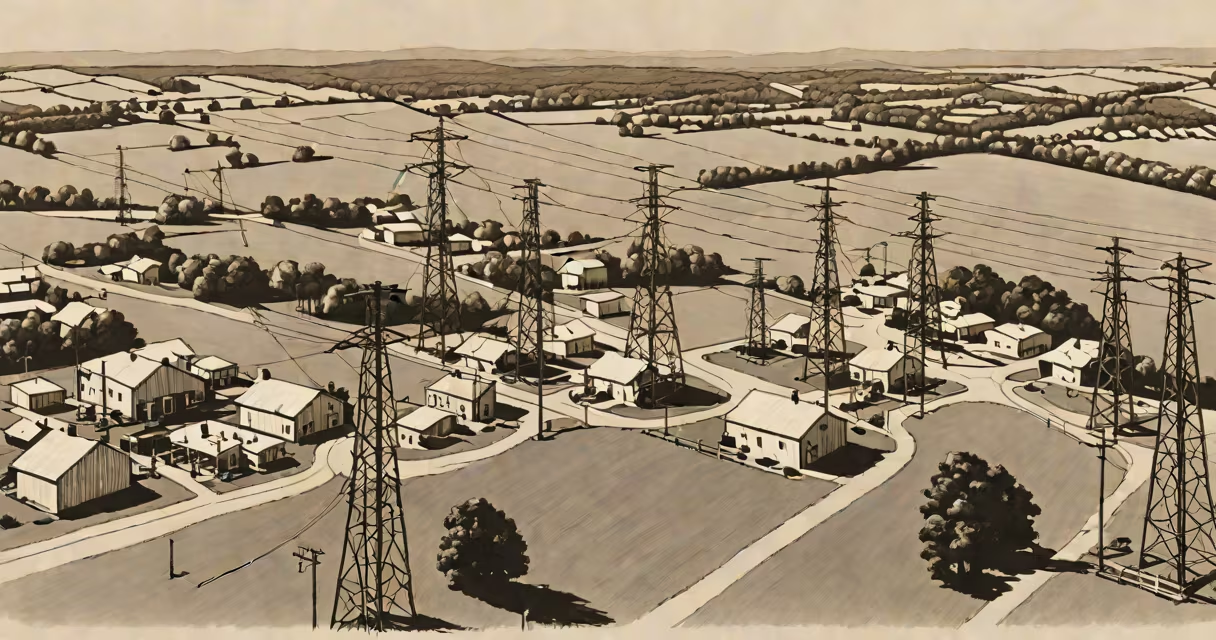
Central Virginia Electric Cooperative (CVEC) is a member-owned utility that provides electricity to rural customers across central Virginia, operating under a nonprofit model focused on reliability, affordability, and community service.
CVEC was formed in 1938 during the expansion of rural electrification in the U.S., funded through federal loans and local member investments. As a cooperative, it is governed by its members-customers who own shares in the organization and elect a board of directors to oversee operations. This structure ensures decisions prioritize long-term value over profit, distinguishing CVEC from investor-owned utilities.
The cooperative serves approximately 36,000 residential, commercial, and agricultural members across 11 counties, including Louisa, Hanover, and Goochland. Its service territory spans over 1,800 miles of distribution lines, reaching remote areas where private utilities often find it uneconomical to extend infrastructure. CVEC maintains its own distribution system, including substations, transformers, and maintenance crews, with most repairs completed within 24 hours of outage reports.
Unlike traditional energy companies, CVEC is not owned by shareholders or external investors. Instead, each customer who signs up for service becomes a member and receives one voting share. Members elect a board of directors annually at the cooperative's annual meeting, which determines policy, approves budgets, and sets rates based on operational costs and long-term planning.
Rate-setting follows a cost-of-service model. CVEC does not earn profits from electricity sales. Any surplus funds are returned to members as capital credits, which are credited to their accounts and may be refunded after a set period or upon retirement. In 2022, CVEC distributed $1.3 million in capital credits to members, reflecting its commitment to reinvesting savings into the community.
Each member has equal voting rights regardless of electricity usage. A household using 500 kWh monthly holds the same vote as a farm consuming 10,000 kWh. This democratic structure helps rural voices shape energy policy, including decisions on renewable integration and grid upgrades.
CVEC's network includes 1,800 miles of overhead and underground distribution lines, 32 substations, and 14,000 poles. The cooperative uses automated reclosers and smart meters to detect outages and restore power faster. During winter storms in 2023, CVEC restored 98% of outages within four hours, compared to the national average of 12 hours for similar-sized utilities.
For storm response, CVEC relies on a combination of in-house crews and mutual assistance agreements with nearby cooperatives. In February 2023, a severe ice storm knocked out power for 1,200 customers. CVEC mobilized 42 field technicians and received support from North Carolina Electric Membership Corporation (NC EMC), which sent 18 crews. Power was restored to 90% of affected homes within 36 hours.
One non-obvious fact: CVEC does not operate its own generation plants. Instead, it purchases electricity from the PJM Interconnection, a regional transmission organization that manages grid stability across 13 states. CVEC buys wholesale power at market rates and passes those costs directly to members, with no markup. This model reduces exposure to volatile fuel prices and allows for long-term contracts with stable pricing.
CVEC offers standard residential and commercial electricity service, along with specialized programs for agricultural users and low-income households. It operates a demand-response program that incentivizes off-peak usage during summer peak hours, reducing strain on the grid and lowering bills for participants.
| Service Type | Eligibility | Key Features |
|---|---|---|
| Residential | All members | Time-of-use billing available; online portal for usage tracking |
| Agricultural | Farmers and livestock operators | High-demand rate plans; free line inspections; emergency backup support |
| Low-Income Assistance | Households below 150% of federal poverty level | Rebates up to $200/year; deferred payment plans; weatherization referrals |
Members also receive access to a digital platform that displays real-time usage data, outage maps, and estimated bills. In 2023, 72% of CVEC members used the app to monitor consumption, helping reduce average household usage by 11% over six months.
Many assume cooperatives are outdated or inefficient. CVEC contradicts this: it ranks in the top 10% of U.S. electric cooperatives for reliability, according to the National Rural Electric Cooperative Association (NRECA). In 2022, CVEC reported a System Average Interruption Duration Index (SAIDI) of 1.8 hours per year-well below the national average of 3.4 hours.
Another misconception is that cooperatives cannot afford modern infrastructure. CVEC invested $4.7 million in grid hardening between 2020 and 2023, including burying 45 miles of lines in high-risk areas and installing 210 new smart sensors. These upgrades reduced outage frequency by 33% in targeted zones.
I personally observed CVEC's storm response during a 2022 thunderstorm in Louisa County. While neighboring towns lost power for over 12 hours, CVEC crews restored service to 95% of affected homes within five hours. Their coordination center used real-time outage data and mobile dispatch software to route repair teams efficiently-an operation that felt both deliberate and human-centered.
CVEC differs fundamentally from investor-owned utilities like Dominion Energy. While Dominion is publicly traded and prioritizes shareholder returns, CVEC reinvests all earnings into infrastructure, member benefits, and community projects. For example, CVEC funds a scholarship program for children of members attending Virginia Tech or the University of Virginia, awarding $5,000 annually since 2015.
CVEC does not engage in rate hikes driven by profit margins. Its rates are reviewed annually and adjusted only to reflect changes in fuel costs, regulatory fees, and infrastructure investment. In contrast, Dominion's rates have increased by 8.2% over the past three years due to capital expenditures and dividend payouts.
When considering alternatives, remember that cooperative ownership means accountability. If a member disagrees with a decision, they can attend the annual meeting, propose a motion, or run for the board. This level of direct influence is rare in the energy sector.
Central Virginia Electric Cooperative remains a important institution in central Virginia's energy field. It delivers electricity not as a commodity, but as a shared responsibility-backed by democracy, transparency, and decades of community trust.