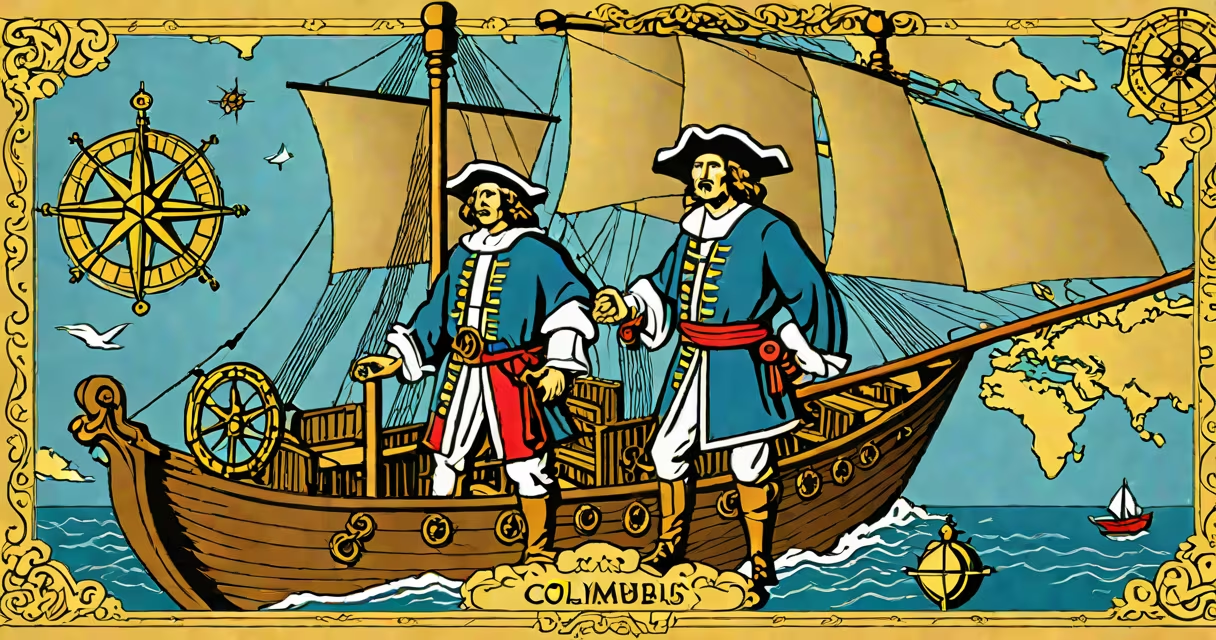
Christopher Columbus was an Italian explorer who sailed west across the Atlantic Ocean in 1492, hoping to find a faster route to Asia. Instead, he landed in the Caribbean, encountering islands inhabited by Indigenous peoples. His voyages marked the beginning of sustained European contact with the Americas.
Columbus did not "discover" the Americas. Native populations had lived there for thousands of years before his arrival. He also misunderstood the size and shape of Earth, believing the distance to Asia was much shorter than it actually was. His expeditions were funded by Spain's King Ferdinand and Queen Isabella, not by the United States, which did not exist yet.
His first voyage included three ships: the Santa Maria, the Pinta, and the Niña. Columbus commanded the Santa Maria, which ran aground on Hispaniola in December 1492. He left 39 crew members behind to build a settlement called La Navidad, which was later destroyed by Indigenous people. The remaining ships returned to Spain in March 1493.
Columbus made four total voyages between 1492 and 1504. On his second trip, he brought over 1,200 settlers, animals, and supplies to establish colonies. He claimed land for Spain and began enslaving Indigenous people, forcing them to work in mines and plantations. This system led to widespread suffering and population decline among Native communities.
He never set foot on what is now the mainland United States. His first landfall was on an island he named San Salvador, likely present-day Watling Island in the Bahamas. He believed he had reached the East Indies, so he called the people "Indians," a term that persists despite being incorrect.
Columbus died in 1506 in Spain, still convinced he had reached Asia. He never realized he had crossed into a previously unknown continent. His legacy is complex: celebrated in some countries for exploration, criticized in others for colonial violence and exploitation.
Many children learn that Columbus "discovered America." That is false. Indigenous nations such as the Taíno, Lenape, and Navajo had thriving societies long before his arrival. The idea of a "blank slate" continent was a myth used to justify colonization.
Another myth is that people in the 15th century believed Earth was flat. Historians have confirmed that educated Europeans knew Earth was round. The debate was about distance-not shape. Columbus underestimated how far it was to Asia, not the planet's form.
Some think Columbus was American. He was born in Genoa, Italy, in 1451. He spent years seeking support from Portugal, England, and Spain before Spain agreed to fund his expedition. His name in Spanish is Cristóbal Colón.
When learning about Columbus, distinguish between verified historical facts and popular myths. Reliable sources include primary documents like his own journals, scholarly analysis from institutions like the Library of Congress, and peer-reviewed research from historians such as Dr. Felipe Fernández-Armesto.
| Type of Fact | Example | Source |
|---|---|---|
| Verified Historical Event | Columbus landed on San Salvador on October 12, 1492 | Library of Congress, Columbus's journal entries |
| Documented Action | He enslaved Taíno people during his second voyage | Spanish royal records, Bartolomé de las Casas' chronicles |
| Myth | Columbus proved Earth was round | Dr. Fernández-Armesto, "Before Columbus: The World in 1491" |
One non-obvious fact: Columbus never saw the Pacific Ocean. He thought the Caribbean was near Asia. He died believing he had reached the Orient, not realizing he had found a new hemisphere.
A classroom activity using Columbus facts can involve comparing his journal entries with modern maps. Students can trace his route on a globe or paper map, noting the actual distances versus his estimates. For example, Columbus thought Japan was about 2,400 nautical miles west from the Canary Islands. The real distance is over 6,000 miles.
I once led a 5th-grade lesson where students read excerpts from Columbus's journal and then debated whether he was a hero or a colonizer. They used evidence from primary sources and secondary histories. One student pointed out that Columbus wrote about finding gold, but also described people who "would make good slaves." That moment shifted the conversation from mythology to ethics.
Teachers often use Columbus facts to teach critical thinking. Questions like "Why did Spain fund him?" or "How did Indigenous people respond?" encourage deeper inquiry. The goal isn't to glorify or condemn-but to understand context.
Christopher Columbus facts for kids must reflect accuracy, not just simplicity. Avoid oversimplifying his impact. He was a navigator, not a mythical discoverer. His voyages changed global history, but they also caused immense harm.
When sharing facts, emphasize that history includes multiple perspectives. The Taíno people had rich cultures, advanced agriculture, and complex social systems. Their stories deserve equal space in education.