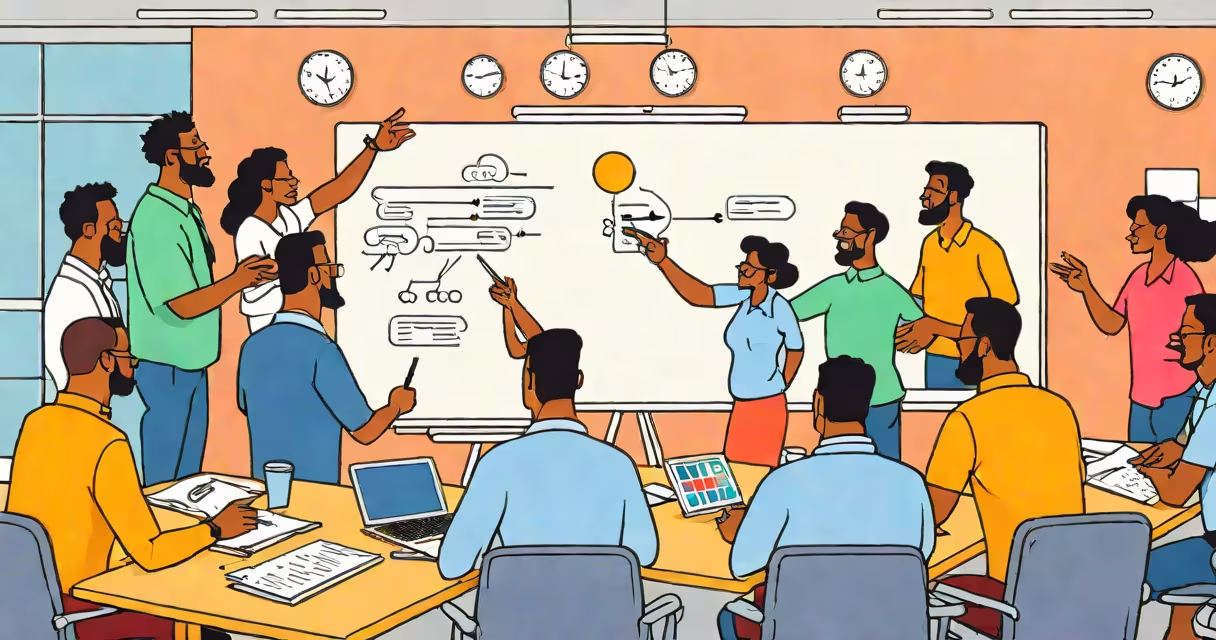
Scrum is an iterative, incremental structure for managing complex projects, especially software development, where work is organized into fixed-length cycles called sprints. It defines specific roles, events, artifacts, and rules to enable teams to adapt quickly and deliver working software regularly.
Scrum operates on the principle that requirements evolve and solutions emerge through collaboration. Instead of planning everything upfront, teams build small increments of functionality in two- to four-week sprints. At the end of each sprint, they demonstrate a potentially shippable product increment. This cycle repeats until the product vision is met.
The structure was formalized in the early 1990s by Ken Schwaber and Jeff Sutherland, based on empirical process control. According to the Scrum Guide, "Scrum is a structure within which people can address complex adaptive problems, while delivering products of high value." The guide is updated annually and serves as the definitive reference for Scrum practice.
Scrum divides project work into time-boxed iterations known as sprints. A typical sprint lasts two weeks and includes five key events: Sprint Planning, Daily Stand-up, Sprint Review, Sprint Retrospective, and the Sprint itself. These events ensure transparency, inspection, and adaptation at regular intervals.
Sprint Planning sets goals for the upcoming sprint. The team selects items from the product backlog-prioritized tasks based on business value-and commits to completing them. During the sprint, the team holds a 15-minute Daily Stand-up to synchronize progress, discuss blockers, and adjust plans as needed.
At the end of the sprint, the team hosts a Sprint Review to demo completed work to stakeholders. Feedback is gathered and incorporated into the product backlog. The Sprint Retrospective follows, where the team reflects on their process, identifies improvements, and adjusts practices for the next sprint.
Three defined roles govern Scrum execution: the Product Owner, the Scrum Master, and the Development Team. The Product Owner manages the product backlog, prioritizing features based on customer value and stakeholder needs. They ensure the team always works on the most impactful tasks.
The Scrum Master facilitates the process, removes impediments, and ensures Scrum principles are followed. They do not manage the team but serve as a coach and enabler of collaboration. The Development Team-a cross-functional group of 5-9 members-designs, builds, tests, and delivers working software each sprint.
Four primary artifacts define the state of work:
These artifacts ensure clarity and consistency. For example, a feature cannot be marked done unless it passes testing, documentation is updated, and deployment scripts are verified-this prevents last-minute surprises.
Scrum is often mistaken for a methodology or a set of rigid rules. It is not. Scrum is a structure-like a skeleton-that provides structure but allows teams to customize processes. As the Scrum Guide states, "Scrum is not a process, technique, or a definite set of rules." Teams adapt ceremonies and tools to fit their context.
A common error is treating the Daily Stand-up as a status report. It's not. The stand-up is a coordination meeting focused on identifying blockers and aligning efforts. Team members answer three questions: What did I do yesterday? What will I do today? What's blocking me? The goal is not reporting progress-it's enabling rapid problem-solving.
Another misunderstanding is equating Scrum with Agile. Agile is a mindset emphasizing flexibility, customer collaboration, and responding to change. Scrum is one way to implement Agile. Not all Agile teams use Scrum. Some prefer Kanban, XP, or SAFe. But Scrum offers a clear path to adopting Agile principles in structured form.
A fintech startup developing a mobile banking app adopted Scrum to manage feature delivery. The Product Owner prioritized security enhancements, transaction history improvements, and biometric login. The backlog contained 120 items, ranked by user impact and regulatory compliance needs.
Over six sprints, the team delivered incremental updates. In Sprint 3, they implemented biometric authentication. The team held a Sprint Review with internal testers and received feedback: the fingerprint scanner failed under low-light conditions. This issue was added to the backlog and prioritized for Sprint 4.
During the Sprint Retrospective, the team identified that testing environments didn't simulate low-light scenarios. They adjusted their test strategy, added environmental variables to their CI/CD pipeline, and reduced regression bugs by 40% in the next sprint.
After 12 sprints, the app launched with 87% of planned features completed. User satisfaction scores rose from 3.2 to 4.6 out of 5. The team maintained velocity stability, averaging 14 story points per sprint. This outcome demonstrates how Scrum enables continuous improvement and measurable results.
Scrum works best in environments with evolving requirements, cross-functional teams, and frequent stakeholder involvement. It's ideal for software development, product design, marketing campaigns, and internal IT projects where priorities shift frequently.
It's less effective in highly regulated industries with strict documentation mandates-such as medical device software-unless paired with compliance frameworks like ISO 13485. In such cases, Scrum may still be used for development, but validation and audit trails require additional processes.
Teams should avoid Scrum if they lack autonomy, have siloed departments, or operate under rigid top-down command structures. Scrum requires psychological safety and ownership. Without trust, ceremonies become performative, and retrospectives fail to drive change.
Understanding differences between Scrum and similar approaches prevents misapplication. The table below compares Scrum with Kanban and Waterfall.
| Aspect | Scrum | Kanban | Waterfall |
|---|---|---|---|
| Work Flow | Time-boxed sprints | Continuous flow | Sequential phases |
| Change Flexibility | High-changes mid-sprint are rare | Very high-new items can be added anytime | Low-changes after phase completion are costly |
| Delivery Cadence | Every 2-4 weeks | As soon as work is ready | End of project |
| Best For | Product teams needing predictability and rhythm | Support teams with variable demand | Projects with fixed scope and budget |
For example, a support team handling 500 monthly tickets might use Kanban to visualize workload and limit work-in-progress. A government agency building a tax filing system with fixed deadlines and legal constraints might choose Waterfall. But a startup launching a new social media platform would likely benefit from Scrum's adaptability and frequent feedback loops.
I once led a team transitioning from waterfall to Scrum. We ran our first sprint with no backlog grooming. The team selected 15 stories from a vague list. By the end of the sprint, only 6 were complete. The retrospective revealed poor estimation and unclear acceptance criteria. After refining our backlog and adding user stories with acceptance tests, velocity stabilized at 12 points per sprint.
Scrum is not a silver bullet. It demands discipline, communication, and commitment. But when applied correctly, it reduces risk, increases transparency, and accelerates delivery of real value.