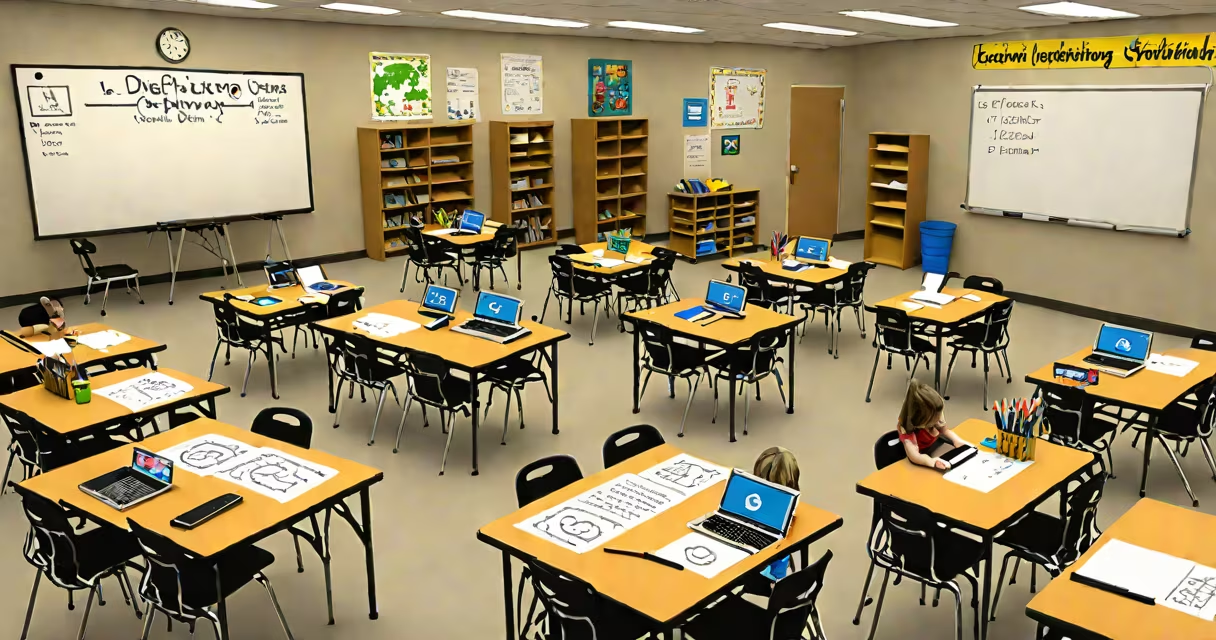
Differentiated instruction learning stations are structured, rotating activity zones within a classroom that deliver targeted content, varied tasks, and multiple pathways to meet students' distinct readiness levels, interests, and learning profiles. These stations allow teachers to provide individualized support while maintaining whole-group structure.
Learning stations function as micro-environments where students engage with curriculum material through different modalities-visual, auditory, kinesthetic, or reading/writing-based on their current needs. A station might offer a video tutorial for visual learners, a manipulative-based math task for tactile learners, or a discussion prompt for verbal processors. Teachers assign students to stations based on formative assessments, learning profiles, or interest surveys, ensuring each learner accesses content at an appropriate challenge level.
Research from the National Center on Accessing the General Curriculum (NCAC) confirms that when implemented with clear objectives and student choice, differentiated learning stations improve academic outcomes, especially for students with learning gaps. For example, a 2021 study in *The Journal of Educational Research* found that students in classrooms using structured learning stations scored 18% higher on post-unit assessments than peers in traditional lecture settings.
Each station operates as a self-contained learning module with a specific goal, materials, instructions, and assessment criteria. Students rotate through stations in small groups or individually, often using timers or visual cues to manage time. The teacher circulates, observes, and provides targeted feedback during rotations.
For instance, in a 5th-grade science unit on ecosystems, four stations might include:
Each station aligns with the same standard-NGSS 5-LS2-1-but offers different entry points and outputs. A student who struggles with reading comprehension may thrive in the model-building station, while a gifted student might find deeper challenge in the research and presentation task.
Learning stations vary by format, duration, and grouping method. The most effective models balance autonomy with accountability.
| Type | Structure | Best For | Example |
|---|---|---|---|
| Rotating Stations | Groups move every 10-15 minutes; all students visit each station | Whole-class review, balanced exposure | A 6th-grade math class rotates through stations focused on fractions, decimals, ratios, and word problems |
| Choice Boards | Students select 3 of 6 activities from a menu; no rotation needed | Independent learners, project-based units | A high school history student picks a podcast interview, a timeline creation, and a letter to a historical figure |
| Flexible Grouping | Teacher assigns students to stations based on ongoing assessment data | Intervention, acceleration, or remediation | Fourth graders grouped by reading fluency level for vocabulary building and inference practice |
| Station Rotation Model | One station is led by the teacher; others are student-led or tech-based | Blended learning environments | Students spend 15 minutes at a teacher-led grammar station, then 10 minutes at a digital quiz station |
One common mistake is treating all stations as equal in rigor. High-quality differentiated instruction helps variation in difficulty reflects actual learning progression-not just novelty. A station offering "match the animal to its habitat" flashcards is not equivalent to one asking students to design a conservation plan for a threatened species. The latter requires higher-order thinking and applies content in context.
Many educators assume that differentiated instruction learning stations require extensive prep time or complex materials. In reality, effective stations can be built using low-cost, reusable resources. A single set of laminated cards, a timer, and a clipboard can support multiple rotations.
Another misconception is that these stations replace direct instruction. They do not. Instead, they complement it. A teacher might deliver a 15-minute mini-lesson on long division, then assign students to stations based on their confidence level: one for basic practice, one for error analysis, and one for applying division to real-world budgeting tasks.
Differentiation is not about creating 30 unique lessons. It's about offering three versions of the same core concept. As Carol Ann Tomlinson, a leading expert in differentiation, explains in her book *The Differentiated Classroom*, "Differentiation is not about doing more-it's about doing better." Her structure emphasizes planning for variability in readiness, interest, and learning profile, not endless customization.
I observed a 4th-grade classroom in Portland, Oregon, where a teacher used differentiated instruction learning stations during a unit on U.S. geography. After a brief whole-group lesson on state capitals, students rotated through four stations:
The teacher assigned students based on a quick exit ticket from the previous day. Two students who struggled with spatial recognition were placed in the map challenge with guided support. Two advanced learners were paired for the design station, which required critical thinking and creativity. Over three days, all students completed all stations, but the depth and complexity of their work differed.
At the end of the week, 92% of students correctly identified the capital of five randomly selected states-a 25-point increase from pre-unit assessment scores. The teacher noted that students who had previously disengaged during lectures were actively participating in the station work.
When done well, differentiated instruction learning stations reduce achievement gaps by making learning accessible to all. They also build student agency. As one 5th grader told me, "I picked the game because I wanted to beat my friend, but I learned more than I thought."