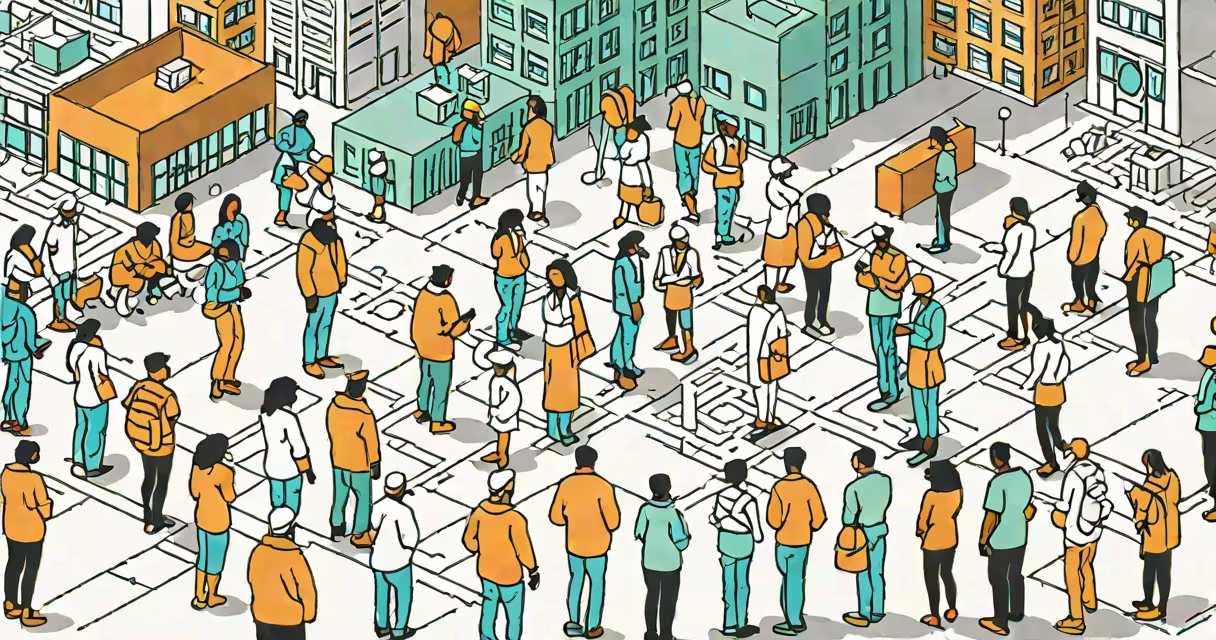
Ethnic diversity definition describes the presence of multiple ethnic groups within a community, organization, or society, each defined by shared ancestry, language, traditions, and cultural practices. It reflects variation in heritage and identity beyond race or nationality.
Unlike racial categorization, which often relies on physical traits, ethnic diversity centers on cultural lineage and lived experience. For example, within the United States, individuals may share the same racial classification-such as "Asian"-but differ in ethnicity, including Chinese, Vietnamese, Korean, or Filipino descent. These distinctions shape unique histories, family structures, and community norms.
The U.S. Census Bureau defines ethnicity based on self-identification with a specific cultural group, such as Hispanic or Latino, which includes people from Mexico, Puerto Rico, Cuba, and other Latin American countries. This structure shows that ethnic diversity is not just about visible differences-it's about how people understand themselves and their place in society.
When institutions or regions have high ethnic diversity, they include people whose identities stem from different geographic origins, languages, religious practices, and historical narratives. This variety influences everything from public services to workplace culture.
For instance, a school district in California with large populations of Mexican-American, Cambodian-American, and Russian-American families must offer multilingual resources, culturally responsive curricula, and inclusive extracurricular programming. Without recognizing ethnic diversity, these systems risk misrepresenting student needs and alienating families.
Research from the Pew Research Center confirms that ethnic diversity is rising in many Western nations. In 2020, 46% of U.S. residents identified as belonging to a racial or ethnic minority group-up from 36% in 2000. This shift underscores the growing relevance of ethnic diversity in shaping national discourse around equity, representation, and civic engagement.
There is no universal list of ethnic groups, as identities are context-specific and self-defined. However, common categories emerge in policy, research, and media:
| Type | Examples | Key Characteristics |
|---|---|---|
| Indigenous | Navajo, Maori, Sami | Long-standing connection to specific territories; distinct oral histories and governance systems |
| Immigrant-origin | Indian-American, Syrian-American, Haitian-American | Migration-based identity; often maintain dual cultural ties |
| Religious-ethnic | Amish, Druze, Baha'is | Identity shaped by faith and communal practice; sometimes excluded from mainstream census categories |
| Language-based | Flemish, Catalan, Yiddish-speaking Jews | Defined by linguistic heritage rather than geography or religion |
One non-obvious distinction: ethnic identity is not synonymous with nationality. A person born in Germany can identify ethnically as Turkish, reflecting migration history and cultural affiliation rather than citizenship status. Similarly, someone born in Japan may identify ethnically as Ainu-a historically marginalized Indigenous group with roots in northern Japan.
People often equate ethnic diversity with racial diversity, but the two are distinct. Race is typically based on physical characteristics like skin color or facial features, while ethnicity involves cultural expression, language, and ancestry. A classroom with students of various skin tones may still lack ethnic diversity if all come from the same cultural background.
Another misconception is that ethnic diversity automatically leads to conflict. On the contrary, evidence from the World Bank shows that ethnically diverse communities with strong institutional support report higher innovation rates and better problem-solving outcomes. For example, a 2019 study of 1,200 small businesses in Canada found that teams with mixed ethnic backgrounds were 35% more likely to capture new markets than homogenous teams.
Some assume ethnic diversity requires assimilation into a dominant culture. But effective inclusion respects and integrates difference. In Toronto, public transit signage appears in 12 languages, including Punjabi, Tagalog, and Arabic. This reflects a commitment to ethnic diversity not as a challenge to overcome, but as a foundation for accessibility and belonging.
In 2021, the city of Minneapolis launched a neighborhood revitalization project targeting the Eastside, home to a mix of Somali-American, Hmong-American, and African-American residents. City planners initially focused on infrastructure upgrades-new sidewalks, streetlights, and parks-but early feedback revealed low community engagement.
A follow-up survey showed that residents wanted programs that honored their cultural practices. Somali families requested prayer space near community centers. Hmong elders asked for gardens to grow traditional herbs. African-American residents wanted murals reflecting local civil rights history.
City officials adjusted the plan. They hired community liaisons from each group. Budget allocations included funding for cultural events, multilingual outreach, and design elements reflecting local heritage. Within two years, participation in city meetings rose 60%, and crime rates dropped 18% in targeted zones.
This case illustrates that ethnic diversity definition matters not just for statistics-it shapes how people experience safety, opportunity, and dignity in public life.
Understanding ethnic diversity definition enables fairer policies, richer educational environments, and more representative leadership. It is not a vague ideal-it is a measurable, actionable structure for building societies where everyone belongs.