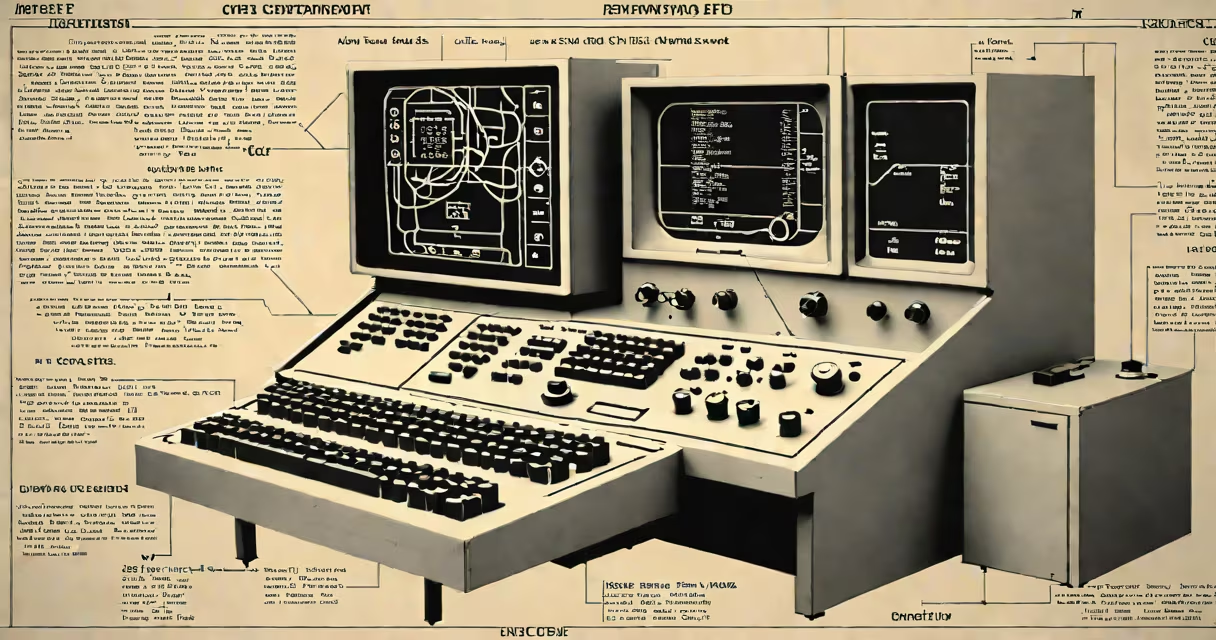
The first AI chatbot was ELIZA, created in 1966 by Joseph Weizenbaum at MIT. It simulated a Rogerian psychotherapist using basic pattern matching and scripted responses, giving users the illusion of understanding despite no actual comprehension.
ELIZA operated entirely through text input and output. Users typed statements into a terminal, and ELIZA responded with paraphrased questions or reflections, often repeating parts of the input with minimal modification. For example, typing "I am feeling sad" might trigger "Why do you feel sad?" or "Can you tell me more about that?"
Despite its simplicity, ELIZA demonstrated that humans could attribute emotional intelligence to machines based on surface-level linguistic cues. This phenomenon, known as the ELIZA effect, remains relevant in evaluating modern AI systems.
ELIZA used a technique called script-based parsing. It scanned user input for predefined keywords-like "mother," "father," or "sad"-and matched them to response templates. These templates were designed to reflect the user's statement back in a questioning format.
For instance, if a user said, "My father never listens to me," ELIZA might respond, "Tell me more about your father." The system had no memory of past exchanges, no internal model of emotion, and no access to external knowledge. All responses were generated from a fixed set of rules.
ELIZA's architecture relied on regular expressions and substitution logic. A single rule might look like: "If input contains 'mother' and 'never,' then respond with 'Your mother never listens?'" This limited but effective design allowed the program to run on low-memory computers of the time.
ELIZA was written in MAD-SLIP, a dialect of LISP used at MIT. Its core components included a parser, a set of response rules, and a simple state machine to track conversation flow. There was no learning component-no neural network, no training data, no feedback loop.
The program's interface was purely text-based. It ran on a DEC PDP-10 mainframe, accessible via teletype terminals. Users saw no graphics, no avatars, no animations-just lines of text scrolling down a screen.
ELIZA's most famous script was "DOCTOR," which mimicked a therapist. Other scripts included "VARSITY," a version that acted as a college admissions counselor, and "MORPHO," which processed noun phrases. These variants showed how modular the system could be, even with minimal programming.
ELIZA was primarily used in academic settings at MIT and later at Stanford. Researchers studied how people interacted with it, particularly whether they projected empathy onto a system that lacked consciousness.
Studies conducted in the late 1960s revealed that many users treated ELIZA as if it understood them. Some patients in clinical trials reported feeling better after talking to it, even though it had no insight into their condition. This highlighted the power of human expectation in shaping perceived intelligence.
By 1973, ELIZA had been ported to multiple university systems and inspired dozens of imitations. It became a benchmark for early conversational agents and is still cited in AI ethics literature for illustrating the risks of anthropomorphism in machine interaction.
Many assume ELIZA was a precursor to modern chatbots like ChatGPT. It was not. While both process natural language, ELIZA's behavior was rule-based and deterministic. Modern systems use deep learning models trained on vast datasets, enabling context-aware responses and creative generation.
Another myth is that ELIZA passed the Turing Test. It did not. The Turing Test measures a machine's ability to mimic human conversation so well that a judge cannot reliably distinguish it from a person. ELIZA failed this test under controlled conditions-participants quickly noticed its repetitive patterns.
A lesser-known fact: Weizenbaum himself grew disillusioned with ELIZA's popularity. He later wrote *Computer Power and Human Reason*, warning against overestimating AI's capabilities and advocating for ethical boundaries in machine design.
| Type | Year | Language | Response Method | Known For |
|---|---|---|---|---|
| ELIZA (DOCTOR) | 1966 | LISP | Pattern matching + template rules | Simulating therapy; first widely recognized chatbot |
| Shakey | 1966-1972 | Prolog-like | Logical inference + sensor input | First mobile robot with reasoning capability |
| PARRY | 1972 | LISP | Simulated paranoid personality | Modeled mental illness; countered ELIZA's therapy role |
While ELIZA focused on dialogue, PARRY modeled a patient with paranoia, showing that chatbots could simulate psychological states beyond simple reflection.
In 1967, a graduate student at MIT typed: "I have a terrible fear that my mother will die." ELIZA replied: "You seem to be afraid that your mother will die. Can you explain why?"
The student paused, then typed: "Yes, because she's sick." ELIZA responded: "Are you sure she is sick?" The student continued the exchange for 12 minutes, reporting afterward that he felt "heard," even though the system had no way of knowing his mother's health status.
This interaction illustrates the core issue: users projected intent and care onto a system that merely echoed their words. The emotional impact came from the user, not the machine.
Today, ELIZA is preserved in archives at the MIT Museum and available for historical study. It runs on emulated environments and is used in courses on AI history and philosophy.
Understanding the first AI chatbot helps clarify what AI can and cannot do. It sets a baseline for measuring progress-and caution.