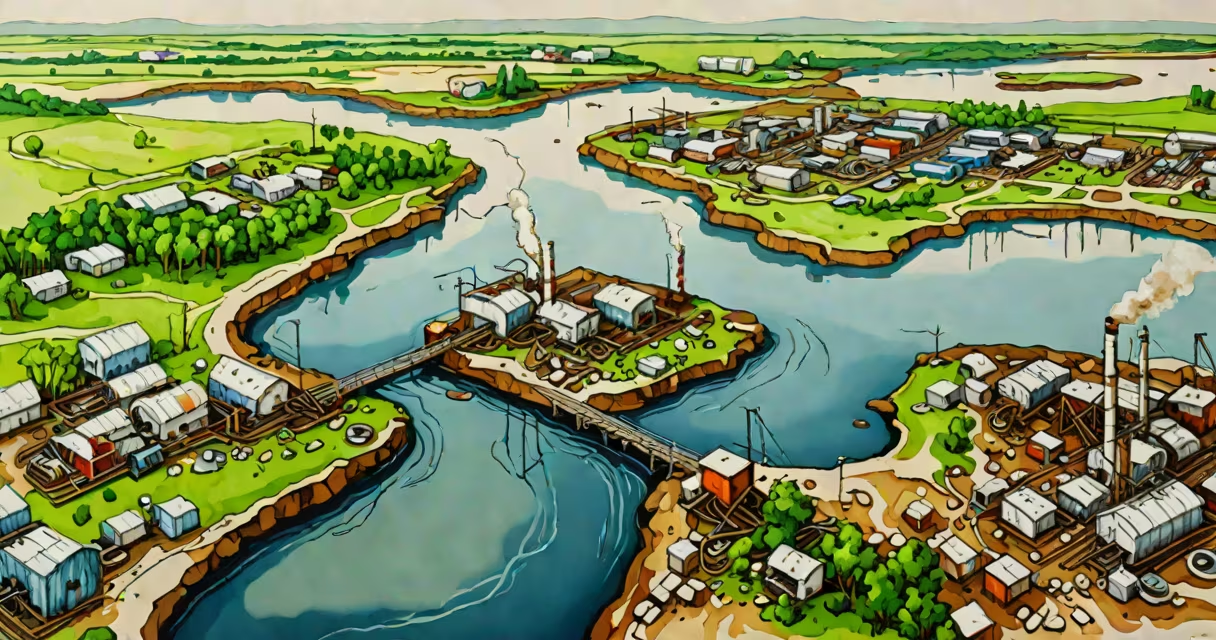
Water pollution is a severe environmental and public health crisis that contaminates freshwater and marine systems with harmful substances, disrupting ecosystems, threatening biodiversity, and endangering human life. It results from untreated sewage, industrial discharge, agricultural runoff, and plastic waste entering waterways.
Contaminants include heavy metals like lead and mercury, synthetic chemicals such as pesticides and pharmaceuticals, pathogens from fecal matter, and microplastics. These pollutants degrade water quality, reduce oxygen levels, and accumulate in food chains. According to the World Health Organization (WHO), 2 billion people globally use drinking water sources contaminated with feces, leading to diseases like cholera and dysentery.
The United Nations Environment Programme (UNEP) reports that 80% of wastewater worldwide flows untreated into rivers, lakes, and oceans. This level of contamination drives habitat destruction, fish kills, and the collapse of aquatic food webs. In regions like South Asia and Sub-Saharan Africa, polluted water sources contribute to high child mortality rates due to preventable waterborne illnesses.
When pollutants enter water bodies, they don't disappear-they move through physical, chemical, and biological processes. Runoff from farmland carries nitrogen and phosphorus from fertilizers into rivers, triggering algal blooms. These blooms deplete oxygen as they decompose, creating dead zones where aquatic life cannot survive.
Industrial facilities release toxic compounds like polychlorinated biphenyls (PCBs) and dioxins, which persist in sediments and bioaccumulate in fish. Humans consuming contaminated fish ingest these toxins, which can cause cancer, developmental delays, and reproductive issues. A 2021 study published in *Environmental Science & Technology* found detectable levels of PFAS (forever chemicals) in 98% of U.S. tap water samples tested.
Plastic pollution adds another layer of harm. Microplastics-particles smaller than 5mm-enter water systems through wastewater treatment plants, which are not designed to filter them. These particles absorb toxins and are ingested by marine organisms, eventually reaching humans through seafood consumption.
Water pollution stems from identifiable sources, categorized as point-source or non-point-source. Point-source pollution originates from a single, traceable location-like a factory pipe discharging effluent. Non-point-source pollution comes from diffuse sources, such as stormwater runoff carrying oil, pesticides, and sediment from roads and fields.
| Pollutant Type | Common Sources | Primary Environmental Impact |
|---|---|---|
| Pathogens | Untreated sewage, animal waste | Disease outbreaks, fish kills |
| Nutrients (Nitrogen/Phosphorus) | Fertilizer runoff, detergents | Algal blooms, hypoxia |
| Heavy Metals | Mineral mining, battery disposal | Neurotoxicity, bioaccumulation |
| Plastics & Microplastics | Single-use packaging, textiles | Habitat disruption, ingestion by wildlife |
| Organic Chemicals | Industrial solvents, pesticides | Cancer risk, endocrine disruption |
A notable example is the Cuyahoga River in Ohio, which famously caught fire in 1969 due to thick layers of oil and industrial waste. That event helped spark the creation of the U.S. Clean Water Act in 1972, which led to measurable improvements in water quality downstream.
Water pollution affects every continent, but its impacts are most acute in low- and middle-income countries with underdeveloped sanitation infrastructure. In India, the Ganges River supports over 400 million people yet receives 1.5 billion liters of untreated sewage daily. Despite government cleanup efforts, levels of coliform bacteria remain 100 times above WHO safety thresholds.
In contrast, wealthier nations still face significant challenges. In the United States, the Environmental Protection Agency (EPA) estimates that 40% of assessed river miles and 50% of lake acres are too polluted for safe fishing or swimming. The Flint water crisis in Michigan, where lead leached from aging pipes into drinking water, exposed over 100,000 residents to unsafe levels, resulting in elevated blood lead levels in children.
Marine environments suffer disproportionately. The Great Pacific Garbage Patch, a swirling mass of plastic debris spanning 1.6 million square kilometers, contains an estimated 1.8 trillion pieces of plastic. Marine animals like sea turtles and seabirds mistake plastic for food, leading to starvation and death.
Many assume that water pollution is primarily caused by large-scale industrial accidents. While events like the 2010 Deepwater Horizon oil spill attract media attention, they represent a small fraction of total pollution. Most contamination comes from everyday activities-flushing medications, washing cars near storm drains, using excessive fertilizer on lawns.
Another misconception is that filtering water at home eliminates all risks. Reverse osmosis filters remove many contaminants but do not eliminate emerging pollutants like perfluoroalkyl substances (PFAS) or certain pharmaceuticals. A 2022 study in *Nature Water* showed that standard household filters removed only 60% of PFAS variants tested.
Some believe that natural water bodies can self-cleanse. While ecosystems have resilience, they have limits. Once nutrient loads exceed threshold levels, recovery takes decades-even centuries. The Baltic Sea, for example, has experienced recurring eutrophication since the 1970s despite mitigation efforts.
Once the fourth-largest lake in the world, the Aral Sea shrank to less than 10% of its original size between 1960 and 2000. The cause was Soviet-era irrigation projects diverting water from the Amu Darya and Syr Darya rivers to grow cotton. As water levels dropped, salinity rose sharply-over 100 grams per liter, compared to seawater's 35.
The ecological collapse led to the extinction of 20 native fish species. Dust storms from the dried seabed carried salt and pesticide residues across Central Asia, causing respiratory illness and birth defects in nearby populations. Today, the region remains a stark warning of how mismanaged water use leads to irreversible environmental degradation.
I once visited the former shoreline of the Aral Sea in Kazakhstan. The cracked mudflat stretched for miles, littered with rusted ship hulls and abandoned fishing nets. The silence was overwhelming-not from lack of life, but from its absence.
Water pollution is not a distant problem-it is a direct threat to survival. It undermines food security, worsens climate vulnerability, and increases healthcare costs. The economic toll is massive: the World Bank estimates that water pollution costs the global economy $260 billion annually in lost productivity and medical expenses.
Understanding the scale of harm helps clarify why water pollution ranks among the most pressing environmental crises. It's not just about dirty water-it's about poisoned ecosystems, sick communities, and broken futures. The evidence shows that water pollution is profoundly bad, and its effects are both immediate and long-lasting.