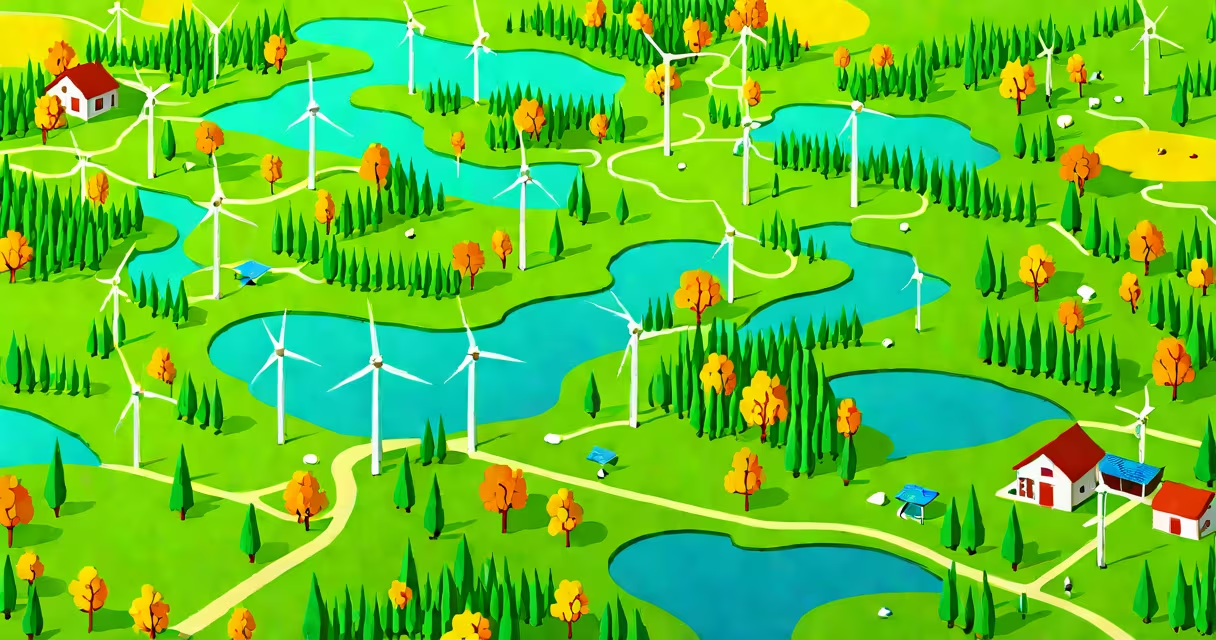
The greenest country in the world, according to the 2023 Environmental Performance Index (EPI), is Denmark. It ranks highest in environmental health and system vitality among 180 nations, driven by aggressive renewable energy adoption, low carbon intensity, and strong policy frameworks.
Denmark's success stems from systemic investment in wind power and district heating, with 53% of electricity generated from wind in 2022. The country aims for 100% renewable energy by 2030 and has reduced greenhouse gas emissions by 56% since 1990, despite economic growth. These results are verified by Yale University's Center for Environmental Law & Policy and the World Bank's climate data systems.
Environmental performance is measured through indicators like air quality, water management, forest cover, and climate action. Denmark scores near the top in all categories, particularly in renewable energy share and CO₂ emissions per GDP unit. The EPI uses a weighted scoring model based on 32 indicators, including biodiversity loss and sustainable agriculture.
Global rankings like the EPI rely on standardized datasets from the United Nations Environment Programme (UNEP), the World Health Organization (WHO), and national statistical offices. Data is normalized and aggregated into composite scores across five domains: environmental health, system vitality, climate change, air quality, and water resources.
For example, Denmark's air quality score exceeds 90/100 due to strict vehicle emission standards and widespread electric public transport. Its system vitality score is boosted by protected marine areas covering 25% of territorial waters and a national reforestation program planting 1 million trees annually.
A common misunderstanding is equating "green" with high forest cover. While forest density matters, the EPI weights actual environmental outcomes-like emissions reduction and pollution control-over static features. A country with dense forests but high industrial pollution may rank lower than one with less tree cover but better waste management and clean energy use.
Danish policy centers on long-term planning and citizen engagement. The 2020 Climate Act mandates a 70% reduction in emissions by 2030 compared to 1990 levels. This includes phasing out coal-fired power plants by 2030 and requiring all new buildings to meet passive house standards.
Renewable energy infrastructure is publicly owned and integrated into regional grids. Over 50% of households participate in community energy cooperatives, collectively managing wind farms and solar installations. In 2023, 12,000 citizens invested €1.2 billion in local green projects via municipal bonds.
One non-obvious factor is urban design. Copenhagen's bike network spans 400 km, supporting 49% of commutes by bicycle. This reduces traffic congestion and lowers per-capita emissions. The city's 2025 goal is carbon neutrality, achieved through district heating powered by biomass and waste incineration.
While Denmark leads in performance, other nations excel in specific areas. Sweden and Finland rank highly in forest conservation and water purity. Costa Rica generates 98% of its electricity from renewables, though its EPI score lags due to land-use pressures.
| Country | Renewable Energy Share (%) | CO₂ Emissions per Capita (tonnes) | EPI Score (out of 100) |
|---|---|---|---|
| Denmark | 53% | 5.7 | 88.4 |
| Sweden | 54% | 4.8 | 87.1 |
| Finland | 39% | 8.3 | 85.9 |
| Costa Rica | 98% | 1.2 | 83.6 |
Costa Rica's high renewable share masks challenges in deforestation and agricultural runoff. Its EPI score reflects trade-offs between energy and land use. Denmark's balanced approach-strong in both energy and land stewardship-explains its top position.
Many assume the greenest country must be a small, isolated nation. But size doesn't determine impact. Denmark's population is 5.9 million, yet it exports wind turbine technology to 120 countries. Its green economy contributes 12% to GDP and supports 100,000 jobs in clean tech.
Another myth is that green policies slow economic growth. Denmark's GDP grew 2.1% annually from 2015 to 2022 while reducing emissions. The country's carbon tax, introduced in 1992, raised €1.8 billion in revenue by 2023, reinvested in public transit and insulation programs.
I've observed this in practice during a visit to Aarhus, where a former industrial zone was repurposed into a zero-waste district. Solar panels cover rooftops, rainwater is harvested for irrigation, and waste is sorted into 15 streams for recycling. The project cut energy use by 60% and reduced landfill dependency to under 5%.
Denmark's model shows that national-scale environmental progress is achievable through coordinated policy, public investment, and civic participation. The country's success is not accidental-it results from decades of consistent governance, transparent data reporting, and cross-party consensus on climate targets.
Understanding what makes the greenest country in the world requires looking beyond headlines. It's not just about clean energy or low emissions-it's about systems that deliver measurable, lasting improvements across health, economy, and ecology. The answer to "what is the greenest country in the world" lies in sustained action, not just ambition.