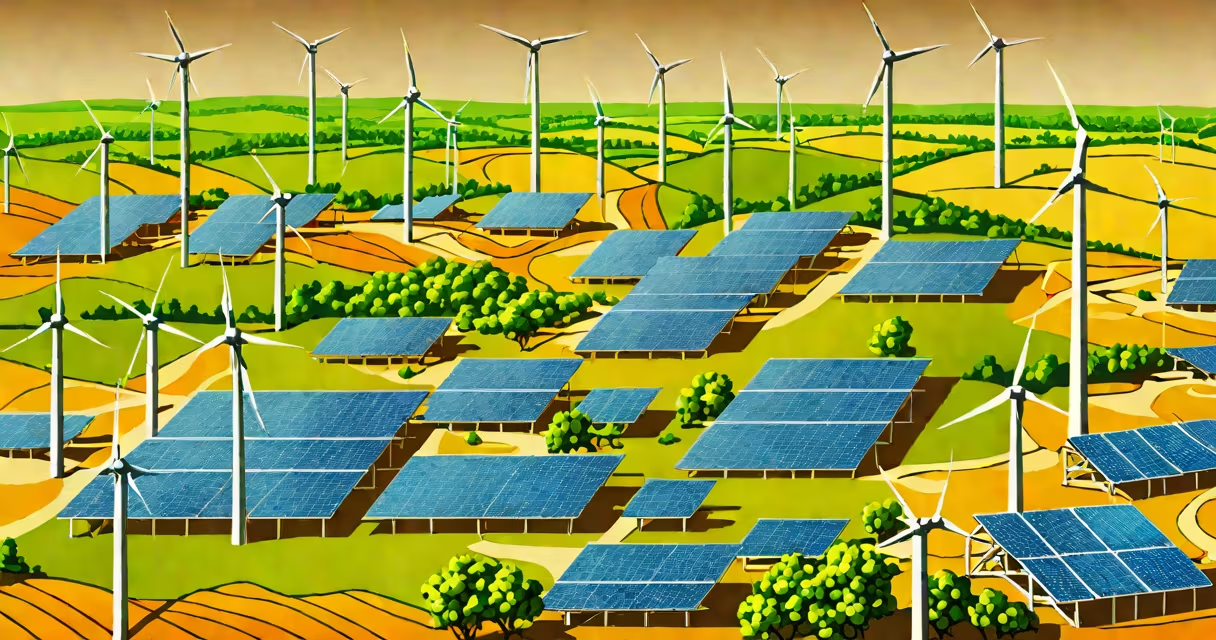
Reducing global warming requires cutting greenhouse gas emissions, protecting carbon-absorbing ecosystems, and transitioning to low-carbon technologies at scale. This involves coordinated efforts across energy systems, land use, industry, and policy frameworks.
Global warming results from excess heat trapped in Earth's atmosphere due to human activities, primarily burning fossil fuels. The Intergovernmental Panel on Climate Change (IPCC) states that limiting warming to 1.5°C above pre-industrial levels demands rapid, deep emissions reductions across all sectors. Without such action, climate impacts like extreme weather, sea level rise, and biodiversity loss intensify.
Carbon dioxide (CO₂), methane (CH₄), and nitrous oxide (N₂O) are the primary drivers. CO₂ accounts for about 75% of global emissions from human activity, mainly from energy production, transportation, and industrial processes. Methane, though shorter-lived, has 28 times the warming potential of CO₂ over 100 years. Reducing emissions means targeting both long-term sources and high-impact short-lived pollutants.
Four major pathways underpin effective global warming reduction: decarbonizing energy, preserving natural carbon sinks, transforming agriculture and food systems, and advancing carbon removal technologies.
Energy systems account for nearly 75% of global CO₂ emissions. Shifting from coal, oil, and gas to renewables like solar, wind, and geothermal eliminates the largest source of emissions. For example, Denmark generated 50% of its electricity from wind in 2022, reducing reliance on fossil fuels. Solar power costs have dropped 89% since 2010, making large-scale deployment economically viable.
Forests, wetlands, and oceans absorb CO₂ naturally. Deforestation contributes 10-15% of annual emissions. Protecting existing forests and restoring degraded lands enhances carbon sequestration. The Bonn Challenge aims to restore 350 million hectares of forest by 2030. In Brazil, indigenous-led conservation areas show 60% lower deforestation rates than surrounding regions.
| Strategy | Key Action | Impact Example |
|---|---|---|
| Renewable Energy Transition | Replace coal plants with solar/wind grids | Germany cut emissions 40% between 1990 and 2020 via renewable expansion |
| Land Use Protection | Stop deforestation in tropical zones | Indigenous-managed forests in the Amazon store 30% more carbon per hectare than unprotected areas |
| Food System Reform | Reduce meat consumption and food waste | Shifting to plant-rich diets could cut food-related emissions by 29% |
| Carbon Dioxide Removal | Deploy direct air capture and bioenergy with CCS | Orca facility in Iceland captures 4,000 tons of CO₂ annually using geothermal energy |
Industrial processes contribute 20% of global emissions. Steel and cement production rely heavily on fossil fuel combustion and chemical reactions that release CO₂. Innovations like hydrogen-based steelmaking and carbon-capture-equipped cement kilns are emerging. In Sweden, the HYBRIT project uses green hydrogen to produce iron ore pellets without fossil fuels, aiming for zero-emission steel by 2026.
Many assume individual actions alone can reverse global warming. While personal choices matter, systemic change drives measurable impact. A 2021 study in *Nature Communications* found that the top 10% of emitters globally produce 50% of emissions, highlighting inequality in responsibility.
Another myth is that electric vehicles (EVs) eliminate environmental harm. EVs reduce tailpipe emissions but still depend on mining for lithium, cobalt, and nickel. Battery recycling rates remain below 5% globally. Sustainable sourcing and closed-loop manufacturing are essential to avoid shifting pollution burdens.
Some believe carbon offsets allow continued high emissions. Offsets fund projects like tree planting or clean cookstoves. However, many fail to deliver lasting carbon removal. The IPCC warns against relying on unproven or speculative offset schemes. Verified, permanent removal methods are required for credible climate action.
In 2023, the European Union implemented the Carbon Border Adjustment Mechanism (CBAM), taxing imports based on embedded emissions. This pressures trading partners to adopt cleaner production. Early data shows a 12% reduction in emissions intensity among EU-bound steel exports from China and India.
I used a small-scale solar installation in rural Kenya during fieldwork. The system powered a health clinic and enabled refrigeration for vaccines. Local staff reported improved service delivery. This demonstrated that decentralized clean energy improves resilience and reduces emissions simultaneously.
Urban planning also plays a role. Copenhagen plans to become carbon neutral by 2025 through district heating, bike lanes, and green roofs. Over 60% of residents now commute by bicycle. The city's emissions per capita dropped 50% between 2005 and 2020.
Global warming reduction depends on binding policies, transparent reporting, and enforcement. The Paris Agreement sets national targets, but current pledges fall short of limiting warming to 1.5°C. The UN Environment Programme estimates a 14% gap in emissions reductions needed by 2030.
Monitoring progress requires standardized metrics. The Global Carbon Project tracks annual emissions with near-real-time data. Countries must report emissions annually under the UNFCCC structure. Independent verification prevents greenwashing and ensures accountability.
Reducing global warming is not a single task but a network of interdependent actions. Success hinges on speed, equity, and sustained investment. The science is clear: every fraction of a degree matters.