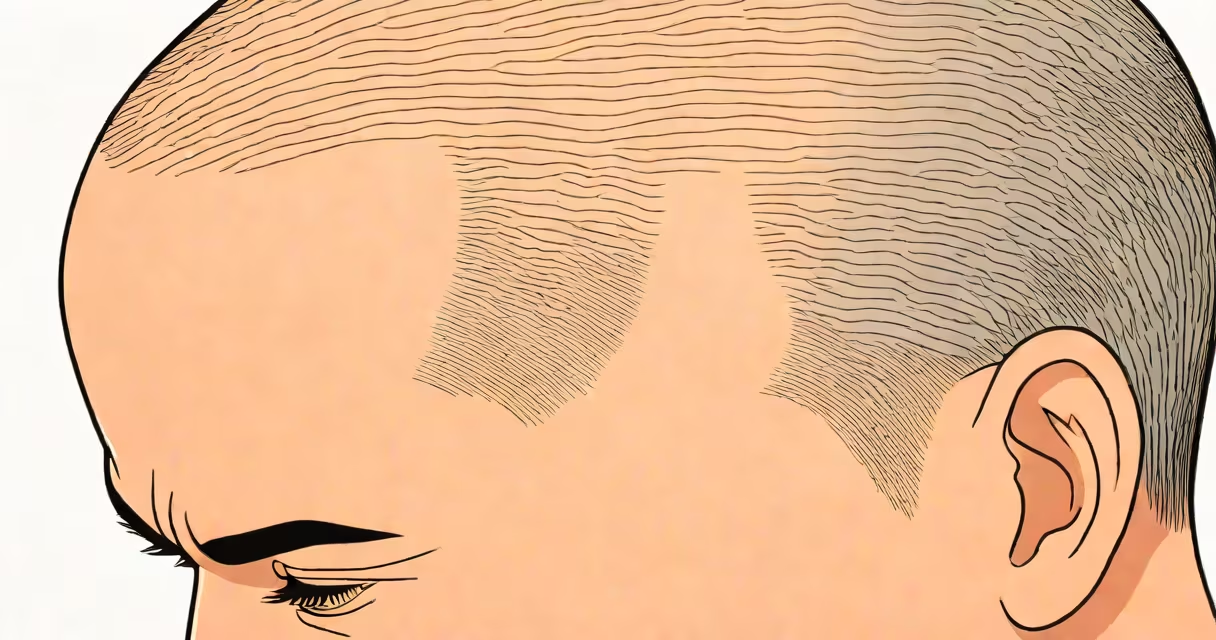
Genetic predisposition, visible hairline recession, and thinning at the crown are key indicators of likely future baldness. These signs often appear in your late teens to early 30s and can be assessed through family history and physical observation.
Baldness, particularly male pattern baldness, is primarily driven by genetics and hormones. If your father or grandfather experienced significant hair loss, especially a receding hairline or thinning crown, your risk increases substantially. The condition stems from sensitivity of hair follicles to dihydrotestosterone (DHT), a derivative of testosterone. Over time, DHT shrinks follicles, shortening the growth phase and leading to finer, shorter hairs until no new hair grows.
Medical research confirms that genetics account for about 80% of baldness cases. A study published in the journal Nature Genetics identified multiple gene variants linked to hair loss, including variants near the AR gene, which regulates DHT sensitivity. This means that while lifestyle factors play a minor role, your DNA largely determines whether you'll go bald.
Visible changes on the scalp are among the most reliable early warnings. The most common pattern begins with a receding hairline, forming an M-shape. This typically starts at the temples and progresses slowly over years. Another frequent sign is thinning at the crown, which may appear as a widening part or a noticeable gap in the center of the scalp.
These patterns follow a classification system called the Norwood scale, used by dermatologists to stage male pattern baldness. Stage 3 involves a distinct M-shaped recession at the temples. By Stage 5, the hairline has receded further, and the crown area begins to thin. Stage 7 marks extensive baldness, with only a horseshoe-shaped band of hair remaining around the sides and back.
A real-world example: a 26-year-old man notices his hairline has receded about 1 inch from his original position over two years. He also observes that his hair feels thinner at the crown when wet. His father began losing hair at 30, and his maternal grandfather was completely bald by 50. Based on this family history and current scalp changes, he is likely progressing toward Stage 4 or 5 on the Norwood scale.
Not all hair loss leads to complete baldness. While male pattern baldness affects about 50% of men by age 50, other forms exist. Androgenetic alopecia (the medical term for male pattern baldness) is the most common, affecting over 95% of men with progressive hair loss. Non-androgenetic causes include telogen effluvium (temporary shedding due to stress or illness), alopecia areata (an autoimmune condition causing patchy loss), and traction alopecia (from tight hairstyles).
Understanding the difference matters. For example, telogen effluvium causes diffuse thinning across the scalp, not a receding hairline. It usually resolves within six months after the triggering event-such as surgery, childbirth, or severe illness. In contrast, male pattern baldness follows a predictable progression and rarely reverses without treatment.
| Type | Onset | Pattern | Reversible? |
|---|---|---|---|
| Male pattern baldness | Teens to 30s | Receding hairline, thinning crown | No, without intervention |
| Telogen effluvium | After stress/illness | Diffuse thinning, no specific pattern | Yes, usually within 6 months |
| Alopecia areata | Any age | Patches of complete loss | Variable; some recover spontaneously |
Many people assume that hair loss only happens after age 40. But research shows that 25% of men begin losing hair before age 30. A 2020 study in The Journal of Clinical and Aesthetic Dermatology found that nearly half of men aged 20-30 reported noticing hair thinning. Early onset doesn't mean faster progression-it just means the process began earlier.
Another myth is that wearing hats causes baldness. There's no evidence linking hat-wearing to hair loss. Hats don't block oxygen to the scalp-hair follicles don't rely on airborne oxygen. However, tight-fitting hats worn daily may contribute to traction alopecia over time, especially if they pull on the hairline.
Some believe that washing hair frequently causes baldness. This is false. Shampooing removes dead skin cells and excess oil, which can improve scalp health. Frequent washing doesn't affect DHT levels or follicle sensitivity. In fact, a clean scalp allows better absorption of topical treatments like minoxidil.
If you're concerned about future baldness, start with a visual assessment. Look in a mirror under good lighting. Check for a receding hairline, thinning at the crown, or increased hair shedding-especially if you notice more than 100 strands in your shower drain daily. Use a magnifying mirror to examine the scalp for visible thinning or exposed skin.
For a more accurate evaluation, consult a dermatologist. They can perform a scalp biopsy or use a dermoscope to assess follicle density and hair shaft diameter. These tools detect early signs before visible thinning occurs.
I once observed a 22-year-old patient who came in worried about sudden hair loss. On examination, his hairline was stable, but the crown showed early thinning. A scalp biopsy confirmed reduced follicular density. After starting minoxidil and finasteride, he stabilized his hair loss over 12 months. This case illustrates that early detection enables effective management.
While you can't change your genes, you can influence outcomes. Treatments like finasteride reduce DHT levels by 70%, slowing hair loss in 80% of users. Minoxidil increases blood flow to follicles and extends the growth phase. Both require consistent use-results fade if stopped.