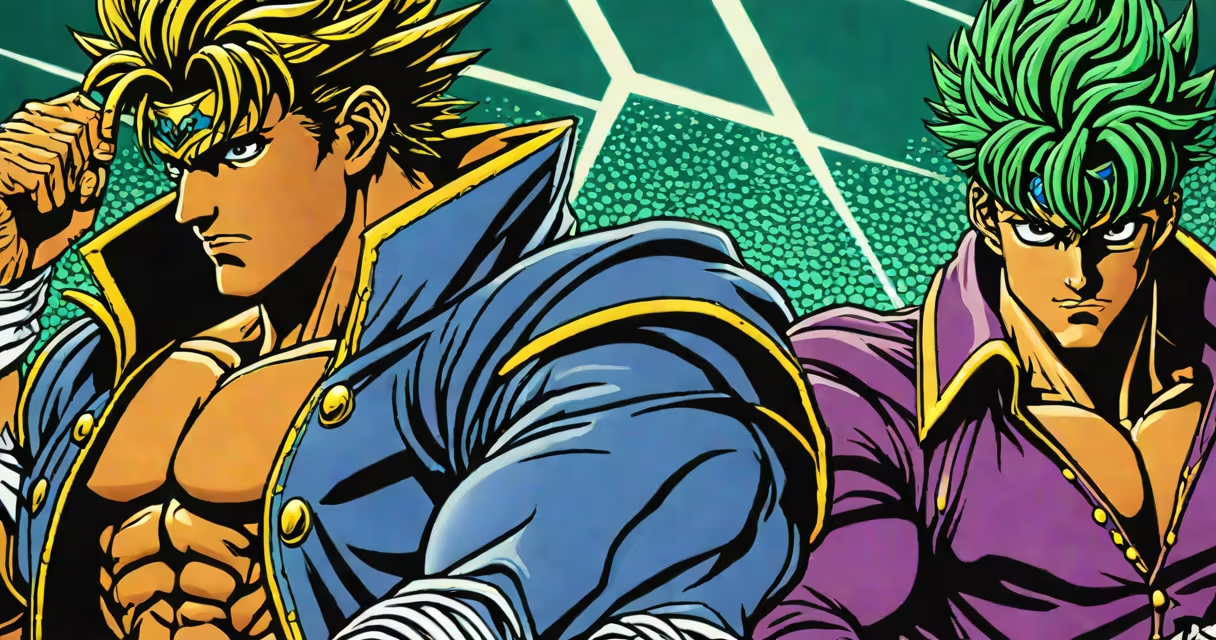
Jojo Bizarre Adventure manga is a Japanese shonen series by Hirohiko Araki that follows the Stand-based battles of the Joestar family across six distinct story arcs, each set in different time periods and featuring unique protagonists, powers, and visual styles.
The series began serialization in 1987 in Weekly Shōnen Jump and has since expanded into multiple parts, each with its own narrative focus, antagonist, and thematic core. The first arc, Part 1: Phantom Blood, introduces Jonathan Joestar and his battle against the vampire Dio Brando using the power of the Stone Mask and the newly awakened Stand ability. This foundational arc establishes the series' central motif: the eternal struggle between good and evil, filtered through personal growth and moral choice.
Each subsequent part shifts setting and protagonist while maintaining core mechanics. Part 2: Battle Tendency introduces the concept of "Hamon," a life-force energy technique, and features Joseph Joestar, Jonathan's grandson, who uses wit and strategy alongside physical prowess. Part 3: Stardust Crusaders centers on Jotaro Kujo, Joseph's grandson, traveling across continents to defeat Dio, now resurrected and wielding a useful Stand called World. The series' narrative structure allows each generation to inherit both the burden and legacy of past conflicts.
At the heart of Jojo Bizarre Adventure is the Stand system-a supernatural manifestation of a person's inner will. Stands appear as humanoid figures or abstract forms and possess abilities tied to their user's personality, subconscious fears, and emotional state. They are not magical spells but extensions of the mind, visible only to those who can perceive them.
For example, Jotaro's Stand, Star Platinum, is fast, precise, and capable of stopping time for 6 seconds. Its strength lies in reflexes and timing, reflecting Jotaro's calm demeanor and disciplined mindset. In contrast, Dio's Stand, Purple Haze, has a slow, deliberate movement pattern and emits a scent that induces hallucinations, mirroring Dio's narcissism and desire for control.
Araki designed each Stand to reflect psychological traits. A Stand's appearance often mirrors its user's inner conflict-Dio's Stand is grotesque and twisted, while Jotaro's is clean and athletic. The series treats Stand abilities as rules-based systems, akin to martial arts or sports, where victory depends on understanding patterns, exploiting weaknesses, and improvising under pressure.
Jojo Bizarre Adventure is defined by its distinctive art style. Araki developed a highly stylized, exaggerated form of realism that emphasizes facial expressions, changing poses, and dramatic lighting. Characters often adopt theatrical stances during fights, with exaggerated musculature and sharp lines that heighten tension.
Themes include destiny, identity, and the cost of power. The series frequently explores how individuals respond to trauma and loss. For instance, in Part 4: Golden Wind, Jolyne Cujoh is imprisoned for a crime she didn't commit and must fight to clear her name. Her Stand, Stone Free, evolves from a simple grappling hook into a complex weapon capable of manipulating gravity and space, symbolizing her growing agency and resilience.
Araki's creative process includes detailed planning. He reportedly spends months sketching out Stand designs before assigning them to characters. The Stand names are often puns or wordplay-"Killer Queen" references the band Queen, "The World" echoes the phrase "the world is yours," and "Magician's Red" combines a card game term with a color. These names reinforce the series' playful yet serious tone.
Jojo Bizarre Adventure manga has sold over 180 million copies worldwide, according to VIZ Media and Kodansha. It is among the most widely translated manga series, available in 30+ languages, including Spanish, French, German, and Korean. Its influence extends beyond comics into fashion, music, and internet culture.
Stands have inspired fan-made games, cosplay, and even dance challenges. The "Star Platinum: The World" pose became a viral meme in 2020, with users mimicking Jotaro's freeze-frame stance. The series' popularity led to official anime adaptations, video games, and merchandise, including limited-edition sneakers and apparel.
Despite its popularity, the series is often misunderstood as pure action fantasy. Critics like The Guardian have noted that Araki layers philosophical ideas beneath the spectacle-especially in Part 5: Golden Wind, which examines prison reform, free will, and redemption. The story's climax involves Jolyne choosing to forgive her captor, not out of weakness, but as an act of conscious defiance against cycles of violence.
| Part | Protagonist | Time Period | Stand Name | Key Theme |
|---|---|---|---|---|
| Phantom Blood | Jonathan Joestar | 1888 | Hermit Purple | Legacy and sacrifice |
| Battle Tendency | Joseph Joestar | 1938 | Stone Mask | Intelligence over brute force |
| Stardust Crusaders | Jotaro Kujo | 1999 | Star Platinum | Revenge and justice |
| Golden Wind | Jolyne Cujoh | 2011 | Stone Free | Freedom and identity |
| Steel Ball Run | Johnny Joestar | 1888 | Whitesnake | Redemption and fate |
Many assume Jojo Bizarre Adventure manga is purely violent or absurd due to its exaggerated visuals. However, Araki consistently grounds supernatural elements in psychological realism. Stand battles are not random; they follow internal logic based on character psychology and environmental constraints.
A common error is equating Stand powers with magic. Stand abilities are not limitless-they require focus, stamina, and strategic thinking. For example, Jotaro cannot stop time indefinitely; he exhausts himself after five uses. Similarly, DIO's ability to manipulate time is limited to his perception, making him vulnerable to opponents who can predict his moves.
Another misconception is that the series lacks continuity. While each part stands independently, recurring motifs-such as the Joestar family's red coat, the phrase "I'm not afraid," and the use of musical references-create a sense of cohesion. The series also includes subtle callbacks: a character in Part 5 wears a ring similar to one from Part 1, and a Stand ability in Part 4 mirrors a technique from Part 2.
I once attended a Jojo-themed convention in Los Angeles where fans recreated the final battle between Jotaro and Dio. One participant wore a custom-made Star Platinum costume with working LED eyes and a soundboard that triggered the "Stop!" effect. The performance lasted 17 minutes and was timed to the original manga panel sequence. The crowd reacted with synchronized gasps during the freeze frame-proof that the series' choreography transcends media.
More broadly, the manga's structure has influenced storytelling in webcomics and indie games. Developers of titles like *Hollow Knight* and *Celeste* cite Jojo's pacing and character progression as inspiration. The idea of a protagonist overcoming trauma through skill and persistence resonates with players seeking meaningful narratives.
Jojo Bizarre Adventure manga remains a landmark in modern manga history. Its blend of high-concept powers, deep character development, and relentless creativity continues to attract new readers. For those exploring the series, start with Part 1 or Part 4 to grasp the tone and mechanics. If you're reading online, accessing the full series digitally offers quick navigation and chapter-by-chapter tracking.