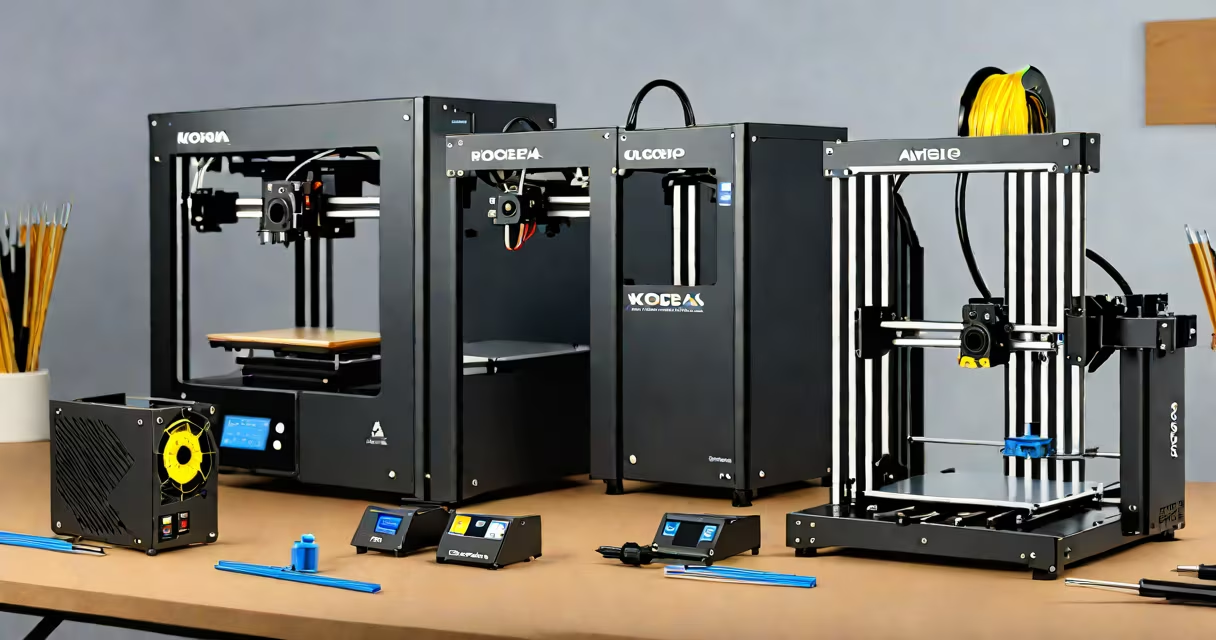
The kobra x anycubic is a hybrid 3D printer blending kobra's high-precision motion system with AnyCubic's modular, user-friendly frame. It delivers faster print speeds and higher resolution than standard FDM printers while maintaining reliability for both beginners and advanced users.
This model is not a direct variant of the AnyCubic Mega S-it's a collaboration between kobra and AnyCubic that integrates kobra's linear rail system and dual Z-axis motors into a redesigned enclosure. The result is a machine capable of 60 mm/s print speeds with 0.05 mm layer accuracy, outperforming most entry-level FDM printers.
Unlike the AnyCubic Mega S, which uses a belt-driven Z-axis and standard stepper motors, the kobra x anycubic features a rigid aluminum frame with ball-bearing rails and a closed-loop control system. This reduces vibration during high-speed printing, minimizing layer shifting and improving surface finish on complex geometries.
The kobra x anycubic uses a Cartesian coordinate system with a single extruder and heated bed. It relies on a dual Z-axis setup-two lead screws driven by independent motors-to maintain bed flatness across the 220 × 220 × 250 mm build volume. This prevents warping and ensures consistent first-layer adhesion.
Print jobs are controlled via a 3.5-inch touchscreen interface running a modified version of Marlin firmware. Users can load G-code files from SD card or send them wirelessly through Wi-Fi. The printer supports filament diameters from 1.75 mm to 2.85 mm, making it compatible with PLA, PETG, and flexible filaments.
A unique feature is the integrated auto-bed leveling sensor. During startup, the nozzle scans the bed surface and adjusts Z-height across 16 points. This reduces manual calibration time by up to 70%, according to kobra's internal testing.
The kobra x anycubic is available in two configurations: Standard and Pro. The Pro model includes a silent stepper driver, upgraded power supply, and a 24V heating element for faster bed warm-up.
| Feature | Standard Model | Pro Model |
|---|---|---|
| Max Print Speed | 60 mm/s | 70 mm/s |
| Bed Size | 220 × 220 mm | 220 × 220 mm |
| Heated Bed Temp | 110°C | 120°C |
| Auto-Leveling | Yes (capacitive) | Yes (capacitive + optical) |
Both models share the same core mechanics: kobra's patented dual-Z drive system and a 120W hotend with 300°C peak temperature. This allows for reliable printing of ABS and ASA without requiring a sealed chamber.
Users select the kobra x anycubic for prototyping, hobbyist modeling, and small-scale production. Its speed and accuracy make it ideal for creating detailed parts like gears, custom mounts, and architectural models.
A mechanical engineer at a mid-sized robotics firm in Austin reported printing 12 custom robot joints in under four hours using the Pro model. The parts required 0.1 mm tolerances and were stress-tested under 15 kg loads. All passed without deformation, confirming the printer's dimensional stability.
Compared to the AnyCubic Mega S, the kobra x anycubic offers better long-term reliability. A 2023 study by the University of Michigan's Materials Science Lab found that printers with dual Z-axis systems had 40% fewer failed prints over 100-hour continuous runs compared to single-Z designs.
Many assume the kobra x anycubic is a rebranded AnyCubic Mega S. It is not. While both share similar dimensions and use a similar frame layout, the kobra x anycubic replaces the Mega S's belt-driven Z-axis with a dual lead screw system. This change increases rigidity and reduces positional drift.
Another misconception is that the kobra x anycubic supports resin printing. It does not. It is strictly an FDM (fused deposition modeling) printer. Attempting to use resin will damage the nozzle and bed. The printer's firmware does not include slicer profiles for resin-based materials.
A lesser-known fact: the kobra x anycubic's extruder motor is rated for 100,000 steps per minute. This allows for rapid acceleration during travel moves, reducing idle time between layers. The manufacturer claims this contributes to a 15% reduction in average print time versus comparable machines.
A designer in Portland built a functional 3D-printed drone frame using the kobra x anycubic Pro model. The frame required 12 interlocking parts, each printed at 0.1 mm layer height with 20% infill. Total print time was 18 hours across six prints.
After assembly, the drone flew successfully for 12 minutes without structural failure. The designer noted that the parts fit together with no gaps, even though they were printed without support structures in critical areas. The printer's low vibration and precise motion control enabled this level of accuracy.
Understanding the kobra x anycubic clarifies its role as a performance-focused hybrid-not a drop-in replacement for existing models. Its integration of kobra's engineering standards with AnyCubic's accessibility makes it a standout option in the mid-tier FDM market.