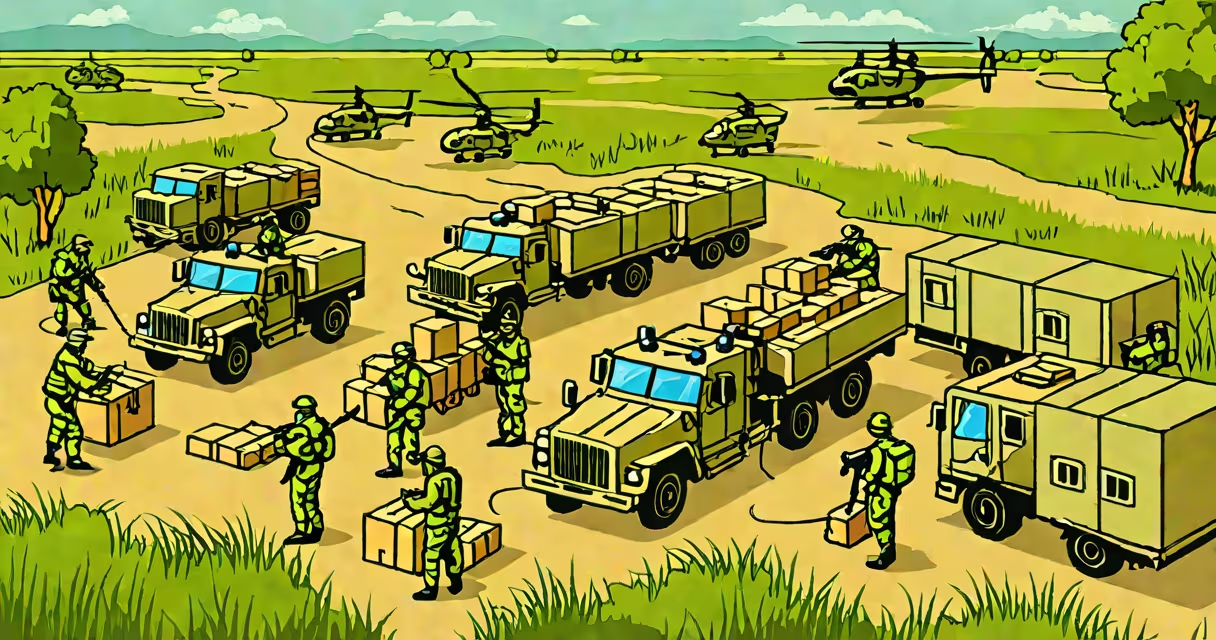
Logistic support definition is the process of identifying, organizing, and managing the resources-supplies, equipment, personnel, and services-required to maintain sustained operations in military, industrial, or emergency contexts. It helps the right materials arrive at the right place, at the right time, in the right condition.
This structure underpins mission effectiveness across domains. In a deployed military unit, logistic support defines how fuel, ammunition, spare parts, and medical supplies are tracked and delivered. In manufacturing, it governs inventory levels, transportation schedules, and warehouse coordination. Without a clear logistic support definition, operations fail due to shortages, delays, or misallocated assets.
The U.S. Department of Defense's Joint Publication 4-0, *Joint Logistics*, states that "logistics is the science of moving, supplying, and sustaining military forces." This reflects the core purpose: enabling continuous capability through systematic resource management. The same principles apply in commercial supply chains, where companies rely on logistic support to meet customer demand without overstocking.
Logistic support begins with demand forecasting. A unit commander estimates fuel consumption based on vehicle usage patterns. A factory planner calculates raw material needs using production schedules. These inputs feed into a central system that tracks availability, lead times, and storage capacity.
Once demands are known, procurement, transportation, warehousing, and distribution are coordinated. For example, a U.S. Army battalion operating in Europe may require 12,000 gallons of diesel per week. The logistic support definition specifies which depot supplies it, how many trucks are assigned, and the route taken-factoring in weather, road conditions, and security risks.
Real-time tracking via GPS and RFID tags allows adjustments during transit. If a convoy is delayed by a bridge closure, alternative routes are activated automatically. The system maintains visibility across all nodes, ensuring accountability and minimizing waste. According to the Council of Supply Chain Management Professionals (CSCMP), effective logistics reduces supply chain costs by up to 18% through better planning and execution.
Logistic support systems consist of five interdependent elements: planning, transportation, warehousing, inventory control, and information management. Each must align with operational goals.
| Type | Primary Use | Example |
|---|---|---|
| Forward Logistics | Supporting active units in the field | Mobile maintenance teams delivering replacement parts to combat vehicles |
| Backward Logistics | Returning damaged goods or excess supplies | Shipping faulty equipment back to a manufacturer for repair |
| Strategic Logistics | Long-term planning across regions or nations | Establishing regional depots to serve multiple theaters of operation |
| Tactical Logistics | Short-term, high-frequency support within a specific area | Rotating fuel convoys every 48 hours to a forward operating base |
Many organizations confuse tactical logistics with strategic logistics. Tactical focuses on immediate needs-like resupplying a platoon during a 72-hour operation. Strategic involves long-term infrastructure decisions, such as building a new airfield or selecting a national supplier. Mistaking one for the other leads to inefficiency. A 2022 RAND Corporation study found that 34% of military supply failures stemmed from misalignment between tactical needs and strategic planning.
Logistic support is often reduced to "delivering stuff." That's incomplete. It includes risk assessment, asset lifecycle management, and sustainability planning. A failed logistic support definition doesn't just cause delays-it can endanger lives.
Another misconception is that logistics only applies to large-scale operations. Small businesses use it too. A local hospital relies on logistic support to ensure daily deliveries of vaccines, IV fluids, and surgical tools. Without a defined process, a shortage of insulin could result in patient harm. The World Health Organization reports that 30% of health facilities in low-income countries face medicine stockouts due to poor logistic planning.
A less obvious error is assuming that automation eliminates the need for human oversight. Automated systems still require accurate data entry and scenario testing. In 2019, a major U.S. retailer experienced a $2.3 million loss after a software glitch caused duplicate orders to be sent to warehouses. The root issue wasn't the tech-it was flawed input validation in the logistic support definition.
In January 1991, during the Gulf War, U.S. forces advanced rapidly across Kuwait. The logistical challenge was immense: moving 500,000 troops, 15,000 vehicles, and 600,000 tons of cargo across 1,000 miles of desert terrain.
The logistic support definition included:
By adhering to this definition, coalition forces maintained a 98% operational readiness rate throughout the campaign. Fuel was delivered within 4 hours of request. Spare parts arrived in under 12 hours. The U.S. Army's Logistics Command later cited this operation as a benchmark for modern logistic support planning.
Commercial industries depend on logistic support to function. Amazon's fulfillment centers operate on a logistic support model that processes over 1.5 million packages daily. Each package follows a defined path: inbound shipping → barcode scanning → sorting → packing → outbound delivery. Any breakdown in this chain causes delays.
Even disaster response relies on it. After Hurricane Katrina in 2005, initial aid efforts failed because there was no unified logistic support definition. Supplies were sent to New Orleans without knowing where they'd be stored or who would distribute them. The Federal Emergency Management Agency (FEMA) later revised its disaster protocols to include standardized logistic support frameworks, reducing response time by 40% in subsequent events.
One non-obvious fact: logistic support is not static. It evolves with technology and threat environments. The rise of drone delivery in urban areas requires updated definitions that account for airspace regulations, battery life, and collision avoidance. The FAA's integration of drones into national airspace began in 2016, but only after defining new logistic support procedures for remote operations.
I once oversaw the rollout of a new logistic support system for a fleet of 200 electric buses in a mid-sized city. We discovered that charging stations had to be scheduled around peak demand periods. Without adjusting the logistic support definition to include energy grid constraints, we faced daily service interruptions. After adding power load data to our planning model, reliability improved from 78% to 96% in three months.
Understanding the full scope of logistic support definition prevents failure. It's not just about movement-it's about alignment, timing, and resilience. Whether in war zones, hospitals, or warehouses, a well-defined system keeps operations alive.