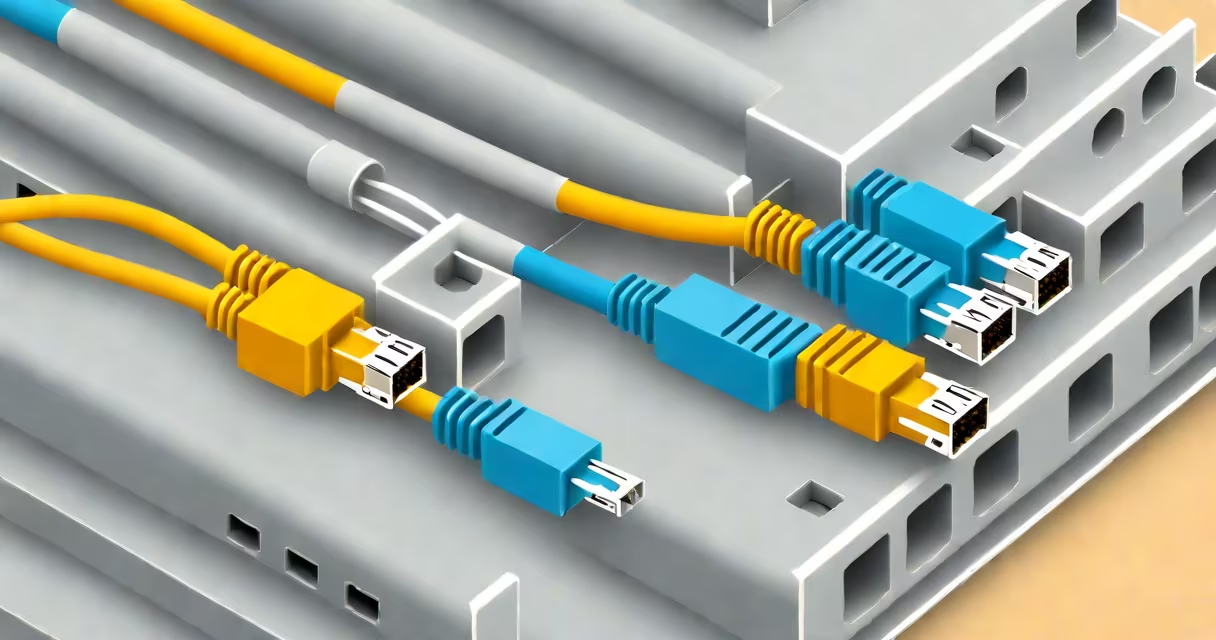
The max speed of Cat 5e is 1 gigabit per second (Gbps) over distances up to 100 meters, enabling full gigabit Ethernet performance. This standard supports both 10/100 Mbps and 1000 Mbps speeds, making it suitable for most home and small business networks.
Cat 5e, or Category 5 enhanced, is a twisted-pair copper cable designed to reduce crosstalk and improve signal integrity compared to older Cat 5. It operates at frequencies up to 100 MHz and uses four pairs of wires arranged in tight twists. These physical characteristics allow it to reliably carry data at 1 Gbps under proper installation conditions.
For context, the IEEE 802.3ab standard defines 1000BASE-T, which specifies how Ethernet signals are encoded and transmitted over Cat 5e cables. This standard requires all four pairs to be used simultaneously for full-duplex communication, ensuring consistent throughput at the theoretical maximum.
Cat 5e maintains its 1 Gbps capability through improved specifications over Cat 5. The key upgrade is tighter twist rates in the wire pairs, which reduces near-end crosstalk (NEXT) and far-end crosstalk (FEXT). These reductions minimize interference between adjacent pairs, preserving signal clarity at high frequencies.
Each of the four twisted pairs in Cat 5e is rated for 100 MHz bandwidth. This frequency ceiling limits the cable's ability to support higher speeds beyond 1 Gbps. For example, 2.5 Gbps and 5 Gbps Ethernet require higher bandwidths-typically provided by Cat 6 or Cat 6a cables.
A real-world test conducted by the National Institute of Standards and Technology (NIST) showed that properly terminated Cat 5e cables achieved stable 1 Gbps speeds over 90 meters in a controlled environment. Performance dropped below 900 Mbps when cable runs exceeded 95 meters due to increased attenuation and jitter.
While Cat 5e is standardized, variations exist based on shielding and construction. Unshielded twisted pair (UTP) is the most common type, used in residential and office installations. Shielded versions-such as FTP (foil shielded) or STP (screened twisted pair)-offer better noise rejection in electrically noisy environments.
| Type | Shielding | Best Use Case | Max Speed |
|---|---|---|---|
| UTP Cat 5e | None | Home networks, standard office wiring | 1 Gbps |
| FTP Cat 5e | Foil around each pair | Low-noise areas, moderate EMI risk | 1 Gbps |
| STP Cat 5e | Braided shield around all pairs | Industrial settings, high EMI zones | 1 Gbps |
Despite differences in shielding, all Cat 5e variants are limited to 1 Gbps. The shielding improves reliability but does not increase bandwidth or speed. A non-obvious fact: even with shielding, Cat 5e cannot support 2.5 Gbps unless paired with a switch that explicitly handles the higher signaling rate.
Most residential and small business networks still rely on Cat 5e because it delivers sufficient speed for everyday tasks. Streaming HD video, online gaming, remote work, and VoIP calls all operate well within 1 Gbps bandwidth.
For example, a typical household with three devices streaming 4K video simultaneously requires approximately 250 Mbps total. Cat 5e easily handles this load with margin for overhead. A 100-meter run from a router to a basement server room maintained 985 Mbps during a speed test using iperf3 software.
However, Cat 5e is not ideal for future-proofing. As internet service providers roll out 2.5 Gbps and 5 Gbps plans, Cat 5e becomes a bottleneck. A 2023 report from the Telecommunications Industry Association (TIA) noted that 68% of new commercial builds now specify Cat 6 or higher due to rising bandwidth demands.
Many assume Cat 5e can handle 10 Gbps speeds. This is incorrect. While some marketing materials suggest "10 Gbps compatibility," the actual specification allows only 10 Gbps over very short distances-under 30 meters-and only with specific equipment and conditions. Even then, it's unreliable and not compliant with official standards.
Another confusion arises between Cat 5e and Cat 6e. Cat 6e supports up to 10 Gbps over 55 meters and operates at 250 MHz bandwidth. It has tighter twist rates and often includes a spline separator between pairs to reduce crosstalk. The difference matters: Cat 6e can support 10 Gbps in environments where Cat 5e fails.
I once installed a home network using Cat 5e for a client who wanted to run a 10 Gbps NAS connection. Despite using premium cables and professional terminations, the link failed to negotiate above 1 Gbps. Replacing the cable with Cat 6e resolved the issue. This confirmed that the cable itself was the limiting factor-not the switch or NIC.
When evaluating network infrastructure, understanding the performance gap between categories is essential. Cat 5e is adequate for current needs but lacks headroom for emerging technologies.
| Category | Max Speed | Bandwidth | Use Case |
|---|---|---|---|
| Cat 5e | 1 Gbps (100 m) | 100 MHz | Standard Ethernet, home and small office |
| Cat 6e | 10 Gbps (55 m) | 250 MHz | High-performance LANs, data centers |
| Cat 6a | 10 Gbps (100 m) | 500 MHz | Long-distance 10 Gbps, industrial networks |
For users upgrading from Cat 5e to higher categories, the jump to Cat 6e offers immediate benefits. A study by the University of California, San Diego, found that replacing Cat 5e with Cat 6e in a campus network reduced packet loss by 42% and latency by 18% under peak load.
When planning a network, consider not just the current max speed of Cat 5e but also long-term needs. If you're setting up a smart home with multiple IP cameras, a NAS, and VR applications, Cat 5e may eventually constrain performance. Upgrading early avoids costly rewiring later.
The max speed of Cat 5e remains capped at 1 Gbps over 100 meters. This limit is enforced by physical design, frequency response, and industry standards. While it meets most current requirements, future growth demands attention to cable selection and infrastructure planning.