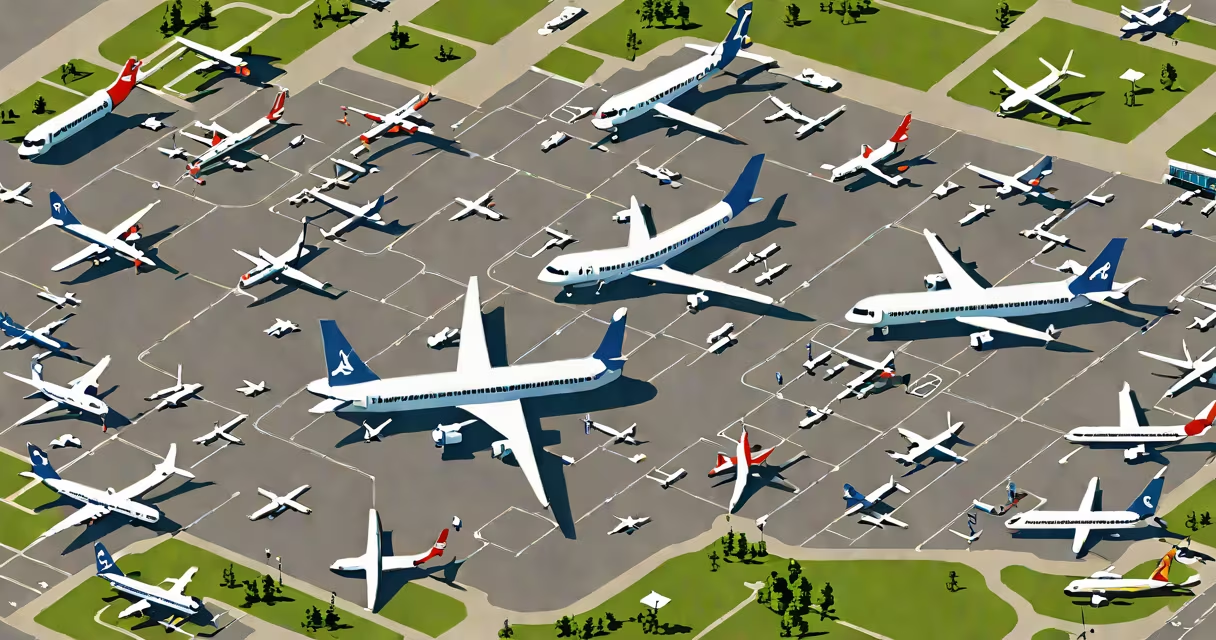
Aviation is the practice and science of flying aircraft, including airplanes, helicopters, gliders, and drones. It spans the entire lifecycle of flight-from engineering and manufacturing to air traffic control, safety regulation, and operational management. Aviation enables global mobility, supports national defense, powers international trade, and drives technological innovation.
The term covers both civil and military applications. Civil aviation includes passenger and cargo transport, private flying, aerial surveying, and emergency medical services. Military aviation involves combat aircraft, surveillance drones, and strategic bombers. Aerospace, a related field, extends into spaceflight, but aviation specifically refers to flight within Earth's atmosphere.
According to the International Civil Aviation Organization (ICAO), aviation is regulated through standardized procedures across 193 member states. These standards ensure safety, security, and interoperability in international air travel. The Federal Aviation Administration (FAA) in the U.S. sets similar rules for domestic operations, enforcing airworthiness requirements and pilot certification protocols.
Aviation relies on aerodynamics-the study of how air moves around objects in motion. Lift, drag, thrust, and weight are the four forces governing flight. Lift is generated when air flows faster over the curved upper surface of a wing, creating lower pressure above and higher pressure below. This upward force counteracts gravity and allows an aircraft to rise.
Engines provide thrust to overcome drag-the resistance caused by air friction. Jet engines compress incoming air, mix it with fuel, ignite the mixture, and expel hot gases backward to propel the aircraft forward. Propeller-driven planes use rotating blades to push air rearward, generating forward motion.
Aircraft are controlled using flight surfaces: ailerons (roll), elevators (pitch), and rudder (yaw). Pilots manipulate these via control yokes or side-sticks. Modern aircraft also use fly-by-wire systems, where electronic signals replace mechanical linkages between controls and actuators. For example, Airbus A350s use digital flight control systems that automatically adjust surfaces based on sensor inputs to maintain stability.
Aviation is divided into several categories based on purpose, vehicle type, and operational environment. The following table outlines major aviation sectors:
| Type | Primary Use | Examples | Regulatory Body (U.S.) |
|---|---|---|---|
| Civil Aviation | Passenger and freight transport | Boeing 787, Airbus A321 | FAA |
| Military Aviation | Combat, reconnaissance, logistics | F-35 Lightning II, MQ-9 Reaper drone | Department of Defense |
| General Aviation | Private flying, training, emergency response | Cessna 172, Piper Cub | FAA |
| Unmanned Aircraft Systems (UAS) | Surveying, delivery, monitoring | DJI Mavic Pro, Amazon Prime Air prototype | FAA (Part 107 regulations) |
Each category operates under distinct rules. For instance, commercial airlines follow strict maintenance schedules and crew duty limits enforced by the FAA. General aviation pilots must pass written exams and flight tests, but they operate under less stringent reporting requirements.
One non-obvious distinction: not all flying is aviation. Parachuting, hot air ballooning, and kite flying involve airborne movement but fall outside aviation because they lack powered, controlled flight. The FAA defines aviation as involving "controlled, powered flight." This excludes unpowered gliding unless done with a motorized launch system.
Aviation connects continents. In 2023, the International Air Transport Association (IATA) reported 4.3 billion passengers flew commercially worldwide. That number reflects aviation's role in tourism, business travel, and humanitarian aid. During the 2020 pandemic, cargo flights carried medical supplies across borders when ground routes were closed.
Aviation also supports infrastructure development. Remote communities in Alaska rely on bush planes for food, medicine, and mail. In sub-Saharan Africa, regional airlines deliver vaccines to clinics unreachable by road. The World Health Organization notes that air transport reduced vaccine delivery times by up to 70% in rural areas.
Another critical function is disaster response. After Hurricane Maria devastated Puerto Rico in 2017, the U.S. Air Force deployed C-130 Hercules transports to deliver water, generators, and personnel. These aircraft flew nearly 1,200 missions in six weeks, supporting recovery efforts.
I once witnessed a search-and-rescue mission in the Rocky Mountains where a helicopter equipped with thermal imaging located a lost hiker at night. The pilot used instrument landing systems to land safely on a narrow ridge. That moment confirmed how precision and training define effective aviation operations.
People often confuse aviation with aerospace. While both deal with flight, aerospace includes vehicles that leave Earth's atmosphere-like rockets and satellites. The SpaceX Falcon 9 rocket is aerospace, not aviation. Aviation remains confined to atmospheric flight.
Another mistake is assuming all aircraft require human pilots. Autonomous drones now perform tasks such as crop spraying, pipeline inspection, and wildfire monitoring. The FAA permits Beyond Visual Line of Sight (BVLOS) operations for certain drones under Part 107 waivers, enabling remote-controlled flights over long distances.
Some believe aviation is solely about speed or luxury. But efficiency and safety are equally central. The average fuel burn per passenger-kilometer for modern jets is 3.5 liters per 100 km-about 70 mpg. Airlines like Delta and Lufthansa have reduced emissions by 15% since 2015 through optimized routing and lighter materials.
Finally, aviation is not limited to large airports. Small airstrips serve thousands of communities globally. In Papua New Guinea, over 600 airstrips support regional connectivity. Many are unpaved, requiring pilots trained in short-field landings and rough terrain navigation.
Understanding what aviation means begins with recognizing its scale and diversity. From the first powered flight by the Wright brothers in 1903 to today's electric vertical takeoff and landing (eVTOL) prototypes, aviation continues to evolve. It shapes economies, enables exploration, and saves lives.