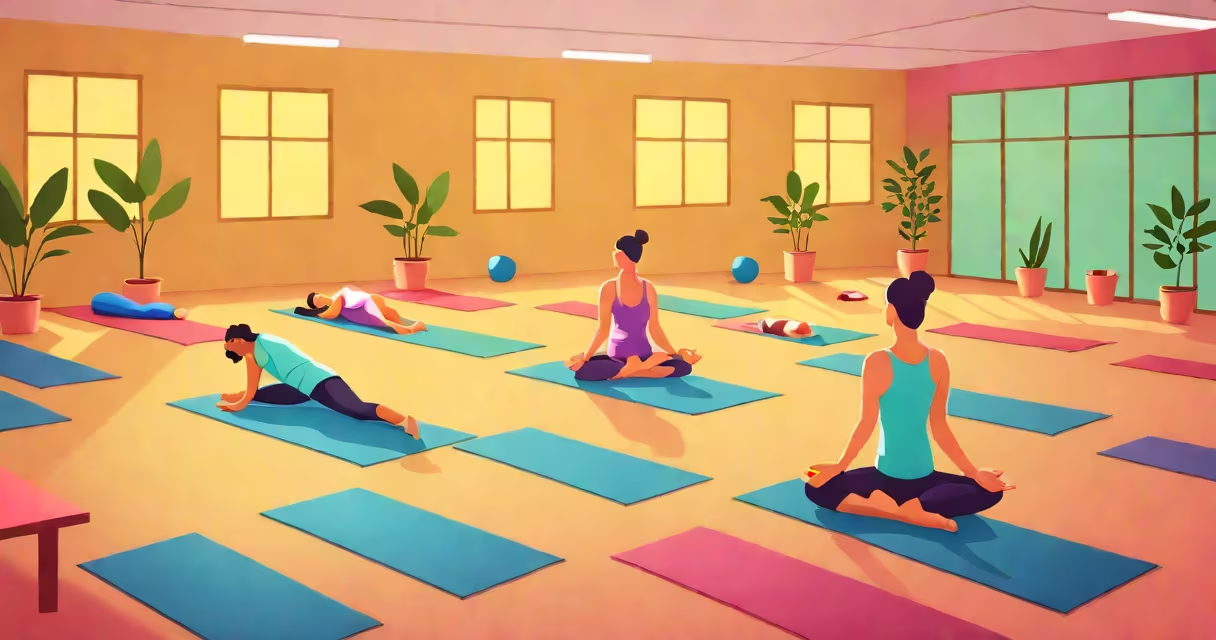
A mindful yoga studio is a dedicated space where yoga practice emphasizes present-moment awareness, intentional movement, and breath-centered focus rather than physical performance or aesthetic form. Sessions prioritize internal experience over external results, using slow pacing, minimal props, and guided attention to cultivate mental clarity and bodily sensation.
Unlike traditional yoga studios that may emphasize flexibility, strength, or advanced poses, a mindful yoga studio centers on stillness, observation, and non-judgmental awareness. Classes often include seated meditation, breath tracking, and body scans. Instructors guide participants to notice sensations without reacting-such as tension in the shoulders or the rhythm of inhalation-and to return attention gently when it wanders.
The environment supports this focus: dim lighting, low noise levels, and uncluttered layouts reduce sensory distraction. Mats are spaced apart to allow personal space. Some studios incorporate nature sounds, incense, or soft instrumental music-but only if they don't disrupt inner listening. The goal is not relaxation as escape, but presence as practice.
Mindful yoga integrates principles from mindfulness-based stress reduction (MBSR), developed by Jon Kabat-Zinn at the University of Massachusetts Medical School. MBSR uses meditation and body awareness to manage chronic pain, anxiety, and emotional reactivity. Mindful yoga applies these tools within a movement context.
Each session begins with a brief intention-setting-often silent or whispered. Participants are invited to observe their breath, posture, and thoughts without labeling them "good" or "bad." For example, if someone feels frustration during a pose, the instruction is not to fix it, but to acknowledge it: "I feel resistance in my hips. That's okay. I'm noticing it." This reduces automatic reaction patterns.
Physical postures are held longer than in changing styles like vinyasa. A typical pose such as child's pose may last five minutes. During that time, the instructor might prompt: "Notice the weight of your torso on your thighs. Where do you feel pressure? Is there warmth? Coolness? Breathe into those areas." This cultivates interoception-the sense of internal bodily states-which research shows improves emotional regulation and decision-making.
Mindful yoga studios typically offer three core formats:
| Type | Duration | Focus | Best For |
|---|---|---|---|
| Seated Mindfulness & Breath | 30-45 min | Stillness, breath awareness, mental observation | Beginners, high-stress individuals, meditation newcomers |
| Gentle Movement + Body Scan | 60-75 min | Slow flow, tactile sensation, posture awareness | Chronic pain sufferers, older adults, injury recovery |
| Restorative Yoga with Guided Meditation | 75-90 min | Supported poses, extended holds, mental calm | Insomnia, burnout, emotional fatigue |
Some studios also host weekly drop-in circles where participants sit in silence for 10 minutes, then share one sentence about their experience. These are not therapy sessions but communal reflection spaces grounded in non-verbal empathy.
Mindful yoga does not require prior experience. A class titled "Mindful Beginnings" at a studio in Portland, Oregon, reports that 78% of first-time attendees said they felt calmer afterward, even if they struggled to stay still. The studio tracks mood via anonymous pre- and post-session surveys using a 1-10 scale.
Many people assume mindful yoga is passive or inactive. In reality, it demands active attention. Holding a pose while noticing subtle shifts in balance or temperature requires sustained focus-similar to meditating while walking. The effort lies in attention, not exertion.
Another confusion: equating mindful yoga with "yoga for depression." While mindfulness techniques are used in clinical settings to treat mood disorders, a mindful yoga studio is not a substitute for therapy. The American Psychological Association notes that mindfulness-based interventions are most effective when combined with professional care. A studio cannot diagnose or treat mental health conditions.
Also, not all quiet studios are mindful. Some studios play ambient music or use dim lights to create a "calm" atmosphere without teaching awareness practices. True mindful yoga includes explicit instruction in observing thoughts, emotions, and physical sensations-not just creating a peaceful setting.
In 2022, a study published in *Frontiers in Psychology* analyzed 120 participants attending weekly mindful yoga sessions over eight weeks. The group practiced 60-minute classes twice weekly, focusing on breath and posture awareness. After eight weeks, 64% reported reduced perceived stress, and 52% showed measurable improvement in heart rate variability-a physiological marker of resilience.
One participant, Sarah, a software engineer from Austin, Texas, described her experience: "I came in expecting to stretch. Instead, I noticed how tense my jaw was-without realizing it. The teacher asked me to place my hand on my face and feel the muscles. I hadn't done that in years. By week four, I caught myself clenching during meetings and paused. That small shift changed my workday."
This illustrates a key point: mindful yoga trains attention not for immediate relief, but for long-term behavioral awareness. The change happens in micro-moments, not grand transformations.
Neuroscience confirms that regular mindfulness practice strengthens the prefrontal cortex-the brain region responsible for impulse control and emotional regulation. A 2021 review in *Nature Human Behaviour* found that consistent mindfulness training increases gray matter density in areas linked to attention and self-awareness.
For individuals managing anxiety, chronic pain, or burnout, mindful yoga provides a low-impact, accessible tool. It doesn't demand fitness or flexibility. It asks only for willingness to pay attention-to the breath, to the body, to the present moment.
If you're exploring a mindful space yoga practice, consider starting with a single class at a local studio. Many offer free introductory sessions. Look for instructors who explicitly mention "non-judgment," "present-moment awareness," or "body scanning." Avoid studios that market "deep healing" or "instant transformation"-those claims contradict the foundational principle of mindful practice: showing up, not fixing.
Understanding mindful yoga as a practice-not a product-helps avoid disappointment. It's not about achieving a perfect pose or feeling blissful. It's about learning to be with yourself, exactly as you are, in each moment.