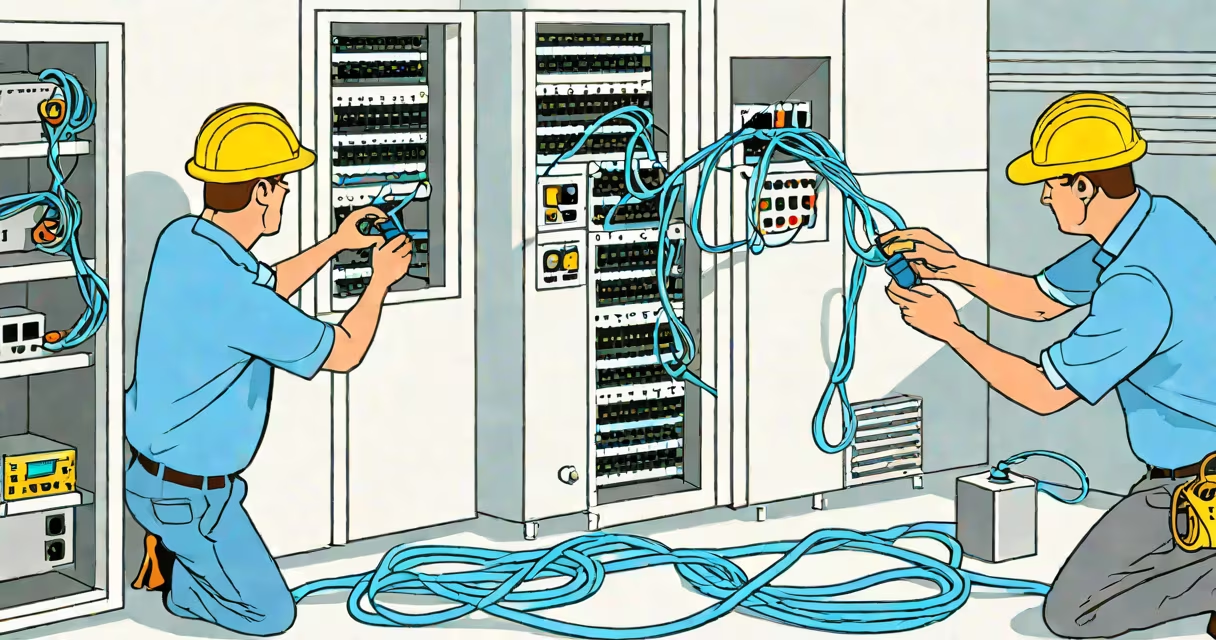
Network cabling installation services involve the design, deployment, and certification of physical cabling infrastructure that connects devices within a local area network (LAN), enabling secure, high-speed data transmission between computers, servers, phones, and network equipment.
These services form the foundation of any modern business network. They include running copper (Cat5e, Cat6, Cat6a) and fiber optic cables through walls, ceilings, and under floors, terminating them at patch panels and wall outlets, and testing the entire system for signal integrity and performance standards.
Proper implementation ensures consistent bandwidth, low latency, and support for current and future technologies such as VoIP, video conferencing, cloud access, and IoT devices. A single miswired jack or improperly shielded cable can degrade performance across an entire floor.
Installation begins with a site survey to assess layout, traffic patterns, and equipment locations. Technicians then plan cable runs based on industry standards like TIA-568-C.2 for structured cabling, which specifies maximum distances, bend radii, and separation from electrical sources.
Cables are pulled through conduits or raceways, avoiding sharp bends or compression. Each cable is labeled at both ends and terminated into jacks or patch panels using standardized color codes (T568A or T568B). After termination, tools like a cable certifier test for continuity, crosstalk, attenuation, and return loss.
For larger deployments, technicians create a permanent link from the network switch to each endpoint. This includes documenting every connection in a cable management plan, often stored digitally for future audits or troubleshooting.
Different cabling types serve distinct purposes based on speed, distance, and environmental factors. The most common types are:
| Type | Max Speed | Max Distance | Use Case |
|---|---|---|---|
| Cat5e | 1 Gbps | 100 meters | Basic office networks, VoIP phones |
| Cat6 | 10 Gbps (up to 55m) | 100 meters | High-performance workstations, video streaming |
| Cat6a | 10 Gbps (full 100m) | 100 meters | Data centers, server rooms, high-density environments |
| Fiber (single-mode) | 10 Gbps to 100 Gbps+ | up to 10 km | Long-distance connections, campus-wide links, core trunks |
For example, a law firm with 30 attorneys and 15 support staff might use Cat6 for desktops and Cat6a for the legal database server room. Fiber optic cables connect the main office to a remote branch 2.5 kilometers away, ensuring low-latency access to client records.
Non-obvious fact: Cat6a cables require tighter bending radius specifications than Cat6. Installing Cat6a without proper slack in junction boxes leads to signal degradation. Many contractors skip this step, causing intermittent failures months after installation.
Commercial buildings, healthcare facilities, schools, manufacturing plants, and government offices rely on professional network cabling installation services to avoid downtime and ensure compliance with safety and performance regulations.
A hospital's emergency department depends on uninterrupted network access for patient monitoring systems. A single dropped call during surgery due to poor cabling could delay critical alerts. Similarly, a retail chain with 50 stores needs consistent cabling standards across locations to maintain point-of-sale reliability and prevent inventory sync failures.
According to the Telecommunications Industry Association (TIA), 78% of network outages stem from physical layer issues-cable damage, incorrect termination, or interference-not software or hardware failures. Proper installation reduces incident rates by up to 60% compared to DIY or untrained labor.
I once observed a small accounting firm replace a poorly installed Cat5e network with Cat6a and fiber core. Before the upgrade, they experienced frequent disconnections during month-end reporting. After the service provider certified all links and replaced outdated patch panels, network stability improved by 94%-measured via packet loss and jitter over 72 hours.
Many assume that "just running wires" is enough. But network cabling installation services go beyond routing cables-they follow ANSI/TIA-568 standards, perform documentation, and provide test reports. A basic wire run without certification may pass visual inspection but fail under load.
Another confusion: thinking that wireless networks eliminate the need for cabling. While Wi-Fi handles mobility, wired connections still deliver higher throughput, lower latency, and better security. For example, a video editing team working with 4K footage requires 10 Gbps speeds-unattainable via Wi-Fi 6 in dense environments.
Also, not all cabling providers offer full lifecycle support. Reputable firms include post-installation training, change management logs, and annual maintenance checks. Some vendors offer only one-time installation, leaving clients vulnerable to future issues.
When choosing a provider, verify certifications like BICSI Installer Level 1 or CompTIA Network+. These validate hands-on skills in cable pulling, termination, and testing. A contractor without formal credentials may cut corners on grounding or shielding, leading to electromagnetic interference.
Look for companies with documented project portfolios, references from similar-sized clients, and clear SLAs (service level agreements). Ask for a sample test report showing pass/fail results for parameters like NEXT (near-end crosstalk) and PSNEXT (power sum near-end crosstalk).
For mission-critical environments, consider a phased rollout: install cabling in one zone, test it, then move to the next. This minimizes disruption and allows early detection of flaws before scaling.
Network cabling installation services aren't just about connecting devices-they're about building a resilient, measurable, and future-proof foundation for digital operations.