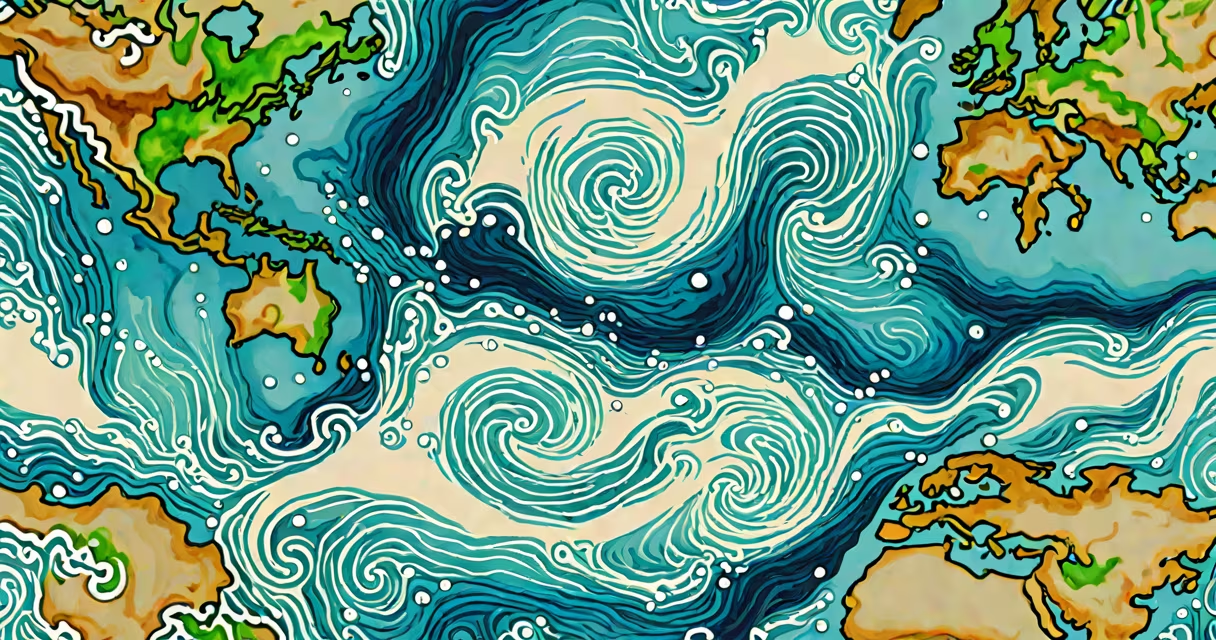
Ocean currents are driven by wind patterns, Earth's rotation, water density variations due to temperature and salinity, and the shape of ocean basins. These forces interact to move vast volumes of water across the globe, influencing climate, weather, and marine life.
Wind is the primary driver of surface currents. Trade winds near the equator push water westward, while westerlies in mid-latitudes push water eastward. This creates large circular current systems called gyres. For example, the North Atlantic Gyre moves warm water from the tropics toward Europe, moderating the climate of countries like the UK and Norway.
The Coriolis effect, caused by Earth's rotation, deflects moving water to the right in the Northern Hemisphere and to the left in the Southern Hemisphere. This deflection shapes the path of major currents like the Gulf Stream, which curves northward along the U.S. East Coast before turning east toward Europe. Without the Coriolis effect, surface currents would flow straight from high-pressure to low-pressure zones, not in spirals.
Deeper currents form through thermohaline circulation, a process driven by differences in water density. Cold, salty water sinks in polar regions, especially in the North Atlantic near Greenland. As this dense water descends, it displaces warmer water below, creating a global conveyor belt of deep ocean flow. The National Oceanic and Atmospheric Administration (NOAA) notes that this system transports heat and nutrients across oceans, affecting marine productivity and long-term climate patterns.
Salinity and temperature are the two key factors altering water density. Evaporation increases salinity in tropical regions, making surface water denser. Conversely, melting ice in polar zones dilutes seawater, reducing its density. A 2021 study published in *Nature Climate Change* found that increased freshwater input from Arctic ice melt is slowing down the Atlantic Meridional Overturning Circulation (AMOC), a critical component of thermohaline circulation.
| Factor | Effect on Currents | Example |
|---|---|---|
| Wind patterns | Drives surface currents | Trade winds generate the North Equatorial Current |
| Coriolis effect | Deflects flow direction | Causes the Gulf Stream to curve northeast |
| Temperature gradients | Creates density differences | Cold water sinks in the Labrador Sea |
| Salinity changes | Alters water buoyancy | High evaporation in the Mediterranean increases salinity |
These forces do not act in isolation. For instance, during El Niño events, weakened trade winds disrupt the normal Pacific current patterns. Warm water that usually flows westward accumulates in the eastern Pacific, altering rainfall patterns globally. The 1997-1998 El Niño caused droughts in Indonesia and floods in California, demonstrating how shifts in ocean currents impact weather far beyond the ocean itself.
A common misconception is that ocean currents are uniform and predictable. In reality, they fluctuate seasonally and over decades. The Pacific Decadal Oscillation (PDO), a long-term climate pattern, reverses the direction of certain Pacific currents every 20-30 years. During its positive phase, the North Pacific current strengthens, bringing warmer water to the western coast of North America. This affects fish migration and commercial fishing seasons.
Another subtle point often missed: the role of underwater topography. Seamounts and mid-ocean ridges redirect currents, creating eddies and upwelling zones. Upwelling brings nutrient-rich deep water to the surface, supporting high biological productivity. Off the coast of Peru, the Humboldt Current generates one of the world's most productive fisheries due to persistent upwelling. Without the Andes Mountains shaping the coastal flow, this system would not exist.
I once observed a small-scale current anomaly while diving off the coast of Baja California. A sudden surge of cold water rose from the seafloor, disrupting the usual warm surface layer. It was caused by a submerged canyon channeling deep water upward-an example of how local geography can override broader patterns.
Understanding how ocean currents are affected by multiple physical forces is essential for predicting climate change impacts. The slowdown of the AMOC, linked to reduced salinity and warming in the North Atlantic, could lead to cooler temperatures in Western Europe despite global warming. According to the Intergovernmental Panel on Climate Change (IPCC), such changes could alter storm tracks and sea level rise patterns by 2100.