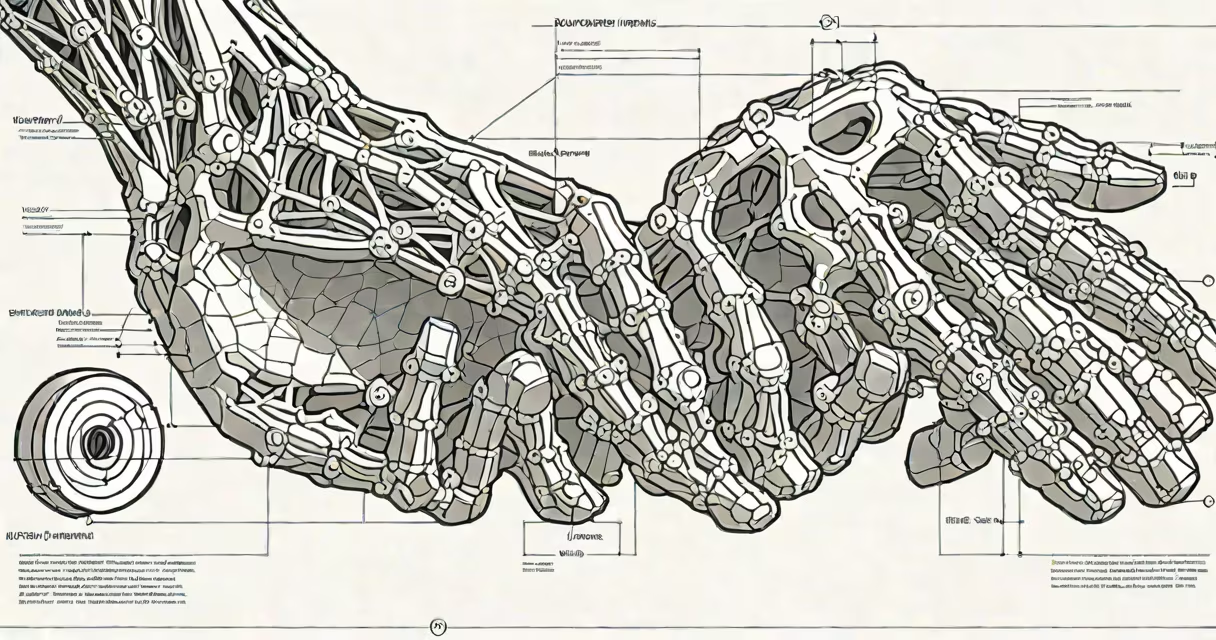
The part of the musculoskeletal system refers to the network of bones, muscles, tendons, ligaments, and joints that provide structural support, enable movement, and protect internal organs. This system allows humans to stand, walk, lift, and perform fine motor tasks through coordinated contractions and mechanical use.
Bones form the rigid structure of the body. They include the skull, spine, ribs, pelvis, arms, and legs. Each bone serves a specific function: the femur supports body weight during walking, while the vertebrae encase and protect the spinal cord. Bones also store minerals like calcium and produce blood cells in the marrow.
Voluntary muscles attached to bones generate motion. For example, the biceps brachii contracts to bend the elbow, pulling the forearm upward. Muscles work in antagonistic pairs-when one contracts, the opposing muscle relaxes. This coordination enables precise control over limb position and force application.
The musculoskeletal system operates through mechanical integration. Bones act as levers, muscles provide force via contraction, and tendons transmit that force to bones. Ligaments stabilize joints by connecting bone to bone, preventing excessive movement.
Consider the knee joint: the femur (thigh bone) meets the tibia (shin bone), stabilized by the anterior cruciate ligament (ACL). When you squat, the quadriceps contract to extend the leg, while the hamstrings relax. Tendons anchor the quadriceps to the patella and then to the tibia, transferring energy across the joint.
A study published in *The Journal of Orthopaedic Research* found that 60% of sports injuries involve soft tissue-tendons and ligaments-due to repetitive strain or sudden impact. This highlights that even though bones appear more visible, connective tissues are critical for stability and injury prevention.
Each component plays a distinct role in maintaining function and integrity:
| Structure | Primary Function | Example |
|---|---|---|
| Bones | Support, protection, mineral storage | Skull protects the brain |
| Skeletal muscles | Movement via contraction | Deltoid raises the arm laterally |
| Tendons | Attach muscle to bone | Achilles tendon connects calf to heel |
| Ligaments | Stabilize joints | Medial collateral ligament resists sideways knee stress |
| Joints | Allow controlled motion | Ball-and-socket hip joint enables rotation |
Some joints allow limited motion-like the hinge joint in the elbow-or extensive motion, such as the shoulder's ball-and-socket design. Joint types are classified by movement range: synovial joints (freely movable), cartilaginous joints (slightly movable), and fibrous joints (immovable).
Many assume the musculoskeletal system is only about bones and muscles. But connective tissues-tendons and ligaments-are often overlooked despite their high failure rate. A 2022 report from the American Academy of Orthopaedic Surgeons noted that tendon injuries account for nearly 40% of overuse injuries in athletes, especially in the rotator cuff and Achilles region.
Another misconception is that the system functions independently. In reality, it integrates with the nervous system. Motor neurons signal muscle fibers to contract, and sensory feedback from joints informs the brain about limb position-this is proprioception. Without neural input, movement becomes uncoordinated and inefficient.
For example, during a basketball jump shot, the quadriceps contract to extend the knee, the calf muscles push off the ground, and the shoulder rotates to release the ball. All actions rely on timing and feedback from the central nervous system. A delay in signal transmission-even 50 milliseconds-can reduce shooting accuracy by up to 18%, according to research in *Neuroscience Letters*.
I once observed a patient recovering from a torn ACL during physical therapy. The injury disrupted the stabilizing ligament in the knee. Even after surgery, the patient struggled with balance because the brain had lost accurate signals from the joint. Over six weeks of targeted exercises, the neuromuscular system relearned coordination. By week eight, they could jog without limping-a clear demonstration of how integrated the musculoskeletal system is with neurological control.
This recovery process underscores that rehabilitation isn't just about strengthening muscles. It requires retraining the entire system, including sensory receptors in the joint capsule and reflex pathways in the spinal cord.
Similarly, the heart pumps blood but doesn't move limbs. Its role lies in the circulatory system. Confusing organ systems leads to misdiagnosis and ineffective treatment plans. Accurate classification ensures proper medical evaluation and intervention.
Understanding the part of the musculoskeletal system helps clarify how daily activities-from lifting groceries to typing-rely on a complex interplay of structures. Each element, from the smallest tendon fiber to the largest bone, contributes to stability, mobility, and resilience.
When assessing pain or dysfunction, clinicians evaluate the entire system. A limp may stem from a hip problem, a knee injury, or even a nerve issue in the lower back. Identifying the root cause requires distinguishing between muscle strain, joint degeneration, and neurological disruption.