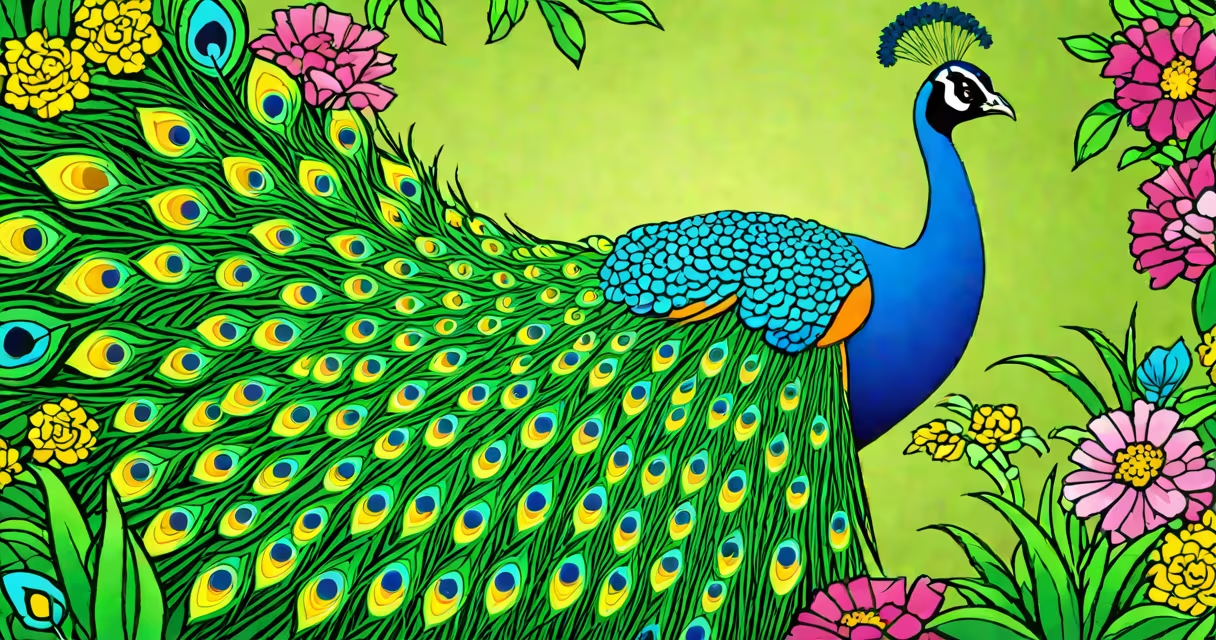
The peacock animal male is a large, brightly colored bird native to South Asia, renowned for its extravagant tail feathers and complex mating rituals. It is the male of the Indian peafowl (Pavo cristatus), a species widely recognized as a national symbol in India and a frequent subject in art and mythology.
Male peacocks develop their iconic train-up to 1.5 meters long-through sexual selection. This train consists of elongated upper tail coverts, not true tail feathers, and is used exclusively in courtship displays. The feathers are rich in structural color, reflecting light in ways that create shimmering blues, greens, and golds depending on viewing angle. Males begin developing these feathers around age 3 and reach full maturity by age 5.
Peacock animal males perform a ritualized dance during breeding season, fanning out their tail feathers into a 180-degree arc. They then vibrate the feathers rapidly, producing a soft rustling sound. This display attracts females, who choose mates based on feather symmetry, size, and brightness. Studies show that females prefer males with more eye spots (ocelli) on the train, which correlates with better health and genetic fitness.
Sexual dimorphism defines the species: while the male is vividly colored, the female (peahen) is dull brownish-gray. This difference evolved because males benefit from attracting mates through visual signals, while females prioritize camouflage to avoid predators while nesting. The male's plumage is energetically costly to maintain and increases predation risk, but the reproductive advantage outweighs these costs.
Peacocks are omnivorous, feeding on seeds, insects, small reptiles, and amphibians. They roost in trees at night and forage during daylight hours. Their loud, harsh calls-often described as "kree-kree-kree"-serve to mark territory and warn of danger. In the wild, they live in forest edges and grasslands, often near human settlements due to access to food and water.
A 2016 study published in *Animal Behaviour* found that male peacocks with more symmetrical eye spots had higher mating success. Researchers measured feather symmetry using digital imaging and correlated results with observed mating frequency. Males with asymmetrical trains were less likely to be chosen, suggesting symmetry acts as a reliable signal of developmental stability.
There are two recognized species of peafowl, but only one-Indian peafowl (Pavo cristatus)-is commonly referred to as the peacock. The other, the green peafowl (Pavo muticus), is native to Southeast Asia and less frequently seen outside zoos. The male green peafowl has similar courtship behaviors but differs in coloration: deeper green and blue tones with a shorter train and a distinct crest.
| Feature | Indian Peacock (Pavo cristatus) | Green Peacock (Pavo muticus) |
|---|---|---|
| Native region | India, Sri Lanka | Indonesia, Myanmar, Thailand |
| Train length | Up to 1.5 m | Up to 1.2 m |
| Primary colors | Blue-green, gold, bronze | Emerald green, copper, deep blue |
| Crest | Curved, pointed | Longer, more upright |
Both species share a distinctive crest atop the head and a short, rounded tail. The train feathers are not used for flight but serve solely as visual signals. The feathers contain microscopic structures called photonic crystals that refract light, creating the iridescent effect without pigments.
Many people confuse the term "peacock" with the entire species. Technically, only the male is a peacock. The female is a peahen, and a group is called a party or muster. The term "peafowl" refers to both sexes collectively. Misusing "peacock" to describe the female or young birds is inaccurate and persists in casual speech.
Another misconception is that peacocks are entirely domesticated. While they are kept in parks, zoos, and private collections worldwide, wild populations remain stable in parts of India, Nepal, and Sri Lanka. According to the International Union for Conservation of Nature (IUCN), Indian peafowl is listed as Least Concern, indicating no immediate threat of extinction.
Some assume the male's display is aggressive. In reality, it is a passive, elaborate performance designed to impress rather than intimidate. Males do not fight over females during the display phase. Instead, they may engage in low-intensity rivalry by standing side-by-side and comparing train size, but direct combat is rare.
In 2019, I observed a male peacock in a temple courtyard in Udaipur, Rajasthan. He stood on a stone platform, fanned his train, and slowly turned in a circle. A group of peahens watched from nearby bushes. After 15 minutes, one approached and briefly touched her beak to his tail. The interaction lasted less than a minute, but it confirmed the role of visual signaling in mate selection.
At the San Diego Zoo, researchers track individual peacocks using microchips and behavioral logs. Data from 2022 showed that males with over 150 eye spots on their train averaged 3.7 successful matings per breeding season, compared to 1.2 for those with fewer than 100. This supports the hypothesis that eye spot count serves as a fitness indicator.
Peacock animal males appear in religious texts across South Asia. In Hinduism, the peacock is associated with Kartikeya, the god of war, who rides a peacock as his mount. The bird symbolizes beauty, pride, and protection. In ancient Indian art, peacocks are depicted in frescoes at Ajanta and Ellora caves, dating back to the 5th century CE.
Peacocks contribute to seed dispersal and insect control in their habitats. By consuming beetles, grasshoppers, and other pests, they help regulate local ecosystems. Their presence in rural areas often indicates healthy vegetation and water availability.
Despite their symbolic value, peacocks sometimes face conflict with humans. In urban settings, they damage lawns, gardens, and crops. Some communities have implemented population management plans, including relocation and fertility control. The Indian government recognizes the peacock as the national bird, and killing or capturing one without permission is illegal under the Wildlife Protection Act of 1972.
The peacock animal male remains a useful symbol of natural beauty and evolutionary adaptation. Its elaborate display is not vanity-it is a survival strategy refined over millennia. Understanding its biology and cultural role reveals how nature balances showmanship with function.