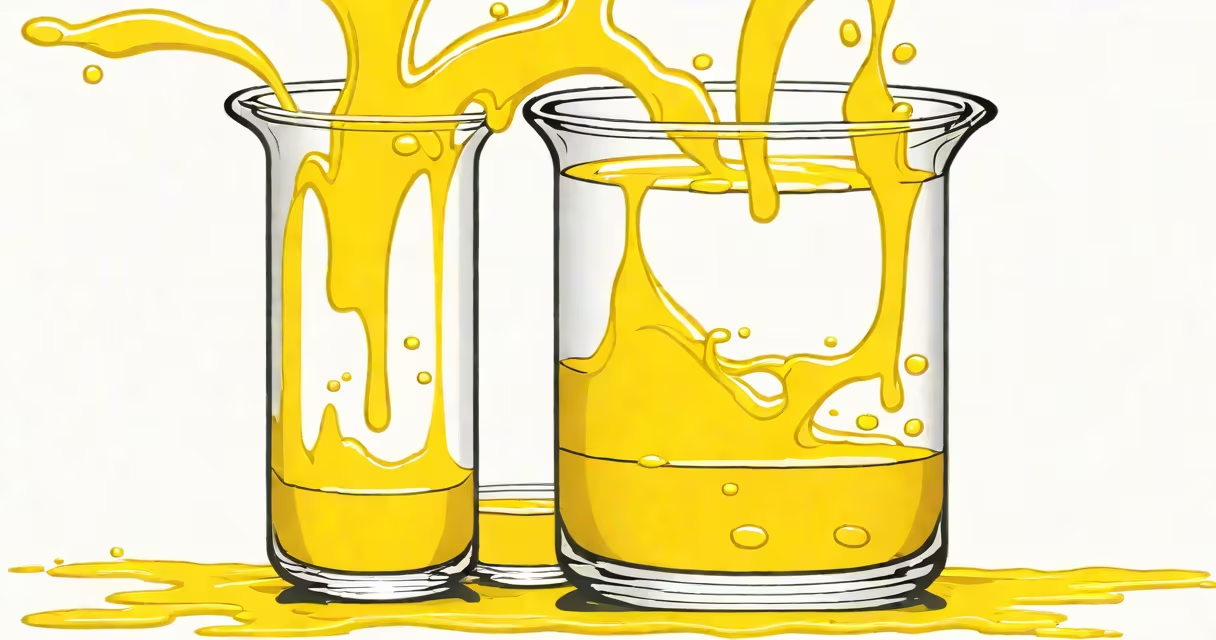
The reaction of lead nitrate with potassium iodide is a double displacement reaction that produces a bright yellow precipitate of lead iodide and aqueous potassium nitrate. This transformation occurs when solutions of lead nitrate and potassium iodide are mixed, resulting in a visible color change and solid formation.
This reaction is frequently used in high school and introductory college chemistry courses to demonstrate precipitation reactions. The visual outcome-a sudden formation of a dense yellow solid-makes it ideal for teaching solubility rules and ion exchange processes. The reaction proceeds rapidly at room temperature and requires no external energy input.
When lead nitrate (Pb(NO₃)₂) and potassium iodide (KI) dissolve in water, they dissociate into their respective ions: Pb²⁺, NO₃⁻, K⁺, and I⁻. The Pb²⁺ and I⁻ ions combine to form insoluble lead iodide (PbI₂), which precipitates out of solution. The remaining K⁺ and NO₃⁻ ions remain in solution as spectator ions.
Each reactant dissociates completely in aqueous solution. Lead nitrate yields Pb²⁺ and two NO₃⁻ ions per molecule. Potassium iodide yields K⁺ and I⁻ ions. When the solutions mix, the Pb²⁺ and I⁻ ions encounter each other and form PbI₂, which has very low solubility in water (solubility product Ksp ≈ 7.9 × 10⁻⁹).
Because PbI₂ is insoluble, it forms a visible solid. The reaction equation is:
Pb(NO₃)₂(aq) + 2KI(aq) → PbI₂(s) + 2KNO₃(aq)The net ionic equation highlights the actual chemical change:
Pb²⁺(aq) + 2I⁻(aq) → PbI₂(s)This net ionic form removes spectator ions (K⁺ and NO₃⁻), focusing only on the species involved in the precipitate formation.
The reaction is classified as a precipitation reaction, a subset of double displacement reactions. These occur when two ionic compounds exchange partners, and one product is insoluble. The outcome depends on the solubility of the products, governed by solubility rules.
| Reactant | Formula | Solubility in Water | Ion Composition |
|---|---|---|---|
| Lead nitrate | Pb(NO₃)₂ | Highly soluble | Pb²⁺, NO₃⁻ |
| Potassium iodide | KI | Highly soluble | K⁺, I⁻ |
| Lead iodide | PbI₂ | Insoluble | Pb²⁺, I⁻ |
| Potassium nitrate | KNO₃ | Highly soluble | K⁺, NO₃⁻ |
Only lead iodide forms a precipitate. All other compounds remain dissolved. This selectivity arises from lattice energy and hydration energy balance-the energy required to break apart the solid crystal is greater than the energy released when ions are surrounded by water molecules.
Many assume the yellow color comes from lead metal or elemental iodine. This is incorrect. The color originates from the crystalline structure of PbI₂, which absorbs blue light and reflects yellow-orange wavelengths. The compound is stable under normal conditions and does not decompose into elements upon formation.
A frequent error is claiming the reaction is redox. It is not. Oxidation states remain unchanged: Pb²⁺ stays Pb²⁺, I⁻ remains I⁻. No electron transfer occurs. The reaction is purely ionic rearrangement.
Another misconception is that the precipitate dissolves in excess potassium iodide due to complex formation. While PbI₂ does show slight solubility in concentrated I⁻ solutions due to [PbI₄]²⁻ complex formation, this effect is minimal at typical lab concentrations and not observable in standard classroom demonstrations.
This reaction is a staple in science education because it combines clear visual feedback with fundamental chemical principles. It teaches students to predict outcomes using solubility rules, balance equations, and interpret net ionic forms.
In a controlled experiment, mixing 10 mL of 0.1 M Pb(NO₃)₂ with 10 mL of 0.1 M KI produces approximately 0.2 grams of PbI₂ precipitate. The yield is close to theoretical, confirming stoichiometric expectations. The precipitate settles within seconds and can be collected via vacuum filtration.
I once observed this reaction during a teacher training workshop. A participant questioned why the precipitate didn't form instantly. The explanation was that nucleation-initial cluster formation-requires time. Once nuclei form, growth accelerates rapidly. This delay, though brief, illustrates kinetic aspects behind thermodynamically favored reactions.
Beyond the classroom, lead iodide has niche uses in photovoltaic research. Its semiconducting properties make it useful in perovskite solar cells, where it contributes to light absorption. However, these applications require highly purified materials and controlled environments, far beyond standard lab setups.
Handling lead nitrate and lead iodide demands caution. Both contain lead, a neurotoxin. Lead nitrate is corrosive and can cause skin irritation. Lead iodide is toxic if ingested or inhaled. Proper disposal through hazardous waste protocols is mandatory. Never pour the mixture down the drain.
For safe handling, wear gloves, goggles, and lab coats. Wash hands thoroughly after use. If spills occur, use absorbent pads and dispose of contaminated materials as heavy metal waste. Always follow institutional safety guidelines.
Understanding the symbol for potassium nitrate-KNO₃-is essential when balancing this reaction. The formula indicates one potassium ion (K⁺) and one nitrate ion (NO₃⁻) per formula unit. This knowledge ensures accurate stoichiometry and prevents errors in predicting product amounts.
The reaction of lead nitrate with potassium iodide exemplifies how simple mixtures can produce dramatic changes. It remains a trusted tool for teaching core concepts in chemistry, combining visual impact with scientific rigor.
When conducting this experiment, always verify reagent purity and concentration. Impurities can alter results. For example, trace chloride ions may form a small amount of PbCl₂, which appears as a white precipitate and can confuse students unfamiliar with solubility differences.
For further details on identifying and using potassium nitrate in chemical systems, reviewing the chemical notation and behavior of potassium nitrate supports deeper understanding of reaction components.