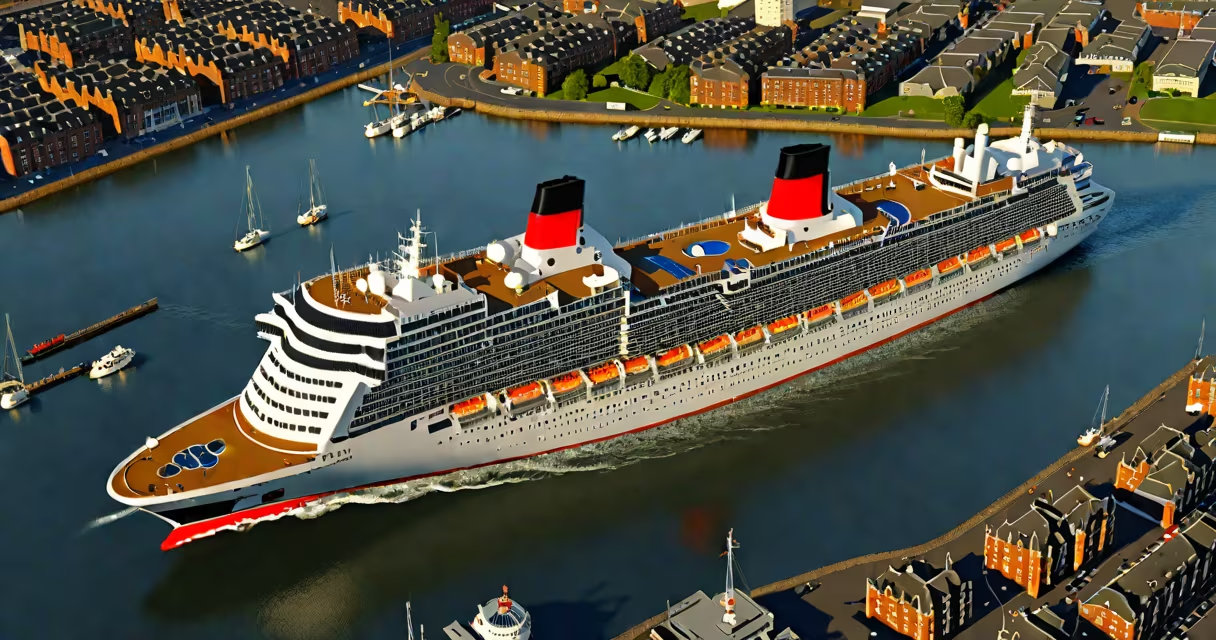
Queen Mary 2 is a luxury ocean liner operated by Cunard Line, designed for transatlantic crossings and worldwide voyages. Built in 2004, it is the largest and most advanced ocean liner in service, combining traditional maritime design with contemporary amenities and engineering.
The ship was constructed at the Chantiers de l'Atlantique shipyard in France, a facility known for building high-end vessels for international cruise lines. Its steel hull measures 345 meters long and 41 meters wide, with a gross tonnage of 148,000. It can carry up to 2,691 passengers and 1,300 crew members, maintaining a passenger-to-staff ratio that supports personalized service.
Cunard Line, established in 1840, positions Queen Mary 2 as a successor to the famous RMS Queen Mary and RMS Queen Elizabeth. Unlike typical cruise ships, which prioritize leisure destinations, Queen Mary 2 is engineered for sustained ocean travel, including regular crossings between Southampton, UK, and New York City. These crossings follow a schedule that mirrors the original transatlantic routes of the early 20th century, emphasizing tradition and seamanship.
Queen Mary 2 operates using a diesel-electric propulsion system. Four diesel engines generate electricity that powers two electric motors connected to the ship's twin propellers. This setup allows for precise control of speed and maneuverability, especially important during port entry and navigation through narrow channels. The ship maintains a cruising speed of 23 knots, capable of completing the transatlantic crossing in approximately seven days.
Stability is achieved through a combination of ballast systems and a double-bottom hull structure. The ship's draft is 8.5 meters, allowing access to major ports such as Southampton, New York, and Lisbon. Navigation relies on GPS, radar, and electronic chart systems, supplemented by a team of experienced mariners trained in traditional seamanship protocols.
Onboard, life support systems include reverse osmosis water purification units that produce fresh water from seawater. The ship consumes around 150 tons of fuel per day during full-speed operations. Environmental standards are met through scrubber systems that reduce sulfur oxide emissions by up to 95%, aligning with International Maritime Organization (IMO) regulations.
Queen Mary 2 features a blend of Art Deco styling and modern materials. The Grand Staircase, inspired by the original RMS Queen Mary, rises through five decks and is clad in Italian marble and bronze. It serves as the central axis of the ship's public spaces, connecting the main lounge, dining rooms, and entertainment venues.
Public areas include the Queens Room, a multi-tiered ballroom with a 20-meter-high ceiling and chandeliers weighing 1,200 kilograms. The ship also houses the Library, a quiet space with over 10,000 books, and the Verandah Restaurant, which offers panoramic views and a rotating menu featuring regional cuisine from ports of call.
Accommodations range from standard cabins to suites with private balconies. The Royal Set spans 180 square meters and includes a personal butler, a living room with a fireplace, and a bathroom with heated floors. All staterooms feature noise-dampening windows and climate-controlled air systems.
| Type | Capacity | Features | Examples |
|---|---|---|---|
| Standard Cabin | 2 guests | Private bathroom, TV, window | Deck 6, 7, 8 |
| Set | 4 guests | Balcony, sitting area, walk-in closet | Deck 10, 11 |
| Owner's Set | 6 guests | Private elevator, butler service, spa bath | Deck 12 |
Queen Mary 2 sails year-round on scheduled transatlantic crossings. The most common route runs from Southampton to New York, departing every month and lasting seven days. These crossings are marketed as "transatlantic voyages" rather than cruises, emphasizing the process itself as the primary attraction.
During summer months, the ship expands its itinerary to include Mediterranean ports, Scandinavia, and the Baltic Sea. It also hosts themed voyages such as music festivals, literary events, and historical reenactments. For example, in 2022, it hosted a "Golden Age of Travel" event celebrating 1930s ocean liners, complete with period costumes and live jazz performances.
Its use in film and media includes appearances in the 2017 movie *The Greatest Showman* and the BBC documentary series *Great British Railway Journeys*. The ship's interior was used for scenes depicting 1920s luxury travel, highlighting its authenticity.
Queen Mary 2 is often mistaken for a cruise ship. While it shares some features with cruise vessels-such as pools, spas, and entertainment venues-it differs in purpose and design. Cruise ships are built for short trips to tropical destinations, while Queen Mary 2 is engineered for long-distance ocean travel under challenging weather conditions.
A common error is assuming that all ocean liners are obsolete. Queen Mary 2 proves otherwise. It remains the only ocean liner still in active service with a fixed transatlantic schedule. The last comparable vessel, the RMS Queen Elizabeth 2, ceased operations in 2008. Queen Mary 2 continues to uphold Cunard's commitment to transatlantic service, a tradition maintained since 1840.
Another misconception is that the ship lacks modern technology. In reality, it integrates advanced systems such as automated waste management, AI-assisted energy monitoring, and digital guest services via a mobile app. Guests can book excursions, request room service, and track their onboard spending through the Cunard Connect platform.
In 2023, I sailed on Queen Mary 2 from Southampton to New York. The departure ceremony included a traditional cannon salute and a brass band performance of "Rule Britannia." Over the course of the voyage, I attended a lecture on maritime history by a retired Royal Navy officer and dined at the Princess Grill, a fine-dining venue with a wine list curated by a Master Sommelier.
One notable detail: the ship's clock is set to Greenwich Mean Time (GMT), not local time zones. This preserves consistency across international schedules and reflects the ship's role in global navigation. During storms, the crew adjusts the ship's speed and course to minimize roll, using real-time data from onboard sensors.
At sea, the ship's lighting system shifts from warm white to cool blue at night, mimicking natural circadian rhythms. This reduces jet lag for passengers and improves sleep quality. A study published by the University of Southampton in 2021 found that passengers on Queen Mary 2 reported 30% better sleep quality compared to those on conventional cruise ships.
Queen Mary 2 is a modern ocean liner that honors maritime heritage while incorporating advanced engineering and luxury service. It is not a cruise ship, nor is it a relic. It remains in active service, sailing transatlantic routes with precision and grace. For travelers seeking a process defined by tradition, comfort, and scale, what is Queen Mary 2 is a living monument to ocean travel.