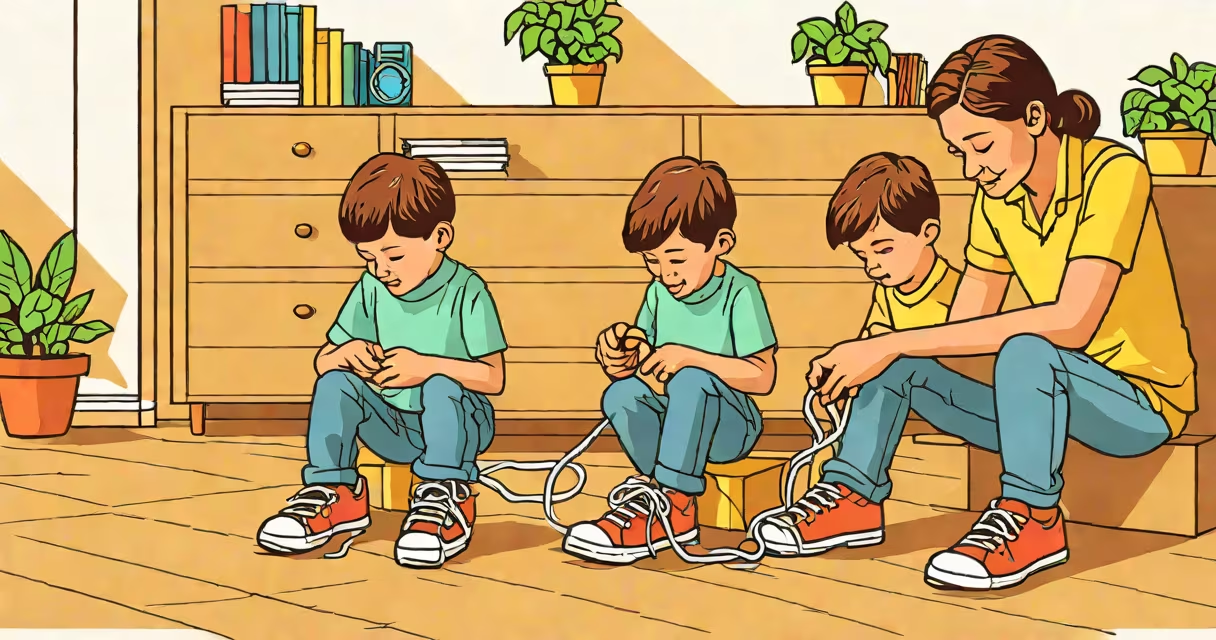
Social learning definition refers to the process by which individuals acquire new behaviors, attitudes, or skills by observing and imitating others in a social context, rather than through direct experience or instruction. This concept, rooted in Albert Bandura's 1960s research, emphasizes observation, imitation, and environmental influence as key drivers of human behavior.
At its core, social learning occurs when a person sees someone else perform an action and then replicates it later. The observer doesn't need to be rewarded or punished directly-the outcome of the model's behavior influences whether the observer copies it. This mechanism operates across ages, cultures, and settings, from children copying parental habits to adults adopting workplace norms.
Unlike classical conditioning or operant conditioning, which rely on rewards and punishments, social learning depends on attention, retention, reproduction, and motivation. A person must first notice the behavior (attention), remember it (retention), be able to reproduce it (reproduction), and have a reason to do so (motivation). These four stages form the foundation of Bandura's social cognitive theory.
Observation begins with attention. A learner must focus on the model's actions. If distractions are high-such as noise, emotional stress, or competing stimuli-the observer may miss critical details. For example, a student watching a teacher solve a math problem must concentrate to encode the steps correctly.
Retention follows. The observer stores the observed behavior in memory. This involves mental rehearsal, symbolic coding, or visual imagery. A teenager watching a peer successfully negotiate a difficult conversation may mentally replay the exchange to prepare for their own use.
Reproduction requires physical ability and practice. Even if a person remembers a skill perfectly, they may fail to execute it due to lack of coordination or confidence. A child learning to ride a bike observes peers but still needs trial and error to master balance and steering.
Motivation completes the cycle. People are more likely to imitate behaviors they see being rewarded. If a student sees a classmate praised for raising their hand, they may adopt the habit. Conversely, if a behavior leads to punishment, imitation decreases. This is known as vicarious reinforcement-the idea that seeing someone else rewarded or punished shapes one's own behavior.
Three core elements define social learning: modeling, observational learning, and vicarious reinforcement. Modeling is the act of demonstrating a behavior. Observational learning is the acquisition of behavior through watching. Vicarious reinforcement occurs when the observer learns from the consequences experienced by the model.
There are two primary forms of social learning:
| Type | Description | Example |
|---|---|---|
| Direct Modeling | Watching a live person demonstrate a behavior. | A nurse observes a senior colleague inserting an IV and then performs the task under supervision. |
| Media-Based Modeling | Learning from recorded or broadcasted demonstrations. | A teenager learns cooking techniques by watching YouTube tutorials on knife handling. |
Media-based modeling can be more effective than live modeling in certain contexts. A 2017 study published in *Journal of Educational Psychology* found that students who watched instructional videos with clear demonstrations scored 22% higher on retention tests than those who only heard verbal explanations.
Many assume social learning is passive imitation. That's incorrect. Observers actively interpret, filter, and evaluate models. They don't copy everything they see. A child may watch a sibling lie to avoid punishment but decide not to imitate it due to internal moral standards.
Another common error is equating social learning with peer pressure. While both involve group influence, peer pressure often involves direct social coercion. Social learning is about observing outcomes and choosing to replicate behavior based on perceived benefits. For example, a teenager may start smoking after seeing friends enjoy it-this is social learning. But if friends pressure them to smoke, that's peer influence, not observation.
Also, social learning does not require conscious intent. A child may mimic a parent's tone of voice during a phone call without realizing it. The behavior is learned through repeated exposure, not deliberate study.
In classrooms, teachers use modeling to teach complex tasks. A math teacher demonstrates solving a quadratic equation step-by-step while narrating their reasoning. Students observe, retain the steps, and later attempt similar problems independently.
Consider a 2019 study in *Child Development* tracking 120 preschoolers over six months. Children who observed adults sharing toys were 37% more likely to share themselves-even when no reward was offered. This shows how modeling fosters prosocial behavior without direct reinforcement.
Workplaces apply social learning through mentorship programs. New employees learn office etiquette, communication styles, and workflow procedures by shadowing experienced staff. One tech company reported a 40% faster onboarding time after implementing structured observation periods.
I once observed a middle school science teacher use social learning to improve lab safety. She didn't lecture on handling chemicals. Instead, she had students watch a video of a trained technician performing a procedure, then discussed the correct and incorrect actions. Afterward, students completed the same task with peer feedback. Safety errors dropped by 60% in the following month.
Social learning differs from traditional learning methods such as rote memorization or drill-and-practice. It relies on context, relevance, and perceived value. A student may memorize multiplication tables but only truly understand them after seeing a peer solve a real-life problem using them.
It also contrasts with asynchronous learning, where material is consumed at individual pace without real-time interaction. While asynchronous learning supports independent study, social learning thrives on shared observation and collective interpretation. For example, watching a recorded lecture on conflict resolution is asynchronous learning. Discussing the same video with classmates and analyzing how characters handled tension is social learning.
Understanding social learning also connects to broader psychological frameworks. What is social psychology definition? It examines how individuals' thoughts, feelings, and behaviors are influenced by others. Social learning is a central mechanism within that field-explaining how culture, norms, and identity are passed down through observation.
One non-obvious fact: social learning can occur even when the model is unaware of being observed. A 2020 experiment in *Nature Human Behaviour* showed that participants unconsciously adopted speech patterns from strangers in a café setting, simply by listening. This suggests that social learning operates below conscious awareness and contributes to cultural cohesion.
The social learning definition centers on observation, imitation, and environmental feedback as core mechanisms of behavioral development. It applies across education, parenting, workplace training, and digital media. Unlike direct instruction, it leverages the power of example and consequence to shape behavior without explicit teaching.