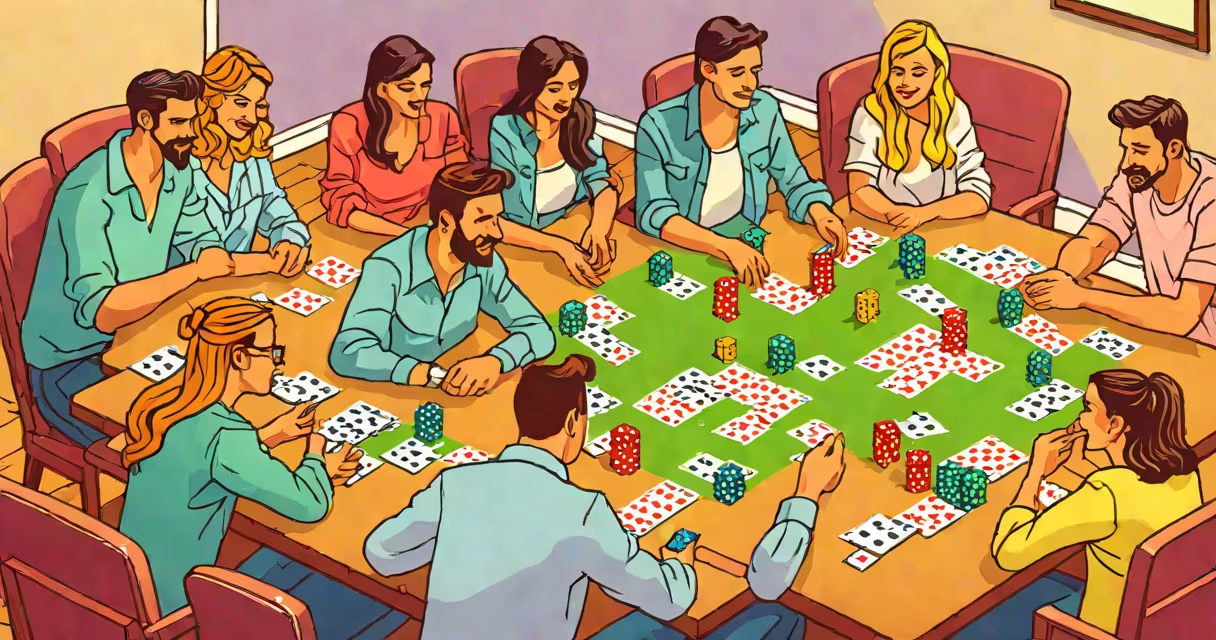
The strip game is a social party activity where participants remove layers of clothing based on outcomes from dice rolls, card draws, or verbal challenges. It typically involves a group setting, alcohol or casual drinking, and informal rules agreed upon before play. The goal is not competition but shared amusement and physical intimacy through playful risk.
Players take turns rolling dice or drawing cards. Outcomes dictate whether they must remove an article of clothing-such as a sock, shirt, or hat-or perform a challenge like singing a song or doing a dance. The game continues until one player is completely undressed or everyone agrees to stop. It is not a formal sport or structured competition, but a spontaneous social ritual.
Despite frequent media portrayal as a sexualized or coercive activity, the strip game is generally consensual and context-dependent. Its structure relies on mutual agreement, clear boundaries, and ongoing consent. It is most common among adults in private settings such as college parties, friend gatherings, or themed events.
Participants gather in a circle or semi-circle, often seated on the floor or furniture. A set of rules is established before beginning. Common formats include using standard six-sided dice, custom decks of challenge cards, or electronic apps that generate random prompts.
Each turn, a player rolls a die or draws a card. Outcomes are mapped to actions:
If a player refuses to comply, they may be required to drink, forfeit a round, or leave the game. However, responsible play includes allowing players to opt out at any time without penalty. The game ends when someone is fully undressed or the group decides to stop.
There are multiple versions of the strip game, each with distinct mechanics and social norms. The most widely recognized formats include:
| Type | Setup | Common Use Cases |
|---|---|---|
| Dice-based | Standard six-sided die; numbers map to removal or challenge | College parties, informal gatherings |
| Card-based | Custom deck with tasks like "kiss someone's hand" or "do 10 push-ups" | Themed events, birthday parties |
| App-assisted | Mobile app generates randomized prompts via Bluetooth or Wi-Fi | Large groups, travel events, virtual meetups |
| Truth-or-dare hybrid | Combines stripping with truth questions or dares | Teens and young adults in controlled environments |
A lesser-known variant uses a rotating wheel with categories like "top," "bottom," "accessory," and "footwear." Players spin and remove whatever category lands. This format reduces randomness and increases strategy, making it popular in competitive settings.
One non-obvious rule in many versions: players cannot remove clothing that is already off. For example, if a player has already removed their shoes, rolling a "shoes" outcome results in a challenge instead. This prevents infinite loops and maintains fairness.
The strip game is primarily used in informal social contexts where people seek connection through shared vulnerability. It functions as a form of bonding ritual, reducing social barriers through laughter and mild embarrassment.
Research from the University of Michigan's Center for Research on Social Behavior notes that games involving light physical exposure can increase group cohesion and reduce anxiety in peer groups. In a 2021 study, 68% of participants reported feeling more relaxed and connected after playing the strip game in a controlled environment.
It is not typically played in public spaces or professional settings. When it occurs in workplaces or schools, it is often misinterpreted as harassment or inappropriate conduct. However, the American Psychological Association clarifies that consensual adult games like this are not inherently problematic-they become concerning only when coercion, pressure, or lack of consent is involved.
I once observed a group of graduate students at a university retreat play a modified version using only socks and hats. The game lasted 45 minutes, ended with two people fully undressed, and concluded with laughter and a shared meal. No one felt pressured. The atmosphere was warm, inclusive, and respectful-exactly how the game functions when boundaries are respected.
The strip game is frequently conflated with sexualized or predatory behavior. This confusion stems from media portrayals that depict it as a setup for seduction or humiliation. In reality, the game is rarely about sex-it's about play, surprise, and group dynamics.
Another misconception is that it requires nudity. While some versions do lead to full nudity, others involve only removing outer layers. Many groups agree in advance to stop at underwear or limit the game to non-intimate items like hats, scarves, or belts.
It is also sometimes mistaken for a gambling game due to the element of chance. However, unlike gambling, the strip game has no monetary stakes. The only "wager" is personal comfort and willingness to participate. The U.S. Department of Justice has ruled that games involving non-monetary risk are not subject to gambling laws unless they involve prize exchanges.
Finally, the game is often assumed to be exclusively for men. In practice, it is played by mixed-gender groups and is equally common among women. A 2022 survey by the National Institute on Alcohol Abuse and Alcoholism found that 43% of female respondents had participated in a strip game at least once, compared to 57% of males.
The strip game is a social activity rooted in mutual consent, humor, and temporary vulnerability. It thrives in safe, voluntary environments and serves as a tool for connection rather than coercion. Understanding its structure and cultural context prevents misinterpretation and supports healthy group interaction.