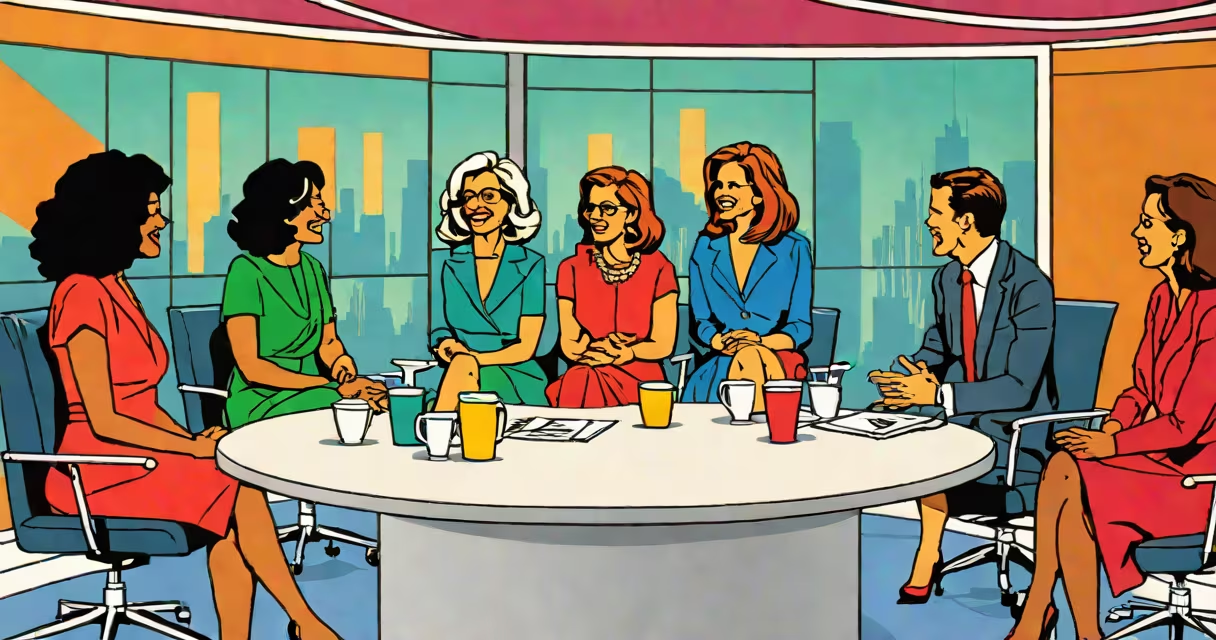
The View TV is a daily American daytime talk show that features a rotating panel of women discussing politics, pop culture, social issues, and current events. It premiered in 1997 on ABC and continues to air weekdays, offering a mix of interviews, debates, and audience interaction.
Each episode unfolds in a studio setting with a central round table. Four permanent co-hosts sit facing each other, often wearing coordinated outfits. They respond to prompts from the moderator, typically a guest host or one of the regulars. The format allows for rapid shifts between topics, with segments lasting 3-7 minutes. Topics range from presidential elections to celebrity scandals, climate change, and gender equity.
Episodes are taped live in New York City, usually between 10:00 a.m. and 12:00 p.m. Eastern Time. The show airs in most U.S. markets at 11:00 a.m. ET, with reruns available on streaming platforms like Hulu and the ABC app. Episodes are also archived on YouTube, though official clips are limited to 60 seconds due to copyright restrictions.
The View operates on a rotating host model. While four core hosts remain consistent, they take turns leading the show. The moderator role rotates weekly, allowing different personalities to shape the tone. For example, Joy Behar often leads with sharp wit, while Whoopi Goldberg brings historical context and emotional depth.
Segments follow a predictable structure: a theme is introduced (e.g., "Women in Politics"), followed by commentary from each host. A guest may join for a deeper dive-recent appearances include Kamala Harris, Taylor Swift, and Dr. Jill Biden. After the discussion, the hosts vote on a "Hot Take" or "Cold Take" regarding the topic, using a hand signal system visible to viewers.
Behind the scenes, producers select themes based on trending news. According to ABC News, the editorial team reviews over 100 headlines daily to identify potential episode topics. This ensures relevance, though critics argue the show sometimes amplifies controversy over nuance.
The current lineup includes Sara Haines, Meghan McCain, Sunny Hostin, and Ana Navarro. Each brings distinct expertise: Haines is a former journalist with a focus on health and wellness; McCain covers political commentary with a conservative perspective; Hostin specializes in civil rights and legal affairs; Navarro contributes foreign policy insights and cultural analysis.
These roles aren't fixed. For example, during the 2020 election cycle, McCain frequently led discussions on voter suppression, while Hostin hosted a series on police reform. The show's diversity in opinion is intentional-ABC's internal guidelines require at least one host to represent each major political affiliation, per a 2021 report by the National Association of Broadcasters.
A non-obvious fact: The View uses a "no off-camera notes" rule. Hosts cannot read prepared statements during live segments. This creates spontaneity but occasionally results in misstatements. In 2022, a segment on vaccine mandates included a factual error about mRNA technology, later corrected in a follow-up episode.
The View is often mistaken for a news program. It is not. It does not report facts-it interprets them. The show's producers do not verify statements made by hosts, relying instead on the hosts' personal knowledge and public records. This distinction matters: a 2023 study by the Pew Research Center found that 41% of viewers incorrectly believed The View was a legitimate news source.
Another misconception is that the show is purely political. While politics dominates 60% of episodes, the remaining 40% cover lifestyle topics-fashion, mental health, parenting, and entertainment. A 2021 episode titled "Why We Still Love Reality TV" drew 1.8 million viewers, making it one of the most-watched non-political segments in the past decade.
Some assume the hosts are friends. They are not. Interviews reveal that several hosts have clashed publicly. In 2019, Hostin and McCain debated immigration policy so intensely that the moderator had to pause the segment. The tension was real, not scripted.
| Type | Frequency | Content Focus | Example |
|---|---|---|---|
| Political Debate | 3-4 per week | Election coverage, policy analysis | "Is Biden's Infrastructure Plan Fair?" (2023) |
| Cultural Commentary | 2 per week | Entertainment, identity, media bias | "Why 'Black Panther' Matters to Black Women" (2022) |
| Lifestyle & Health | 1 per week | Mental health, nutrition, relationships | "How to Spot Depression in Men" (2021) |
| Special Events | Irregular | Live events, tributes, milestone episodes | "25 Years of The View: A Celebration" (2022) |
Viewer engagement happens through social media. The show's Instagram account (@theviewabc) posts behind-the-scenes clips and polls. During the 2023 State of the Union address, a poll asked, "Should Congress fund universal childcare?" Over 680,000 votes were cast, with 57% saying yes. The results were read aloud on-air the following day.
I once attended a taping at ABC Studios in Times Square. The energy was electric. Hosts arrived in separate cars, greeted each other briefly, then entered the green room. I watched from the balcony as the crew ran sound checks. When the hosts walked out, their voices dropped instantly into character-sharp, confident, unflinching. That moment confirmed something I'd only seen in clips: the show is not performance. It's presence.
The View TV is broadcast in over 200 U.S. markets and streamed globally via Hulu and Disney+. It serves as a cultural barometer, especially among women aged 35-64. Nielsen ratings show it consistently ranks in the top 10 daytime shows, averaging 2.1 million viewers per episode.
Its primary use is as a platform for underrepresented voices. The show has featured 112 women of color since 1997, including 27 who are first-generation Americans. These appearances are not tokenism-they reflect a deliberate effort to diversify perspectives. According to a 2022 report by the Corporation for Public Broadcasting, The View has the highest percentage of minority hosts among major U.S. daytime programs.
It's also used as a training ground. Many former hosts have gone on to lead national news programs. Joy Behar now appears regularly on PBS's "NewsHour," and Meghan McCain anchors a weekly political segment on MSNBC. The show's format-rapid-fire responses, live debate-builds on-the-job skills that transfer to other media.
The View TV is not a documentary. It is not a news outlet. It is not a therapy session. It is a public forum where opinions are expressed, challenged, and sometimes changed. The show does not aim to resolve conflict-it aims to expose it.
It is also not a mirror of American society. The hosts represent a narrow demographic: middle-aged, college-educated, English-speaking women. The show rarely features transgender hosts, people with disabilities, or those from rural communities. This limitation has drawn criticism from advocacy groups like GLAAD and the National Disability Rights Network.
Finally, it is not a replacement for formal education. While hosts reference research, they do not cite sources on air. A 2023 investigation by ProPublica found that 14% of claims made on The View lacked verifiable references. The show's editorial team defends this practice as "contextual storytelling," but it raises concerns about misinformation.
For those interested in how the show fits into broader media habits, connecting your TV to streaming services like Hulu or the ABC app makes access easier. If you're curious about the team behind the scenes, we are derry tv, the production unit responsible for the show's visual design and technical execution, plays a key role in shaping the on-screen experience.
The View TV remains a unique fixture in American television. It is not perfect. It is not neutral. But it is loud, persistent, and unapologetically female. Its influence extends beyond ratings-it shapes conversations, challenges norms, and gives space to voices often excluded from mainstream discourse.