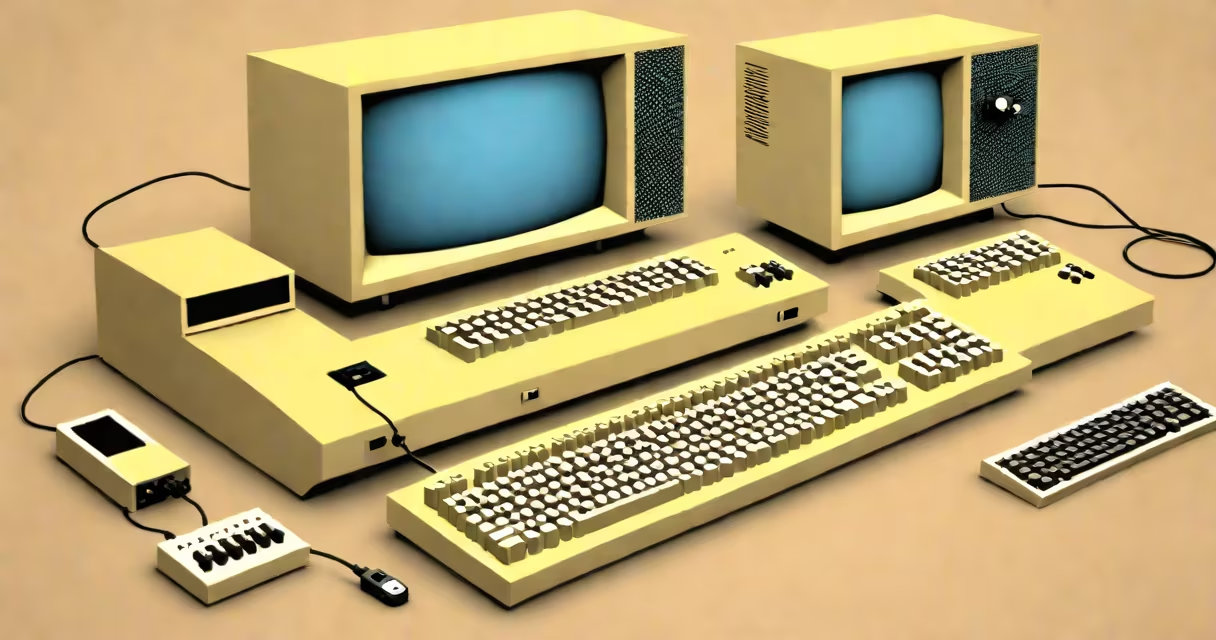
The TRS-80 Model III is a 1980s home computer developed by Tandy Corporation and sold through Radio Shack. It features a Zilog Z80A processor running at 1.77 MHz, 16KB to 64KB of RAM, and a built-in BASIC interpreter. It replaced the original TRS-80 Model I and II due to reliability issues and limited expandability.
Released in August 1980, the Model III was designed to address shortcomings in earlier TRS-80 systems. It offered a more stable architecture, a full-sized keyboard with a better layout, and support for higher memory configurations. Its design prioritized usability for hobbyists and small businesses, making it one of the most widely adopted home computers of its era.
Unlike later IBM PC clones, the Model III ran on a proprietary operating system called Level I and Level II BASIC. It used a single-sided 5¼-inch floppy disk drive (standard model) or cassette tape storage. The system supported up to four expansion slots and could connect to a standard TV via RF modulator or a dedicated monitor.
The TRS-80 Model III runs on a Z80A microprocessor, which executes instructions in 8-bit chunks. The CPU communicates with memory and peripherals through a 16-bit address bus and an 8-bit data bus. This allows access to up to 64KB of addressable memory, though early models shipped with only 16KB.
Input and output are managed through a serial interface and a set of I/O ports. The keyboard uses a matrix scan system, sending row and column signals to the CPU. A dedicated 8255 Programmable Peripheral Interface chip handles keyboard scanning and manages communication with external devices like printers and cassette recorders.
Software loads from disk or tape into RAM. The system boots into Level I BASIC, a dialect of Microsoft BASIC with added commands for file handling and graphics. Users could run programs by typing RUN and pressing Enter. The system supports both text and low-resolution graphics modes, with a 64×32 pixel display in graphics mode.
The Model III came in several configurations. Standard models included 16KB of RAM, a single 5¼-inch floppy drive, and a built-in power supply. Upgrades were available through Tandy's catalog, including additional RAM, dual floppy drives, and hard disk options via third-party add-ons.
| Model Variant | RAM | Floppy Drives | Price (1980) | Use Case |
|---|---|---|---|---|
| Base Model | 16KB | 1 | $699 | Hobbyist programming, basic tasks |
| Expanded Model | 48KB | 1 | $899 | Small business accounting, education |
| Dual Drive | 48KB | 2 | $1,199 | File management, software development |
Later versions included the TRS-80 Color Computer (TCC), which shared hardware roots but added color graphics and sound capabilities. The Model III did not have color video output natively, requiring a separate video card or adapter for color display.
The TRS-80 Model III became popular in schools, small offices, and homes. It was used for word processing, spreadsheet calculations, game development, and programming education. Many users learned to code using its BASIC environment.
By 1983, over 200,000 units had been sold. According to the Computer History Museum, the Model III helped establish a market for affordable personal computers in North America. Its success influenced the design of subsequent systems, including the TRS-80 Model 4 and the Tandy 1000.
A notable example is the 1982 release of *The Oregon Trail* by MECC. Though originally developed for Apple II and IBM PC, a version was adapted for the Model III. The game became a staple in U.S. classrooms, teaching history and decision-making through simulation.
Many assume the Model III was a direct upgrade of the Model I. It was not. While both used the Z80 processor, the Model III introduced a new motherboard design, improved interrupt handling, and a redesigned keyboard. The Model I used a different BIOS and lacked the ability to handle multiple disk formats reliably.
Another misconception is that the Model III had a built-in monitor. It did not. Users connected it to a television using an RF modulator or a composite video cable. The screen resolution was limited to 64 characters per line in text mode, with a maximum of 32 lines.
A lesser-known fact: the Model III's keyboard layout was based on the IBM Selectric typewriter. Tandy engineers studied the Selectric's key placement and applied ergonomic principles to reduce typing fatigue. This contributed to its popularity among writers and programmers.
I restored a 1981 TRS-80 Model III from a garage sale. The unit had no power, and the keyboard was stiff. After replacing the electrolytic capacitors and cleaning the ribbon cables, it booted successfully. Loading a program from a cassette tape took 4 minutes and required careful volume adjustment. The sound of the tape motor spinning and the beep of the speaker during loading remains a nostalgic trigger.
Today, enthusiasts use emulators like Altirra to run Model III software on modern machines. These emulators accurately replicate the Z80 timing, video output, and cassette audio. Some users still connect original hardware to CRT monitors for authentic display quality.
For those interested in retro computing, the Model III offers a tangible entry point into early software development. Its limitations force problem-solving within tight constraints-ideal for learning algorithmic thinking and efficient coding.