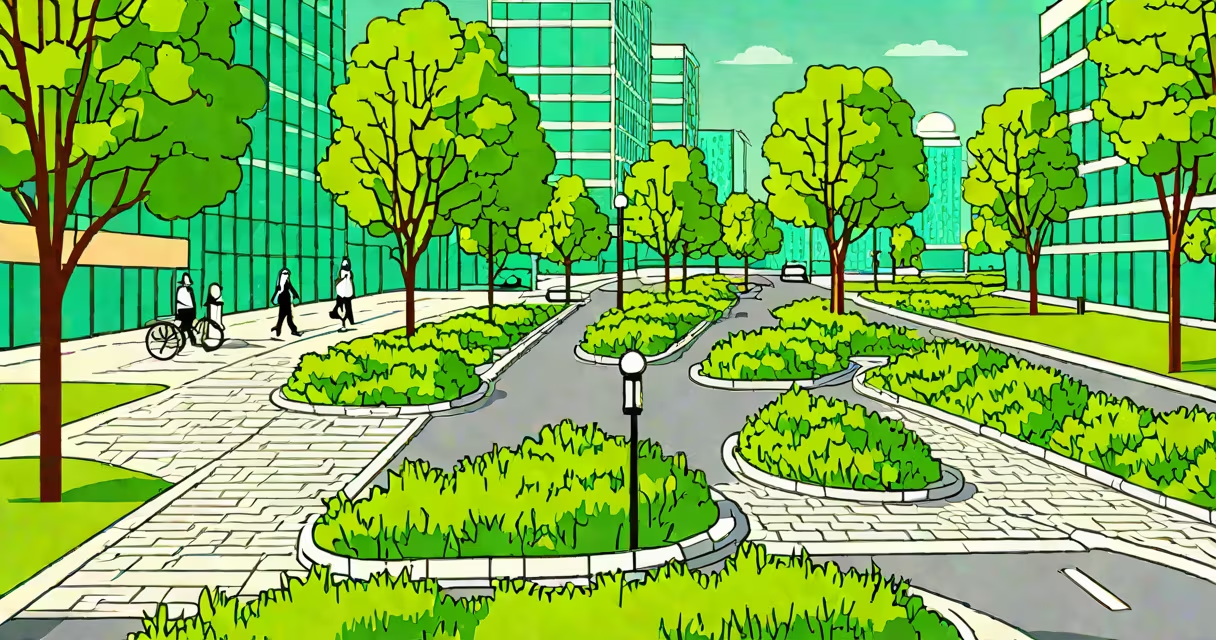
Urban green infrastructure consists of interconnected natural and semi-natural systems-like parks, green roofs, rain gardens, and permeable pavements-that manage stormwater, reduce urban heat, and support biodiversity in cities. These elements function as living systems that absorb rainfall, cool air, and filter pollutants, improving both environmental quality and public health.
Unlike traditional gray infrastructure-concrete storm drains and sewers-urban green infrastructure mimics natural water cycles. It captures rain where it falls, reducing runoff volume and velocity. This lowers flood risk during heavy storms and prevents sewer overflows. The U.S. Environmental Protection Agency (EPA) notes that green infrastructure can reduce stormwater runoff by up to 60% in dense urban areas, depending on design and local conditions.
Green roofs, for example, can retain 50-90% of rainfall during moderate storms, depending on soil depth and plant type. A study by the University of Maryland found that a 10 cm-deep green roof reduced peak runoff by 75% compared to conventional roofing. These systems also lower building energy use by providing insulation, cutting cooling costs by up to 20% in summer months.
Urban green infrastructure operates through infiltration, evapotranspiration, and storage. Rain falls onto vegetated surfaces, where plants absorb water through roots and release vapor into the air. Soil layers filter pollutants and slow water movement. Excess water drains slowly into underground systems or is directed to retention basins.
Bioswales-shallow, vegetated channels along streets-capture runoff from roads and sidewalks. They slow flow, trap sediment, and allow water to seep into the ground. In Philadelphia, bioswales installed along residential streets reduced combined sewer overflow events by 40% between 2011 and 2016, according to city environmental reports.
Permeable pavements allow water to pass through joints or porous materials. A 2020 study by the National Institute of Standards and Technology (NIST) showed that permeable asphalt reduced surface runoff by 85% during a 1-inch rainfall event compared to standard asphalt. These surfaces also cool pavement temperatures by up to 15°C, lowering urban heat island effects.
Urban green infrastructure includes several distinct forms, each suited to specific site conditions and goals.
| Type | Function | Best For | Example Location |
|---|---|---|---|
| Green roofs | Stormwater retention, thermal regulation | Commercial buildings, rooftops | New York City's Brooklyn Navy Yard (over 1 million sq ft) |
| Bioswales | Runoff capture, pollutant filtration | Street corridors, parking lots | Portland, Oregon's Green Streets program |
| Tree pits | Root zone expansion, shade provision | Walkways, sidewalks | Chicago's Urban Forest Initiative |
| Permeable pavement | Surface infiltration, reduced flooding | Parking lots, driveways | Seattle's Rainwise Program |
Each system requires maintenance. Bioswales need periodic debris removal and vegetation trimming. Green roofs require irrigation during dry spells and inspection for root penetration. In Toronto, a 2019 audit found that 30% of municipal green roofs failed within five years due to poor drainage design or inadequate substrate depth.
Urban green infrastructure is often mistaken for simply planting trees or adding grass. But it's not landscaping-it's engineered ecology. A tree planted in a sidewalk planter with limited soil volume provides minimal stormwater benefit. True green infrastructure uses engineered soils, structural supports, and hydrological controls to maximize performance.
Another error is assuming all green spaces deliver equal benefits. A 2021 study in *Field and Urban Planning* showed that only 35% of city parks in Los Angeles met minimum criteria for stormwater infiltration due to compacted soil and impermeable borders. Without proper design, even large green spaces fail to manage runoff effectively.
There's also confusion between green infrastructure and green space. While both improve well-being, green space focuses on recreation and aesthetics. Green infrastructure prioritizes function-managing water, reducing heat, filtering air. The two overlap, but they're not interchangeable.
In 2010, New York City launched a $1 billion initiative to install green infrastructure across the five boroughs. The goal was to reduce combined sewer overflows by 40% by 2030. By 2023, the city had completed over 1,200 projects, including 1,000 bioswales, 150 green roofs, and 200 permeable pavement zones.
One project in Brooklyn involved replacing 400 feet of asphalt with permeable pavers and installing six bioswales along a residential block. Before the upgrade, the area experienced flooding during 12 out of 18 storms above 0.75 inches. After installation, only two floods occurred over the same period. Water quality improved: nitrogen levels dropped by 58%, and suspended solids fell by 72%.
The city also tracked long-term cost savings. Maintenance costs averaged $12 per square meter annually-about half the cost of repairing damaged sewer lines after a major storm. Over ten years, the program avoided $43 million in potential repair expenses.
As a result, New York now mandates green infrastructure on all new developments over 5,000 square feet. The policy has spurred innovation: companies like GreenRoof Inc. have developed modular green roof systems that cut installation time by 60% and reduce material waste by 30%.
Climate change increases the frequency and intensity of extreme weather. Cities face higher risks of flash floods, heatwaves, and infrastructure failure. Urban green infrastructure offers a resilient, low-cost alternative to expanding gray systems. The EPA estimates that every dollar invested in green infrastructure returns $3.50 in avoided damages and operational savings over 20 years.
These systems also improve equity. Low-income neighborhoods often lack green space and suffer disproportionate impacts from flooding and heat. In Detroit, a 2022 pilot project installed 20 bioswales in underserved areas. Post-installation surveys showed a 40% reduction in neighborhood complaints about standing water and a 25% drop in heat-related emergency room visits during summer months.
Urban green infrastructure is not a luxury. It's a necessity for livable, safe, and sustainable cities. Its success depends on integrated planning, community involvement, and ongoing monitoring-not just planting trees.