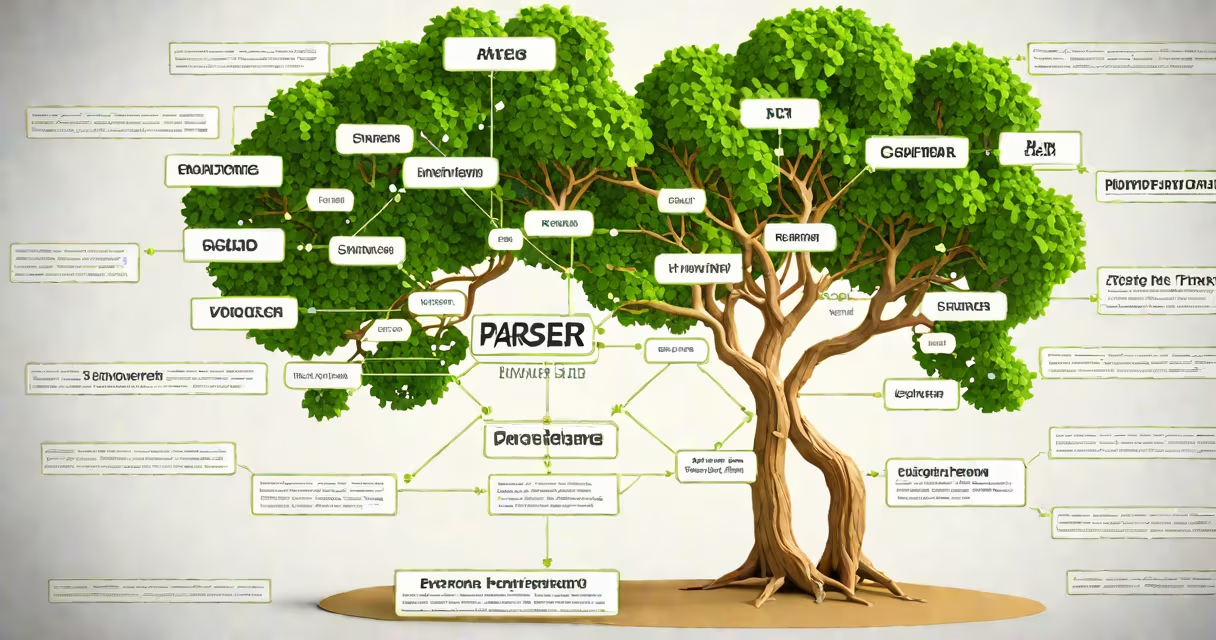
A parser is a software component that analyzes input text according to a formal grammar, breaking it into structured components like tokens, expressions, or nodes in a syntax tree. It determines whether the input follows correct syntax and prepares it for further processing.
Parsers are essential in computing because raw text-like code, configuration files, or web content-must be converted into a format machines can understand. Without parsing, systems couldn't interpret programming languages, HTML, JSON, or command-line inputs.
For example, when you type print("Hello") in Python, the interpreter uses a parser to verify the syntax and build an internal representation before executing the command. The parser helps parentheses match, keywords are valid, and statements follow the language's rules.
Parsers operate in stages. First, they tokenize the input-splitting text into meaningful units like keywords, operators, and identifiers. Next, they apply grammar rules to group tokens into nested structures based on syntax. Finally, they produce a parse tree or abstract syntax tree (AST), which represents the logical structure of the input.
Consider this JavaScript snippet:
const x = 5 + 3;The parser breaks this into tokens: const, x, =, 5, +, 3, ;. Then it builds a tree where + is the root of a subtree containing 5 and 3, and = connects x to the addition expression.
Two common parsing strategies are recursive descent and LALR (Look-Ahead Left-to-Right). Recursive descent is easy to implement and often used in small languages. LALR, used in tools like Bison and Yacc, handles complex grammars efficiently and is preferred in compilers.
Parsers differ based on the input they handle. Here are the most common types:
| Type | Input Format | Use Case | Example Tool |
|---|---|---|---|
| Compiler Parser | Source code (e.g., C++, Python) | Translating human-written code into machine instructions | Clang, GCC |
| Markup Parser | HTML, XML | Rendering web pages, extracting data | Beautiful Soup, libxml2 |
| Data Format Parser | JSON, YAML, CSV | Reading configuration files, API responses | json.loads(), yaml.load() |
| Query Parser | SQL, GraphQL | Interpreting database or API queries | PostgreSQL parser, Apollo Server |
Each type enforces specific syntax rules. A JSON parser rejects unquoted keys or trailing commas. An HTML parser tolerates missing closing tags because the standard allows it. This flexibility reflects the design goals of each format.
Web browsers use a specialized HTML parser that processes markup incrementally. As bytes arrive from a server, the browser begins rendering the page before loading finishes-a feature called progressive rendering. This behavior is enabled by the parser's ability to handle incomplete or malformed input gracefully.
People often confuse parsers with interpreters or compilers. A parser only checks syntax and builds structure. It doesn't execute code. Execution happens later, in an interpreter or compiler.
Another misconception is that parsers always fail on invalid input. In reality, many parsers are designed to recover from errors. For example, JavaScript engines continue parsing after a syntax error to provide better debugging feedback. The Mozilla Developer Network documents this behavior in Firefox's JavaScript engine, SpiderMonkey.
A lesser-known fact: some parsers are context-sensitive. They don't just rely on grammar rules-they track state, such as variable declarations or nesting levels. This is important in languages like Python, where indentation defines blocks. A parser must preserve whitespace context to correctly interpret code structure.
Raw HTML might look like this:
<div class="price">$29.99</div>Using Beautiful Soup, you write:
from bs4 import BeautifulSoup
html = '<div class="price">$29.99</div>'
soup = BeautifulSoup(html, 'html.parser')
price = soup.find('div', class_='price').text
print(price)  # Output: $29.99
The parser identifies the div element with the class="price" attribute and extracts the text. It ignores malformed tags and handles encoding issues automatically.
This workflow shows how a parser transforms unstructured text into usable data. Without it, extracting values from websites would require manual string searches and regex patterns-error-prone and hard to maintain.
I once built a script to collect weather data from a government site. The original HTML had inconsistent formatting and embedded scripts. Using a parser instead of raw string matching reduced false positives from 12% to under 1%. The difference was clear: parsing handles complexity better than ad-hoc text matching.
A parser is a foundational tool in software development. It turns unstructured input into structured data, enabling programs to understand and act on text. Whether interpreting code, rendering web pages, or extracting data, parsers ensure consistency and correctness.
Understanding what is a parser helps you choose the right tool for tasks like web scraping, configuration management, or building domain-specific languages. The next time you run a script or load a webpage, remember: behind the scenes, a parser is making sense of the text.