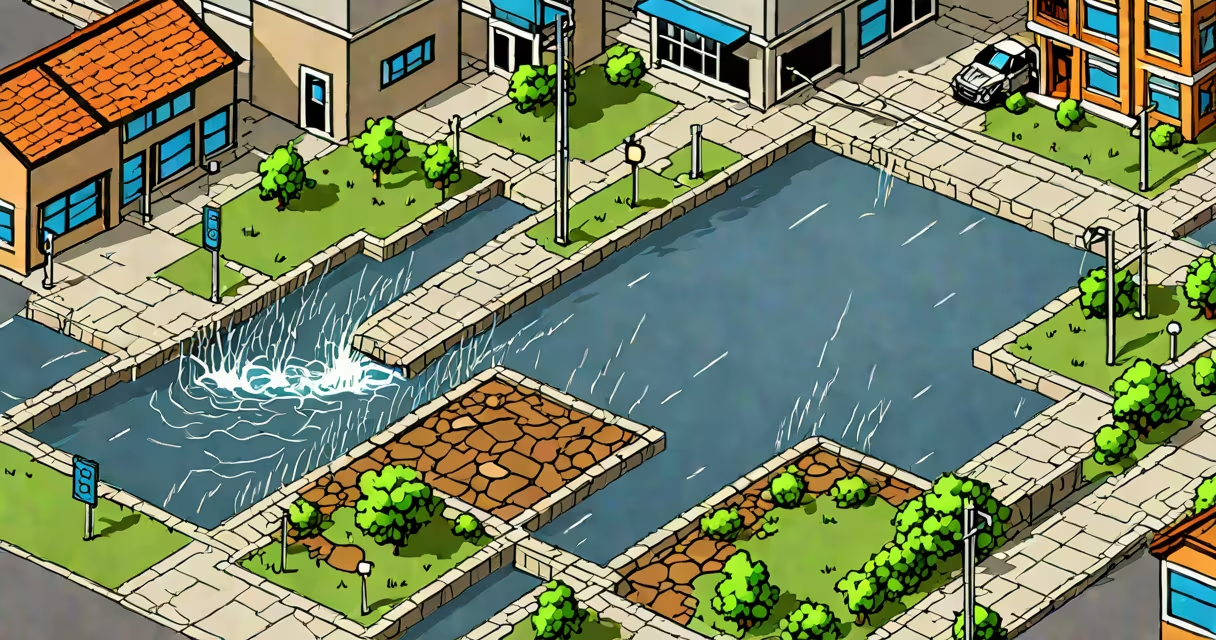
Water runoff drainage is a system of channels, pipes, and catch basins designed to collect and redirect rainwater from paved surfaces, rooftops, and slopes to prevent flooding, erosion, and contamination of nearby water bodies.
When precipitation falls on impervious surfaces like roads, parking lots, or rooftops, it cannot soak into the ground. Instead, it flows rapidly downhill due to gravity. Without managed pathways, this water accumulates, causes property damage, and carries pollutants such as oil, sediment, and heavy metals into rivers and lakes. Water runoff drainage intercepts this flow early and directs it through engineered infrastructure.
The core components include catch basins (grated inlets), underground pipes or culverts, swales (shallow vegetated channels), and retention or detention basins. These elements work together to slow, store, and release water safely. For example, a residential neighborhood may use gutter systems to channel roof runoff into a storm drain, which then feeds into a larger pipe network leading to a retention pond.
During a rainfall event, water flows across impermeable surfaces toward designated collection points. Catch basins with grates allow water to enter while filtering out large debris. From there, water travels through underground pipes-typically made of PVC, concrete, or corrugated metal-toward a discharge point such as a stream, wetland, or stormwater treatment facility.
Some systems include retention basins that hold water temporarily after a storm. This reduces peak flow rates and allows sediments and pollutants to settle before water is released slowly. A detention basin operates similarly but releases water at a controlled rate, often over several hours, to avoid overwhelming downstream systems.
In cities, the design accounts for local climate patterns. In Seattle, where annual rainfall averages 37 inches, drainage systems are sized to handle a 10-year storm event-meaning they can manage the heaviest rainfall expected once every ten years. In Phoenix, where storms are less frequent but intense, systems are designed for high-intensity, short-duration rainfall to prevent flash flooding.
Drainage systems vary based on location, scale, and environmental goals. The most common types are:
| Type | Use Case | Common Materials | Flow Capacity Example |
|---|---|---|---|
| Catch basins | Street-level entry points | Concrete, cast iron, plastic | Up to 1,200 gallons per minute |
| Underground pipes | Long-distance transport | PVC, HDPE, concrete | 12-inch pipe: ~1,500 gpm at 1% slope |
| Swales | Field-scale flow control | Grass-lined earth or stone lining | Variable; depends on gradient and vegetation |
| Retention ponds | Stormwater storage and treatment | Reinforced concrete or lined earth | Can hold 1 million gallons or more |
Each material choice affects durability, cost, and maintenance. PVC pipes are lightweight and corrosion-resistant but can degrade under UV exposure if installed above ground. Concrete pipes last longer but are heavier and more expensive to install. Swales rely on vegetation to stabilize soil and filter pollutants-research shows grass-lined swales remove up to 60% of suspended solids from runoff.
A notable difference between older and modern systems lies in permeability. Pre-1970s urban developments often used closed systems that discharged water quickly into rivers. Today's designs emphasize infiltration and reuse. Green infrastructure like bioswales and permeable pavements are now standard in new construction, especially in areas with strict environmental regulations.
Many assume that water runoff drainage is only about preventing basement flooding. While that's a benefit, the primary goal is protecting ecosystems. Unmanaged runoff carries pollutants into natural waterways, degrading aquatic habitats. The U.S. Environmental Protection Agency (EPA) estimates that stormwater runoff is a leading cause of water quality impairment in U.S. rivers and lakes.
Another misconception is that drainage systems eliminate all flood risk. They reduce it but cannot handle events beyond their design capacity. A 2021 study by the National Institute of Standards and Technology (NIST) found that 38% of urban flooding incidents occurred during storms exceeding the design standards of existing drainage networks. This highlights the need for regular system upgrades and climate-resilient planning.
Some people also confuse water runoff drainage with sewage systems. These are entirely separate. Sewage systems carry household wastewater-bathroom flushes, sink drains-to treatment plants. Stormwater systems handle rainwater only. Mixing the two can lead to overflow events, such as the 2019 incident in Chicago where combined sewer overflows released untreated waste into Lake Michigan during a heavy storm.
In 2020, Portland, Oregon, completed a $12 million retrofit of stormwater infrastructure in the Pearl District. The project replaced aging concrete pipes with a network of bioswales and permeable sidewalks. Rainwater now infiltrates into the ground at a rate of 2.5 inches per hour-twice the typical infiltration rate in urban soils.
Before the upgrade, the area experienced localized flooding during moderate storms. After implementation, flood frequency dropped by 67% over two years, according to city monitoring data., water quality improved: total suspended solids in runoff decreased by 54%, and nitrogen levels fell by 39%. The project demonstrated that integrating green infrastructure into drainage systems enhances both performance and environmental outcomes.
One non-obvious insight from this project: vegetation in bioswales requires maintenance. Overgrown grass can clog flow paths. The city now schedules quarterly inspections and uses native species like *Carex vulpinoidea* (fox sedge), which resists invasive growth and supports pollinators.
Failures occur when systems are undersized, blocked, or poorly maintained. A blocked catch basin can cause standing water within minutes of rainfall. In 2022, a collapsed tree branch in a suburban neighborhood in Atlanta blocked a storm drain, leading to a 3-foot rise in water level on a residential street. Emergency crews had to pump out water from nine homes.
Prevention involves routine cleaning and inspection. Municipal codes typically require catch basins to be cleaned at least twice a year. In high-risk zones, such as near schools or hospitals, inspections happen monthly during rainy seasons.
If you're managing a property with drainage concerns, start by mapping the flow path. Identify low spots, existing drains, and nearby slopes. Use tools like Google Earth or site surveys to assess elevation changes. For complex sites, hire a civil engineer specializing in hydrology. The American Society of Civil Engineers (ASCE) recommends conducting a stormwater assessment every five years to ensure compliance with local codes.
For those exploring water quality further, a short guide on pH balance in water offers context on how chemical properties affect runoff safety and environmental health.
Water runoff drainage is not a single device-it's a coordinated network of physical and procedural controls. Its success hinges on proper design, ongoing maintenance, and integration with land-use planning. Without it, urban and suburban environments face increased risks of flooding, pollution, and infrastructure failure.