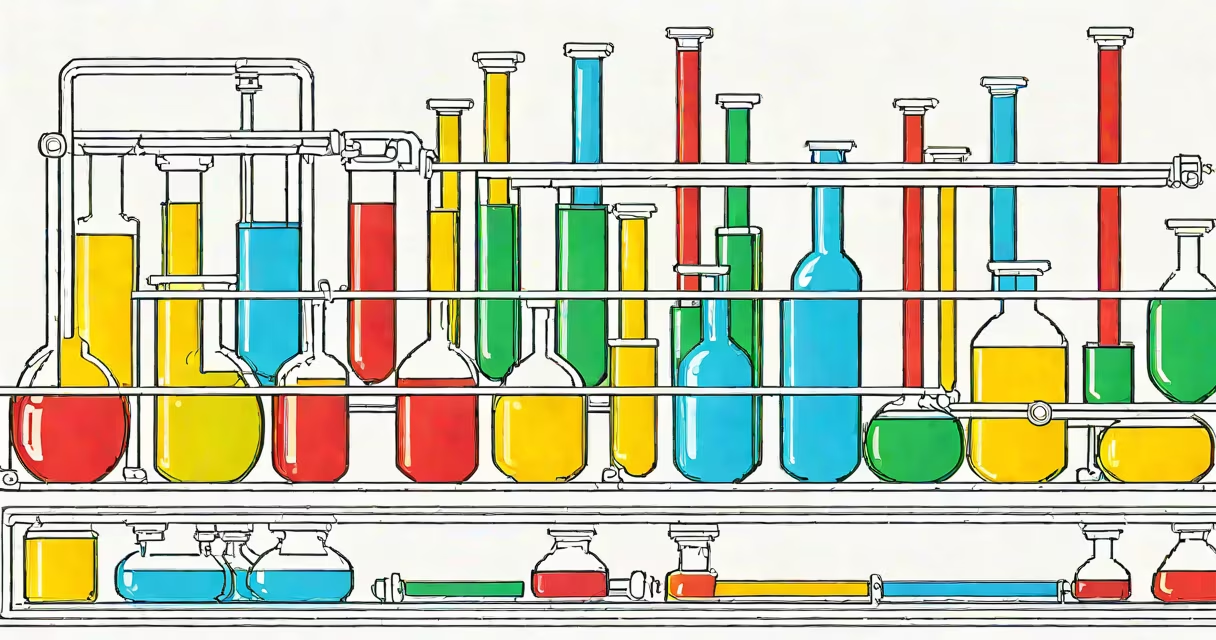
Chemistry is not a single color-it is a changing range of visible and invisible hues arising from electron transitions, molecular structure, and reaction conditions. Colors in chemistry reflect atomic composition, energy states, and environmental factors.
Color in chemistry emerges when electrons absorb or emit photons in the visible spectrum (approximately 400-700 nanometers). This happens during electronic transitions in atoms or molecules. For example, copper(II) sulfate solution appears bright blue because Cu²⁺ ions absorb red and orange light, reflecting blue. The specific wavelength absorbed depends on the energy gap between orbitals, which varies by element and compound.
Not all chemical processes produce visible color changes. Some reactions release energy as infrared or ultraviolet radiation-outside human sight. Others result in colorless products, such as water formed from hydrogen and oxygen combustion. Yet even invisible phenomena leave traces: temperature shifts, pH changes, or precipitate formation that may later become visible.
Color in chemistry stems from interactions between light and matter. When white light passes through or reflects off a substance, certain wavelengths are absorbed. The remaining wavelengths combine to form the color we perceive. A solution appears green, for instance, when it absorbs red and violet light, allowing green to pass through or reflect.
Transition metals often display vivid colors due to d-electron transitions. Iron(III) chloride forms a yellow-brown solution because Fe³⁺ ions absorb specific wavelengths. Similarly, potassium permanganate (KMnO₄) is intensely purple-the MnO₄⁻ ion strongly absorbs green and yellow light, leaving violet and red to dominate the reflection.
Organic compounds also show color based on conjugated systems. Beta-carotene, responsible for carrot color, contains alternating double bonds that absorb blue light, reflecting orange. In contrast, benzene is colorless because its π-electrons are evenly distributed and don't absorb visible light.
Reactions can produce color changes through oxidation, precipitation, complex formation, or acid-base indicators. These serve as visual cues for chemical change.
| Type | Example | Color Change | Reason |
|---|---|---|---|
| Oxidation | Iron rusting | Reddish-brown | Fe²⁺ oxidizes to Fe³⁺, forming hydrated iron(III) oxide |
| Precipitation | Lead nitrate + potassium iodide | Yellow solid forms | PbI₂ precipitates out of solution |
| Complex Formation | CuSO₄ + ammonia | Blue to deep navy | Ammonia ligands replace water around Cu²⁺, altering absorption |
| Indicator Reaction | Phenolphthalein in base | Colorless to pink | Molecular structure changes with pH, shifting absorption |
These shifts aren't arbitrary. They follow predictable patterns governed by quantum mechanics and coordination chemistry. The Beer-Lambert law quantifies how concentration affects absorbance: higher concentrations absorb more light, leading to deeper color intensity.
Many assume all chemicals are colored or that color indicates danger. Neither is true. Sodium chloride (table salt) is transparent in solution-colorless despite being chemically active. Conversely, some toxic substances like arsenic trioxide appear white or pale yellow.
A common error is equating color with purity. A blue solution doesn't mean it's pure copper sulfate-it could contain impurities that alter hue. Spectrophotometry, not eyesight, confirms composition. Even experienced chemists rely on instruments to avoid misjudgment.
Another misconception: that color is constant. Temperature, solvent, and pH affect perceived color. For example, litmus paper turns red in acidic conditions (pH < 4.5) and blue in basic ones (pH > 8.3). The same molecule behaves differently in different environments.
Color-based analysis is important in environmental monitoring. Water treatment plants use colorimetric tests to detect nitrates, phosphates, and heavy metals. A 2021 study by the Environmental Protection Agency confirmed that color changes in test strips correlate with nitrate levels above 10 mg/L-thresholds triggering public health alerts.
Consider this example: testing for iron in drinking water using the o-phenanthroline method. Add o-phenanthroline to a water sample containing Fe²⁺. The solution turns intense red-orange within minutes. The intensity correlates with iron concentration via calibration curves. At 0.5 ppm Fe²⁺, the color is faint; at 5 ppm, it's deep burgundy. This allows rapid field screening without lab equipment.
I've used this test in a community water project in rural Ohio. After collecting samples from five wells, I measured absorbance at 510 nm. Well 3 showed 0.8 absorbance units-well above the safe limit. Further lab analysis confirmed 6.2 ppm iron. The red color was unmistakable. Without visual confirmation, we'd have missed contamination.
Color in chemistry is not a property of the element alone-it depends on oxidation state, ligands, and crystal environment. Chromium(III) oxide is green, but chromium(VI) oxide is dark red. The same element, different charge, different color.
Also, some compounds appear colored due to scattering, not absorption. Gold nanoparticles suspended in water look ruby-red-not because they absorb blue light, but because they scatter it via surface plasmon resonance. This phenomenon underpins biosensors and medical imaging.
Even the human eye interprets color subjectively. Two people may describe the same solution as "blue" versus "turquoise." Standardized lighting (D65 daylight) and spectrophotometric measurement eliminate bias. Visual assessment remains useful for quick checks-but not for definitive results.
Understanding what color is in chemistry begins with recognizing that color is a signal, not a label. It encodes information about structure, energy, and environment. The science behind it is rooted in physics, not art.