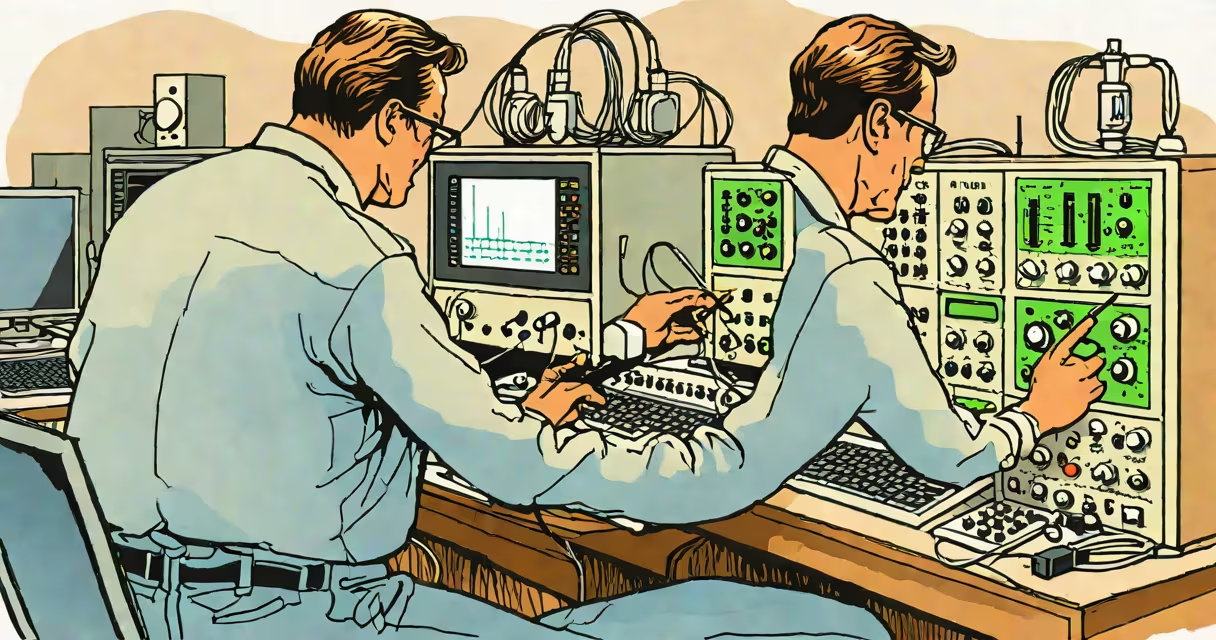
RF engineers design, analyze, and maintain systems that transmit and receive signals using radio frequencies, typically between 3 kHz and 300 GHz. Their work ensures reliable wireless communication in devices ranging from smartphones to radar systems.
These professionals operate at the intersection of physics, electronics, and software. They model how electromagnetic waves travel through air, buildings, and terrain, then build circuits and antennas that efficiently send and capture those waves. A single miscalculation in impedance or frequency response can degrade performance across entire networks.
RF engineers often specialize in areas such as wireless networking, satellite communications, radar systems, or medical imaging equipment. They collaborate with teams across disciplines-mechanical designers, software developers, and network operators-to ensure hardware and protocols function together under real-world conditions.
At its core, RF engineering involves manipulating electromagnetic fields within defined frequency bands. Engineers use mathematical models based on Maxwell's equations to predict wave behavior. These models inform the layout of printed circuit boards, antenna placement, and power amplifier settings.
Signal integrity is paramount. An RF engineer must minimize interference, reflection, and attenuation. For example, in a 5G base station, a 2.5 GHz signal must reach users without distortion caused by nearby metallic structures or overlapping channels. This requires careful simulation and testing using tools like HFSS (High-Frequency Structure Simulator) and ADS (Advanced Design System).
Field measurements validate simulations. Engineers deploy portable spectrum analyzers and vector network analyzers to measure signal strength, phase shifts, and noise levels at actual deployment sites. Data collected during drive tests in urban environments informs adjustments to antenna tilt and power distribution.
RF systems consist of several interconnected parts. The transmitter converts data into modulated radio waves. The receiver captures those waves and extracts the original information. Between them, components like filters, amplifiers, mixers, and oscillators manage signal quality and bandwidth.
| Type | Function | Common Applications |
|---|---|---|
| Low-noise amplifier (LNA) | Boosts weak incoming signals without adding noise | Cellular base stations, satellite receivers |
| Power amplifier (PA) | Increases signal strength for long-range transmission | Wi-Fi routers, mobile phones, radar transmitters |
| Filter | Removes unwanted frequencies from a signal | Bluetooth devices, FM radios, 5G handsets |
| Antenna | Converts electrical signals into electromagnetic waves | GPS units, Wi-Fi access points, drone control links |
Specialized roles include RF system architects who define network performance goals, and RF test engineers who verify compliance with regulatory standards like FCC Part 15 or ETSI EN 301 489. Some focus on emerging domains such as millimeter-wave (mmWave) systems used in 5G and automotive radar.
Every wireless device relies on RF engineering. Cell towers use phased range antennas designed by RF engineers to beam signals toward moving users. Smart home devices communicate via Zigbee or Wi-Fi, both operating in regulated RF bands. Medical MRI machines use RF pulses to excite hydrogen atoms in the body and reconstruct images.
In aerospace, RF engineers develop telemetry systems that transmit flight data from satellites and drones. Military applications include secure encrypted comms, electronic warfare systems, and jam-resistant navigation. Even consumer wearables like smartwatches depend on low-power RF modules to sync with phones.
A non-obvious fact: many RF systems must comply with strict emission limits set by national regulators. For instance, the FCC mandates that unlicensed devices in the 2.4 GHz band cannot exceed 1 watt of effective radiated power. RF engineers calculate actual output power considering antenna gain and cable losses to stay within legal thresholds.
People often confuse RF engineers with software developers working on wireless protocols. While both contribute to wireless functionality, their domains differ. Software engineers implement algorithms for error correction and data encryption. RF engineers handle the physical layer-the actual transmission of electromagnetic energy.
Another misconception is that RF engineering is purely theoretical. In reality, hands-on lab work dominates much of the job. During prototype development, engineers solder surface-mount components, align waveguides, and perform time-domain reflectometry to detect faults in coaxial cables. One project I worked on involved debugging intermittent signal loss in a high-frequency radar module. After days of probing, we discovered a cold solder joint on a microstrip trace-visible only under magnification.
Also, RF engineers aren't limited to large corporations. Startups developing IoT sensors for agriculture or wildlife tracking rely heavily on RF expertise to extend battery life while maintaining connectivity over miles of remote terrain. The challenge lies in balancing range, power consumption, and cost-all within tight regulatory constraints.
Core competencies include proficiency in electromagnetic theory, analog circuit design, and programming for signal processing (e.g., MATLAB, Python). Knowledge of standards bodies like IEEE and ITU is essential. Many employers require a bachelor's degree in electrical engineering, though advanced roles may demand a master's or PhD.
Entry-level positions often involve assisting senior engineers with simulations, testing, or documentation. As experience grows, individuals take ownership of subsystems or lead projects. Senior RF engineers may oversee entire product lines or consult on complex system integration issues.
Consider a city deploying 5G small cells on streetlight poles. An RF engineer leads the site selection process, analyzing coverage maps and traffic patterns. Using predictive modeling software, they determine optimal antenna height and beamforming angles to avoid interference with neighboring cells.
The team selects a 3.5 GHz band module compliant with 3GPP Release 16 specifications. They simulate signal penetration through brick and glass facades using ray-tracing tools. Field tests show 15% lower throughput indoors due to wall absorption. The solution: install internal repeaters and adjust downtilt angles on outdoor units.
Final validation includes measuring adjacent-channel leakage ratio (ACLR) and spurious emissions. All metrics pass FCC Part 15 requirements. The system goes live with average download speeds exceeding 700 Mbps in dense urban zones.
This example illustrates how RF engineers combine theory, measurement, and iteration to deliver functional wireless infrastructure under real-world constraints.