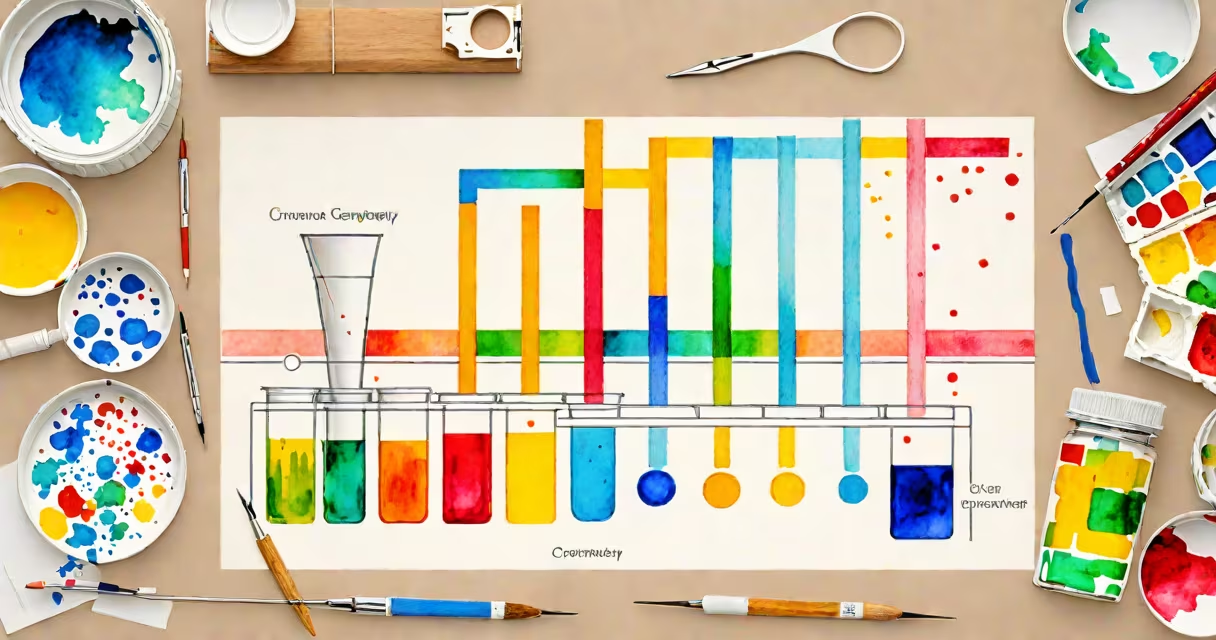
Chromatography means separating components of a mixture based on their different affinities to a stationary phase and a mobile phase. It's a core method in chemistry and biology for isolating substances like pigments, drugs, or proteins.
The process relies on physical differences-such as solubility, size, or charge-to sort molecules. A sample is applied to a medium (like paper or silica gel), and a solvent (the mobile phase) moves through it. Components travel at different speeds, forming distinct bands or spots.
For example, in a classroom experiment, a drop of black ink placed on filter paper separates into red, blue, yellow, and green lines as water rises through the paper. This visual separation demonstrates how chromatography identifies individual dyes in a mixture.
Chromatography depends on partitioning between two phases: the stationary phase (fixed medium) and the mobile phase (moving solvent). Molecules interact differently with each phase, causing them to move at varying rates.
When the mobile phase flows over the stationary phase, compounds in the sample either stick to the surface or dissolve into the solvent. Those with higher affinity for the mobile phase travel farther. The distance traveled relative to the solvent is called the retention factor (Rf), calculated as:
Rf = Distance traveled by compound / Distance traveled by solventAn Rf value ranges from 0 to 1. For instance, if a pigment moved 6 cm while the solvent moved 10 cm, its Rf is 0.6. This number helps identify substances when compared to known standards.
Several chromatography methods exist, each suited to specific applications. The choice depends on the sample type, required resolution, and equipment available.
| Type | Stationary Phase | Mobile Phase | Common Use |
|---|---|---|---|
| Thin-Layer Chromatography (TLC) | Aluminum oxide or silica gel coated on glass/plastic | Liquid solvent (e.g., ethanol-water mix) | Quick screening of organic compounds, such as plant extracts |
| Gas Chromatography (GC) | Porous column packed with polymer or liquid coating | Inert gas (helium or nitrogen) | Detecting pollutants in air samples or analyzing fuel composition |
| High-Performance Liquid Chromatography (HPLC) | Small-particle resin in a metal column | Pressurized liquid solvent | Drug purity testing, protein purification in pharmaceuticals |
| Ion-Exchange Chromatography | Resin with charged groups | Aqueous buffer solution | Separating proteins by charge, used in biotech labs |
Each method exploits a unique property. TLC uses capillary action and is low-cost. GC excels with volatile compounds. HPLC offers high precision for complex mixtures. Ion-exchange targets charged molecules, important in DNA and enzyme research.
Chromatography is used in forensic science to identify drugs in blood samples. In environmental work, it detects pesticides in soil. In food safety, it confirms additives like artificial colors meet regulatory limits.
A common error is assuming all chromatography produces visible results. In reality, many setups require detectors-ultraviolet absorbance, mass spectrometry, or conductivity sensors-to reveal separated components. Without these, results may be invisible to the naked eye.
Another misconception is that chromatography purifies substances completely. While it separates components, further steps like recrystallization or distillation are often needed for pure isolation. For example, HPLC can isolate a drug molecule from a crude extract, but the final product still requires sterile filtration and formulation.
I once ran a TLC test on a leaf extract to identify chlorophyll variants. After developing the plate, I saw four distinct bands under UV light. One band had an Rf of 0.85-close to known standards-but it didn't match any reference. Further analysis revealed a rare pigment not listed in standard databases. That moment showed me chromatography isn't just identification-it's discovery.
One overlooked fact: the stationary phase doesn't just hold molecules-it can chemically react with them. In reverse-phase HPLC, the stationary phase is hydrophobic. Nonpolar compounds bind strongly and elute late. Polar compounds pass through quickly. This interaction is not passive; it's changing and tunable.
For accurate results, the mobile phase must be degassed before use in HPLC. Air bubbles cause pressure fluctuations and noise in detector signals. Even a single bubble can ruin a run. This detail is rarely mentioned in basic guides but is critical in professional labs.
Understanding what does chromatography means includes knowing how it fits into larger workflows. For instance, after separation, collected fractions may undergo spectroscopy or NMR to confirm identity. These tools complement chromatography rather than replace it.
Chromatography remains essential because it turns invisible mixtures into observable patterns. Whether identifying a toxin in water or verifying a vaccine ingredient, it delivers clarity where confusion once stood.