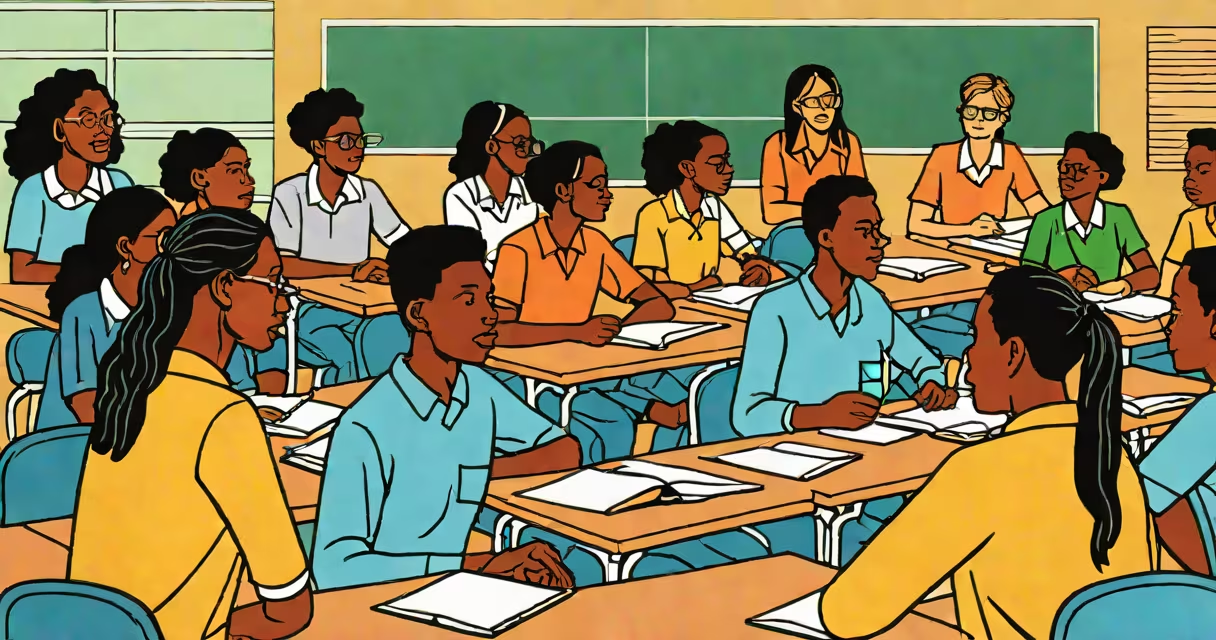
Secondary education is the phase of formal schooling that follows primary education, generally encompassing grades 9 through 12 in the United States and equivalent levels internationally. It serves as a bridge between foundational learning and post-secondary opportunities such as college, vocational training, or employment.
This stage typically begins around age 14 and ends at age 18. Students study core subjects including mathematics, science, English, and social studies, while also selecting electives based on personal interest or career goals. Completion usually results in a high school diploma, a credential required for most university admissions and many skilled jobs.
The structure and duration of secondary education vary globally. In Finland, for example, secondary education starts at age 16 and includes both academic and vocational tracks. In India, the 10th grade marks the completion of secondary education under the Central Board of Secondary Education (CBSE), with students then choosing between science, commerce, or arts streams.
Secondary education operates through a combination of mandated state or national standards and localized implementation. In the U.S., each state sets academic standards, but the Common Core State Standards provide a structure for math and English language arts across most states. These standards define what students should know and be able to do at each grade level.
Instruction occurs in classrooms led by certified teachers. Students attend multiple classes daily, often rotating between different subjects. Assessment methods include quizzes, exams, projects, and standardized tests such as the SAT or ACT, which influence college admissions decisions.
A key feature is the credit system. Most schools require 22-24 credits to graduate, distributed across subjects. For example, a student may need four years of English (one credit per year), three years of math, and two years of science. Elective courses-such as art, music, or computer science-fill remaining credit requirements.
Secondary education systems differ by country and educational philosophy. The table below outlines common models:
| Region | Typical Age Range | Structure | Graduation Credential |
|---|---|---|---|
| United States | 14-18 | Grades 9-12; academic and vocational tracks | High school diploma |
| Finland | 16-19 | Upper secondary school; integrated academic/vocational pathways | Matriculation examination certificate |
| India | 14-16 | Classes 9-10; board-based exams; stream selection after 10th | Secondary School Certificate (SSC) |
| Japan | 15-18 | Three-year high school; uniform curriculum with optional advanced courses | High school diploma |
Some countries integrate vocational training into secondary education. Germany's dual system combines classroom instruction with apprenticeships in fields like engineering or healthcare. Students spend part of their week in school and part in paid work placements, earning a qualification recognized by employers nationwide.
Another model is the International Baccalaureate (IB) program, offered in over 5,000 schools worldwide. IB secondary education emphasizes critical thinking, interdisciplinary learning, and global citizenship. Students complete a two-year curriculum culminating in externally assessed exams and a research paper known as the Extended Essay.
Secondary education is often mistaken for merely preparing students for college. While college readiness is a major goal, many programs also focus on workforce preparation. In the U.S., career and technical education (CTE) programs allow students to earn industry certifications in areas like cybersecurity, nursing, or automotive repair while completing their high school requirements.
A less obvious distinction lies in the difference between secondary education and tertiary education. Secondary education is compulsory in most countries and covers ages 11-18. Tertiary education-university, community college, or professional schools-begins after secondary completion and is generally voluntary. Confusing the two leads to misunderstandings about enrollment timelines and funding responsibilities.
Another misconception is that secondary education is uniform. In reality, public, private, charter, and homeschool models offer vastly different experiences. A student in a rural public high school may have limited access to AP courses or extracurriculars compared to one in an urban magnet school. According to the National Center for Education Statistics, only 58% of public high schools in the U.S. offered Advanced Placement courses in 2022, highlighting disparities in resource availability.
Consider Maria, a 14-year-old entering 9th grade in a public high school in California. Her school requires 22 credits for graduation. Over four years, she takes:
Maria also participates in her school's STEM pathway, which includes internships at local tech firms during summer breaks. By senior year, she earns a GPA of 3.8 and scores 1350 on the SAT. She applies to public universities and receives admission offers from UC Davis and San Diego State. Her success reflects how secondary education integrates academics, extracurriculars, and real-world experience.
During my time teaching high school English in Chicago, I observed that students who engaged early with elective courses and extracurriculars were more likely to develop confidence and direction. One student, Jamal, joined the school newspaper and later earned a scholarship to a liberal arts college. His story illustrates how secondary education extends beyond test scores-it shapes identity and future choices.
Secondary education differs from classical education, which emphasizes the study of ancient texts, rhetoric, and logic. Classical schools often follow the trivium model-grammar, logic, and rhetoric-and may begin earlier than traditional secondary education. While both aim to cultivate critical thinkers, classical education places greater emphasis on enduring texts and philosophical inquiry.
Pedagogy-the method and practice of teaching-shapes how secondary education is delivered. A teacher using inquiry-based learning might guide students through problem-solving tasks rather than lecturing. Research from the National Council of Teachers of Mathematics shows that students taught via inquiry methods scored 12% higher on standardized math assessments than peers in lecture-only classrooms.
Understanding what secondary education means involves recognizing its role as a changing, multi-faceted stage of development. It is not simply a series of required courses but a structured environment where academic, social, and career skills converge. Whether preparing for college, trade school, or direct entry into the workforce, secondary education lays the foundation for lifelong learning and civic participation.
Secondary education remains central to national development strategies. UNESCO reports that countries with universal secondary education attainment see a 15% increase in GDP growth over ten years, underscoring its economic and societal value. As global demands evolve, so too must the relevance and accessibility of this educational phase.