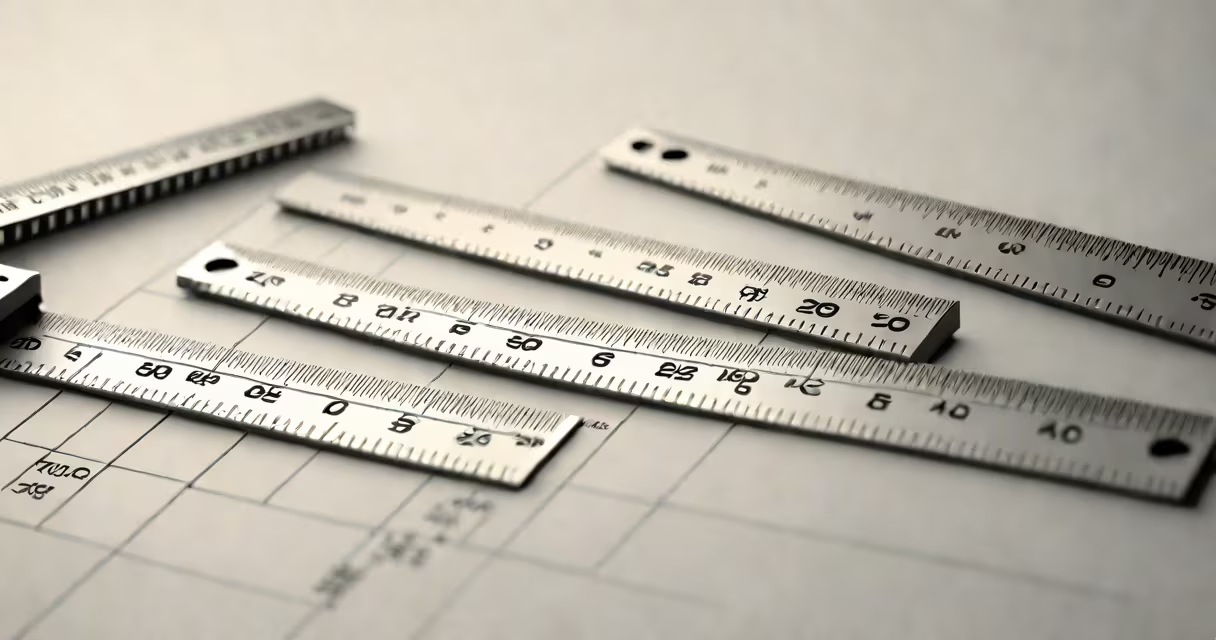
Metric sizes are standardized measurements based on the International System of Units (SI), using meters, grams, and seconds as base units. They express length in millimeters (mm), centimeters (cm), and meters (m), and are used worldwide in engineering, manufacturing, and scientific work.
The metric system replaces inconsistent imperial units like inches and feet with decimal-based values. For example, 1 meter equals 100 centimeters or 1,000 millimeters. This consistency simplifies calculations and reduces errors in global trade and technical design.
Unlike imperial systems, which rely on fractions and non-decimal ratios, metric sizes use powers of ten. A 10 mm bolt is exactly 1 cm, and 100 mm equals 0.1 m. This uniformity enables precise communication across borders and industries.
Each metric size uses a base unit-meter-for length-and prefixes to denote scale. Common prefixes include milli- (1/1,000), centi- (1/100), and kilo- (1,000). So, 5 mm is five-thousandths of a meter, while 2.5 cm is twenty-five hundredths of a meter.
When specifying parts, engineers often use millimeters for precision. A shaft diameter of 12.7 mm is clearer than 0.5 inches in contexts requiring accuracy. The metric system avoids ambiguity because each unit scales predictably.
For example, a 15 mm wrench fits a 15 mm bolt head. This direct match eliminates guesswork. In contrast, imperial tools require fractions like 5/8 inch, which can lead to confusion during assembly.
Metric sizes appear in four primary categories: linear dimensions, thread sizes, fastener diameters, and tolerances. Each serves specific functions in industrial and everyday contexts.
| Type | Common Units | Typical Use Cases |
|---|---|---|
| Linear Dimensions | mm, cm, m | Construction beams, pipe lengths, room layouts |
| Thread Sizes | ISO metric threads (e.g., M6, M10) | Machine bolts, screws, threaded fittings |
| Fastener Diameters | mm (e.g., 4 mm, 8 mm) | Wood screws, machine screws, rivets |
| Tolerances | ±0.1 mm, ±0.05 mm | High-precision machining, aerospace components |
ISO metric thread standards define screw sizes by nominal diameter and pitch. An M8 × 1.25 bolt has a 8 mm diameter and a 1.25 mm thread pitch. This format ensures compatibility across countries and manufacturers.
In automotive repair, metric sizes dominate. A car engine's spark plug may require a 14 mm socket. Using the correct metric tool prevents stripping the bolt head-a common failure in DIY repairs.
Many assume metric sizes are only used in Europe or Asia. That's incorrect. The United States adopted metric standards in aerospace, medicine, and electronics decades ago. NASA uses metric units for spacecraft design, and U.S. medical devices follow ISO standards.
Another misconception is that metric sizes are less accurate than imperial ones. In reality, metric units allow greater precision due to their decimal structure. A 3.14 mm measurement is easier to interpret than 0.1236 inches, especially in digital calipers and CNC machines.
A lesser-known fact: the metric system was designed to be universal. Its foundation lies in natural constants-like the speed of light and Earth's circumference-making it reproducible anywhere. Imperial units, by contrast, originated from arbitrary human references (e.g., the foot based on a king's stride).
Consider a 1 5/8-inch wrench. Converting this to metric requires decimal arithmetic:
Thus, a 1 5/8-inch wrench corresponds to a 41 mm wrench. This conversion is essential when replacing tools or sourcing parts internationally.
I once replaced a faucet washer in a rental apartment using a 1 5/8-inch socket. The hardware store didn't carry it in metric, so I used the conversion above to find a 41 mm equivalent. The fit was perfect-no leaks, no damage.
Global supply chains depend on consistent measurement. A bolt labeled M6 × 1.0 must fit any nut marked M6 with 1.0 mm pitch-regardless of country of origin. Without metric standards, cross-border manufacturing would face constant mismatches.
According to the National Institute of Standards and Technology (NIST), the U.S. government mandates metric use in federal procurement when applicable. NIST states that "standardized units reduce costs and improve safety in technical fields."
The International Bureau of Weights and Measures (BIPM) maintains the SI system. Their guidelines ensure that 1 mm measured in Tokyo equals 1 mm measured in Toronto. This reliability underpins everything from microchip fabrication to bridge construction.
Understanding metric sizes isn't optional-it's foundational for anyone working with physical objects. designing a prototype, knowing how to read and convert metric sizes prevents costly mistakes.