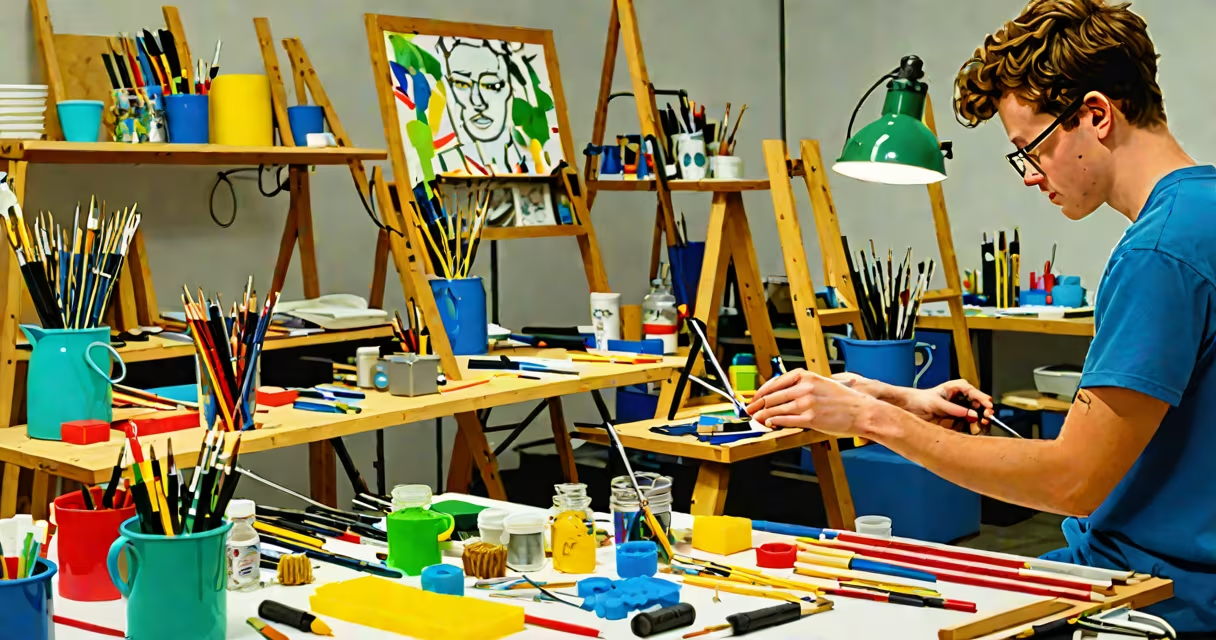
Studio art and design is a field centered on creating original visual work through hands-on practice, critical thinking, and technical skill. It spans drawing, painting, sculpture, graphic design, digital media, and environmental design, grounded in both aesthetic principles and functional purpose.
Students and professionals in studio art and design develop ideas through physical and digital making. They use materials like clay, ink, canvas, code, or 3D printers to produce objects, images, or environments that communicate concepts, solve problems, or evoke emotion. This process emphasizes experimentation, iteration, and personal vision.
According to the National Endowment for the Arts, nearly 60% of college graduates in visual arts report using their training in creative problem-solving across industries beyond traditional art roles. The field blends artistic intuition with structured methods, making it important in advertising, architecture, fashion, and tech.
Studio art and design begins with idea generation, often sparked by observation, cultural context, or personal experience. A student might sketch multiple versions of a character before refining a single concept. This phase includes research, mood boards, and informal prototyping.
The next stage is material engagement. A ceramic artist may throw a bowl on a wheel, adjusting pressure and speed based on feedback from the clay's response. A graphic designer uses software like Adobe Illustrator to test layouts, color palettes, and typography until the composition balances clarity and impact.
Final evaluation involves critique-both self-assessment and peer review. In academic settings, this happens during scheduled reviews called "crits." Feedback focuses on intent, execution, and audience reception. For example, a student designing a poster for a local music festival might revise the font size after noticing that text was unreadable from five feet away.
Studio art and design encompasses several distinct but overlapping areas. Each requires specific tools, techniques, and ways of thinking.
| Type | Focus | Common Tools | Real-World Application |
|---|---|---|---|
| Traditional Visual Arts | Handmade expression using paint, charcoal, or sculptural materials | Brushes, chisels, clay, canvas | Museum exhibitions, public murals, gallery installations |
| Graphic Design | Visual communication for branding, advertising, and digital interfaces | Adobe Creative Set, tablets, wireframing tools | App icons, social media campaigns, packaging design |
| Product Design | Creating functional objects with form and usability in mind | 3D modeling software, CAD tools, prototyping materials | Consumer electronics, furniture, medical devices |
| Digital Media & Animation | Storytelling through moving images, sound, and interactive elements | After Effects, Blender, Unity, audio editing software | Video games, animated films, virtual reality experiences |
A common misconception is that studio art and design are purely subjective. While personal expression matters, successful work meets standards of balance, proportion, and clarity. The Bauhaus movement of the early 20th century demonstrated that design could merge beauty with utility-its iconic chair designs remain in production today.
Another misunderstanding is that digital tools replace hand skills. In reality, many designers use analog sketches to explore ideas before translating them into digital formats. A student in a university design program once told me they spent two weeks drawing 300 hand-drawn thumbnails before beginning a digital animation sequence. The initial sketches helped clarify timing and emotional pacing.
Studio art and design appears in nearly every sector of modern life. In healthcare, designers create patient-friendly instructional videos and ergonomic medical equipment. In education, visual aids developed by studio artists improve learning outcomes-studies show students retain 75% more information when presented with illustrated content compared to text-only formats (National Science Foundation, 2021).
Corporate branding relies heavily on studio design. Apple's product launch visuals, for example, use minimalist layouts, precise typography, and controlled color schemes-all crafted by teams trained in studio principles. These choices aren't arbitrary; they signal quality, innovation, and trust.
Public spaces also depend on studio art and design. The High Line in New York City features commissioned artworks integrated into walkways, benches, and lighting. These pieces weren't added later-they were designed alongside the park's infrastructure, ensuring cohesion between function and aesthetics.
People often confuse studio art and design with fine art alone. Fine art typically aims to provoke thought or emotion without a functional goal. Studio art and design, while expressive, usually serves a purpose-whether to inform, sell, instruct, or improve user experience.
Another error is assuming that only "artists" do this work. In fact, engineers, scientists, and business leaders increasingly use design thinking-rooted in studio practices-to innovate. Stanford's d.school teaches design methods to MBA students and biomedical researchers alike.
Some believe studio work is outdated in a digital world. But the demand for skilled creators remains high. The U.S. Bureau of Labor Statistics reports that employment in graphic design and related fields grew 6% between 2020 and 2022, outpacing average job growth. Demand continues in web design, UX/UI, and augmented reality environments.
One non-obvious fact: many studio art and design programs require students to complete a capstone project that addresses a real-world challenge. At the Rhode Island School of Design, seniors design solutions for community organizations-like a sustainable packaging system for a local food co-op. These projects are reviewed by industry professionals and sometimes lead to paid internships or jobs.
Consider a group of undergraduate studio art and design students tasked with creating signage for a neighborhood garden in Oakland, California. The brief required clear wayfinding, multilingual accessibility, and durability against weather.
Phase 1: Research. Students surveyed residents and studied local plant species. They discovered that 40% of garden users spoke Spanish, and 25% had low literacy levels.
Phase 2: Prototyping. They created 12 mockups using large icons, minimal text, and tactile elements. One version used raised symbols for touch-based navigation-ideal for visually impaired visitors.
Phase 3: Materials testing. They exposed prototypes to simulated rain, sun, and wind. Only one design-using recycled plastic with UV-resistant coating-survived all tests.
Phase 4: Final installation. The team collaborated with city planners and community volunteers. The signs were installed in three locations, each marked with a QR code linking to audio descriptions in English and Spanish.
This project demonstrates how studio art and design integrates research, empathy, material science, and community involvement. It's not just about making something look good-it's about solving problems through thoughtful creation.
For those exploring a career path in design and technology integration, studio art and design offers a foundation in creativity, adaptability, and user-centered thinking. building a prototype for a new device, the core principles remain consistent: observe, iterate, and create with intention.