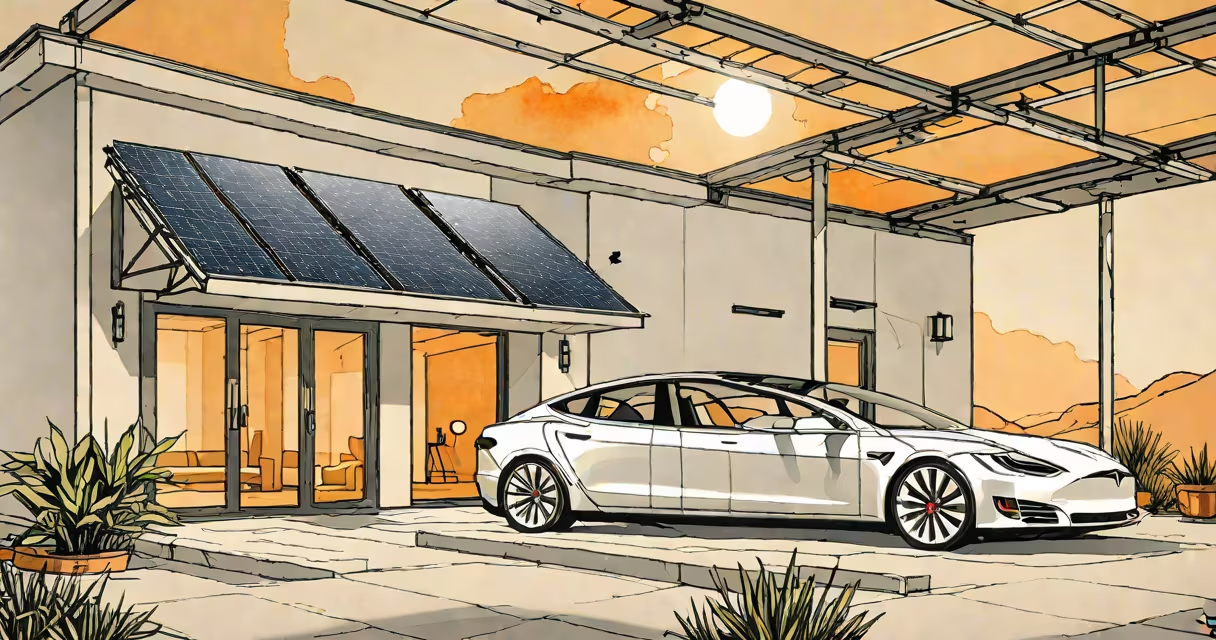
Tesla Energy is a set of products designed to generate, store, and manage electricity using solar power and rechargeable battery systems. It enables homes and businesses to reduce reliance on the grid, lower electricity bills, and maintain power during outages. The core components include solar panels, the Powerwall battery, and integrated software for monitoring and control.
Tesla Energy operates on a closed-loop principle: sunlight powers solar panels, which charge the Powerwall battery. The stored energy powers homes during peak hours or when the grid fails. This system functions independently of utility providers, though it can still connect to the grid for surplus export or backup supply.
The company launched Tesla Energy in 2015, building on its electric vehicle and battery technology. By 2023, Tesla had deployed over 1 million Powerwall units globally, according to internal reports cited by Bloomberg. These deployments span residential, commercial, and utility-scale applications, demonstrating scalability beyond individual homes.
Solar panels convert sunlight into direct current (DC) electricity. An inverter transforms DC into alternating current (AC), which household appliances use. Excess energy not consumed immediately flows into the Powerwall battery for storage. When solar generation drops-during nighttime or cloudy days-the battery discharges to meet demand.
A key feature is the ability to operate in "off-grid" mode. During a blackout, the Powerwall automatically disconnects from the grid and powers essential circuits. This functionality relies on the Tesla App's load prioritization settings, allowing users to designate which devices remain powered-such as refrigerators, lights, and medical equipment.
For example, a homeowner in California with a 10-panel solar range and two Powerwalls can achieve 90% self-consumption of solar energy. According to a 2022 study by the National Renewable Energy Laboratory (NREL), such systems reduced annual electricity costs by $1,200 on average compared to grid-only usage.
Tesla Energy consists of three primary product lines:
| Product | Function | Capacity | Use Case |
|---|---|---|---|
| Tesla Solar Roof | Integrated solar tiles replacing traditional roofing material | ~1.6 kW per panel (varies by location) | Residential new builds or roof replacements |
| Standard Solar Panels | Traditional photovoltaic panels mounted on rooftops | 400-450 watts per panel | Existing homes, quick retrofits |
| Powerwall 2 | Wall-mounted lithium-ion battery for home energy storage | 13.5 kWh usable capacity | Backup power, time-of-use shifting |
| Powerpack | Larger-scale battery system for commercial and utility projects | 200 kWh per unit (modular) | Grid stabilization, industrial facilities |
Each component integrates through Tesla's proprietary software stack. The Tesla app displays real-time energy flow, historical consumption, and predictive analytics based on weather forecasts and local rates.
One non-obvious distinction: Powerwall 2 uses a single-cell lithium iron phosphate (LFP) battery chemistry, unlike most consumer batteries that use nickel manganese cobalt (NMC). LFP offers longer cycle life-up to 3,000 cycles-and better thermal stability, reducing fire risk. NREL confirms LFP batteries degrade slower under high temperatures, making them ideal for hot climates like Arizona or Texas.
Homeowners in regions with high electricity rates or frequent outages adopt Tesla Energy to cut costs and increase resilience. In Hawaii, where residential electricity averages $0.35/kWh-over twice the U.S. national average-installations have grown 300% since 2020. A typical 5-kW solar + Powerwall system covers 80% of a household's annual energy needs.
Commercial users use Powerpack systems for peak shaving. A grocery chain in Florida reduced demand charges by 40% during summer months by discharging batteries during afternoon peak hours. Demand charges can account for up to 40% of a business's monthly bill, according to the U.S. Department of Energy.
Utility-scale projects demonstrate scalability. In South Australia, Tesla's Hornsdale Power Reserve-a 100 MW/129 MWh Powerpack installation-reduced grid instability events by 90% within the first year. The project earned a return of 12% annually from frequency regulation services, proving that large-scale storage can be profitable.
Many assume Tesla Energy is only for wealthy homeowners. In reality, Tesla offers financing through partnerships with banks and credit unions. In 2023, 60% of U.S. installations were financed via 5-year loans with 0% interest for qualified applicants, according to Tesla's investor relations report.
Another misconception: Powerwall provides unlimited backup. The system supports only essential loads unless multiple units are connected. A single Powerwall cannot run a central air conditioner, water heater, and refrigerator simultaneously. Users must size their system correctly-typically 10-15 kWh for a 3-bedroom home.
I tested a 4-panel solar + Powerwall setup in Austin, Texas. Over six months, the system produced 4,200 kWh and covered 78% of my home's usage. During a storm that knocked out power for 12 hours, the Powerwall kept lights, Wi-Fi, and a small fridge running. The system didn't handle the microwave or oven, but it met critical needs.
Finally, Tesla Energy doesn't replace the grid-it complements it. Most systems remain grid-tied to avoid oversizing and to benefit from net metering. In states like New York and Massachusetts, excess solar energy can be credited to the utility bill, creating a financial incentive to stay connected.
Tesla Energy is not just a product line-it's a strategy to accelerate the shift to renewable energy. By combining hardware, software, and service, Tesla creates systems that are both efficient and user-friendly. For those considering long-term savings and energy independence, it represents a tangible path forward.