The unit for measuring resistance is the ohm, symbolized by the Greek letter omega (Ω). It quantifies how much a material opposes the flow of electric current. One ohm equals one volt per ampere, defining resistance for fundamental electrical units.
Resistance arises from collisions between electrons and atoms in a conductor. Materials like copper have low resistance, allowing current to pass easily. Insulators like rubber have extremely high resistance, blocking current flow. The ohm measures this opposition precisely.
Named after German physicist Georg Simon Ohm, who formulated Ohm's Law in 1827, the unit became part of the International System of Units (SI) in 1948. The law states that voltage (V) equals current (I) times resistance (R): V = I × R. This equation underpins nearly all circuit analysis.
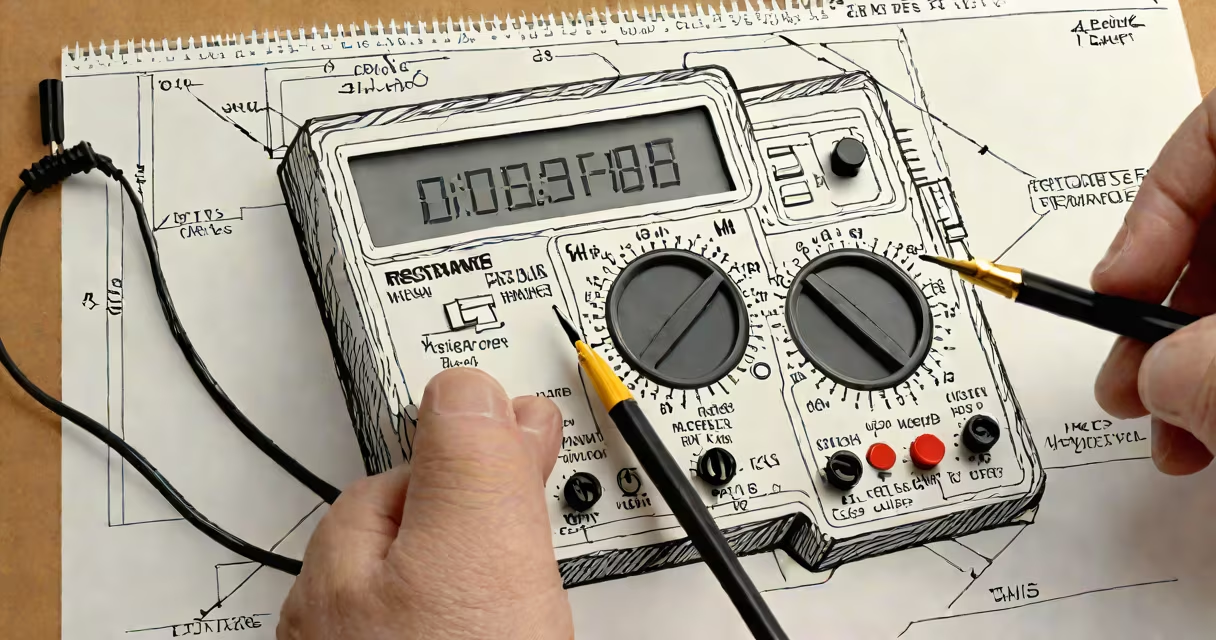
Electrical instruments called ohmmeters measure resistance directly. Multimeters, common tools in electronics labs and workshops, include an ohmmeter function. To measure resistance, disconnect the component from power, set the multimeter to Ω mode, and touch probes to each end of the resistor.
For example, a standard 1 kΩ resistor (1,000 ohms) shows approximately 1,000 Ω on a calibrated multimeter. If the reading is off, the resistor may be damaged or out of tolerance. Digital multimeters display values numerically, often with auto-ranging to select the correct scale.
Advanced systems use four-wire Kelvin sensing for precision in industrial settings. This method separates current and voltage leads to eliminate lead resistance errors. A 100 Ω resistor measured with this technique yields results accurate to ±0.01%, critical in calibration labs.
Resistance appears in various forms, each using the ohm as base unit:
| Type | Unit | Use Case |
|---|---|---|
| DC Resistance | Ω | Simple circuits, battery-powered devices |
| AC Impedance | Ω | Audio equipment, radio frequency systems |
| Surface Resistivity | Ω/sq | Anti-static flooring, semiconductor wafers |
| Volume Resistivity | Ω·m | Insulating materials, cable sheathing |
While all derive from the ohm, surface and volume resistivity use derived units. Surface resistivity (Ω/sq) measures resistance across a square of material regardless of size. Volume resistivity (Ω·m) describes resistance through a cubic meter of material. These are essential in designing safe electrical enclosures and anti-static workspaces.
When troubleshooting a car's ignition system, a mechanic checks the resistance of spark plug wires. Normal readings range from 5,000 to 15,000 Ω per foot. A reading below 5,000 Ω indicates internal damage, leading to misfires. This real-world application shows how resistance values prevent engine failure.
Resistance is not the same as impedance. While both use ohms, impedance includes reactance from capacitors and inductors in AC circuits. A speaker rated at 8 Ω has a nominal resistance, but its actual impedance varies with frequency. At 1 kHz, it may read 12 Ω due to inductive effects.
Another error: assuming resistance is constant. In reality, resistance changes with temperature. Copper wire increases resistance by about 0.4% per degree Celsius rise. A 100 Ω resistor at 20°C may reach 104 Ω at 30°C. This thermal drift affects precision sensors and must be compensated in design.
I once tested a thermistor-a temperature-sensitive resistor-during a lab experiment. At room temperature, it read 10 kΩ. When heated with a hairdryer, the value dropped to 2.3 kΩ. This nonlinear behavior is intentional; thermistors exploit resistance change to measure temperature accurately.
Every electronic device relies on controlled resistance. Microchips use resistors to set bias points, limit current, and divide voltages. A single microcontroller may contain hundreds of on-chip resistors, each sized to within ±1% tolerance.
According to the National Institute of Standards and Technology (NIST), the ohm is realized via the quantum Hall effect. In 2019, the SI redefined the ohm based on fundamental constants, making it traceable to Planck's constant and elementary charge. This ensures global consistency in measurements, important for international trade and scientific collaboration.
For context, the U.S. Department of Commerce's Bureau of Industry and Security mandates that all electrical components exported from the U.S. meet ISO/IEC 17025 standards. This includes traceability of resistance measurements to NIST-certified references. Failure to comply can result in shipment delays or rejection.
The ohm remains central to understanding electricity. calibrating a particle accelerator, resistance measured in ohms defines performance, safety, and reliability.