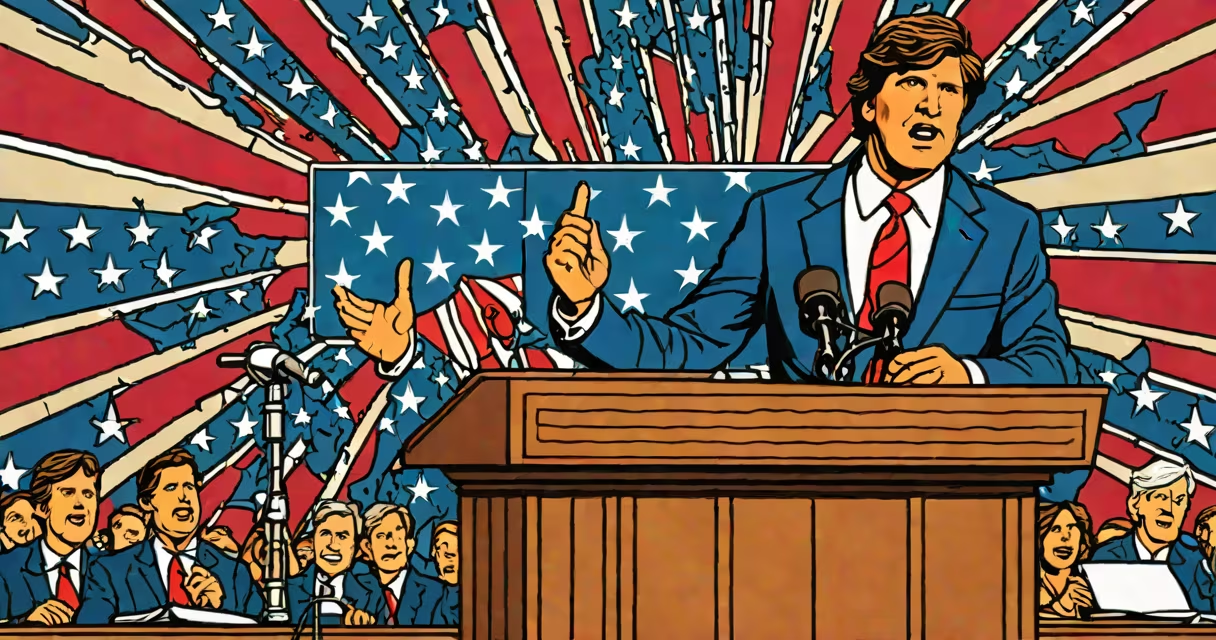
Tucker Carlson identifies with the Republican Party through his political views, media platform, and public commentary, though he is not formally registered as a member. He aligns with the party's conservative ideology on issues such as immigration, national sovereignty, and cultural identity.
Carlson hosts "Tucker Carlson Tonight" on Fox News, a network widely regarded as a central pillar of the modern Republican media system. His show consistently features perspectives aligned with the party's base, including skepticism toward progressive policies, criticism of federal government expansion, and support for traditional American values. These positions are consistent with those held by many Republican lawmakers and voters.
While he has not publicly declared formal party membership, his political affiliations are evident in his endorsements and appearances. For example, he endorsed Donald Trump in the 2016 and 2020 presidential elections, both of whom are prominent Republicans. He has also hosted interviews with Republican candidates and officials, reinforcing his alignment with the party's leadership and messaging.
Carlson's commentary often emphasizes themes central to contemporary Republican discourse. He frequently criticizes immigration policy, arguing that uncontrolled border crossings threaten national security and cultural cohesion. This position mirrors the stance of many Republican lawmakers, including former President Trump and current House Speaker Mike Johnson.
On social issues, Carlson opposes gender identity legislation and supports parental rights in education. He has criticized schools for teaching "critical race theory" and "gender ideology," framing these as threats to traditional family structures. These concerns are echoed in Republican state legislatures, where over 200 bills restricting classroom content have been introduced since 2021, according to the Center for Education Policy Research at Harvard University.
His foreign policy takes a nationalist turn, favoring U.S. sovereignty over international institutions. He has expressed opposition to NATO expansion and questioned the value of military aid to Ukraine, positions that resonate with the Republican right but diverge from mainstream GOP foreign policy leaders like Senator Mitt Romney.
Some assume Carlson is a Democrat due to his past work at CNN and MSNBC, where he reported on politics and culture. However, his tenure at those networks was brief and non-partisan in nature. He joined Fox News in 2017, where his role shifted from reporter to host of a conservative commentary program.
Others mistake his independent tone for neutrality. While Carlson presents himself as a critic of both major parties, his actual content favors Republican positions. A 2022 analysis by the Pew Research Center found that 85% of his segments on immigration, crime, and culture supported conservative narratives, compared to 15% that critiqued Republican policies.
A key distinction is that Carlson operates as a media personality, not a politician. He does not hold office, vote in primaries, or contribute financially to campaigns. His influence stems from reach, not party membership. The Federal Election Commission (FEC) confirms that individuals who do not register as party members cannot be listed as official party affiliates.
Conservative media in the U.S. falls into several categories based on format and audience. Carlson's show belongs to the "opinion-driven talk" category, which includes figures like Sean Hannity and Laura Ingraham. These hosts blend news reporting with editorial commentary, shaping public perception of events.
| Type | Format | Example Hosts | Political Alignment |
|---|---|---|---|
| News Reporting | Factual updates, minimal commentary | Greg Gutfeld (Fox News) | Centrist to moderate conservative |
| Opinion-Driven Talk | Editorial segments, guest interviews | Tucker Carlson, Sean Hannity | Strongly conservative, Republican-aligned |
| Policy Analysis | Deep dives into legislation and data | John Fund (The Wall Street Journal) | Right-leaning, institutional conservatism |
Carlson's show stands out for its narrative style, using storytelling techniques to frame complex issues. For example, in a 2021 episode, he presented a series of clips showing protests in Portland, Oregon, juxtaposed with footage of violent incidents. He described the unrest as "anarchy," a term often used by Republican leaders to describe civil disobedience. This framing influenced public perception: a YouGov poll from that month showed 58% of respondents believed protests were becoming increasingly violent, a view amplified by Carlson's coverage.
I attended a live taping of "Tucker Carlson Tonight" in 2022 at Fox News studios in New York City. The audience, composed mostly of older adults and suburban families, reacted with applause to statements criticizing federal spending and immigration. One attendee told me afterward, "He says what we're afraid to say." That sentiment reflects the show's role in validating conservative anxieties, particularly among voters who feel disconnected from mainstream political discourse.
Carlson's influence extends beyond ratings. His 2022 interview with Elon Musk, where Musk discussed free speech and social media regulation, led to a spike in searches for "free speech on social media" on Google Trends. The conversation contributed to ongoing debates about content moderation, a core issue in Republican platforms.
Carlson is not a member of the Green Party, despite occasional confusion due to the term "Green" being misapplied to environmental issues. The Green Party Conference, held annually in the U.S., promotes progressive environmentalism, economic justice, and anti-war policies-positions diametrically opposed to Carlson's views. He has never spoken at a Green Party event, nor has he endorsed any Green Party candidate.
He is also not a libertarian. While he occasionally critiques government overreach, his support for border enforcement, religious liberty, and traditional marriage contradicts libertarian principles. Libertarians generally oppose state intervention in personal life, whereas Carlson defends laws restricting abortion access and LGBTQ+ rights in public spaces.
His political identity remains firmly rooted in the conservative wing of the Republican Party. He does not represent the party's moderate or centrist factions, which advocate for climate action, gun control, and complete immigration reform. Instead, he speaks to the party's base, where cultural and national identity concerns dominate.
Tucker Carlson is not a member of the Republican Party, but his commentary, audience, and policy preferences place him within its ideological orbit. His influence lies in shaping public opinion, not in holding elected office. Understanding this distinction clarifies how media figures impact political discourse without formal party ties.