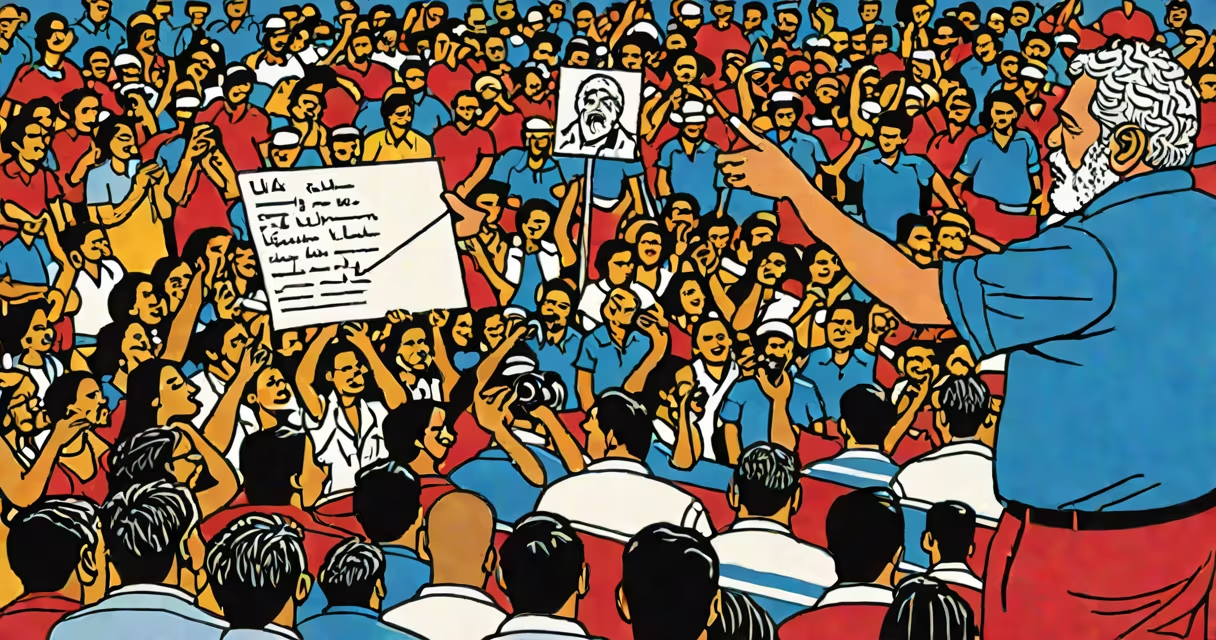
Lula da Silva is a left-wing politician whose career spans decades of Brazilian social democracy, labor activism, and presidential leadership. He identifies with progressive ideals centered on wealth redistribution, social justice, and expanded access to education and healthcare.
His political identity emerged from Brazil's military dictatorship era. Born in 1951 in the northeast, Lula began working in factories at age 12. By his late teens, he was organizing union strikes. In 1980, he co-founded the Workers' Party (Partido dos Trabalhadores, PT), a socialist-leaning party rooted in grassroots labor movements. The PT opposed the military regime and advocated for democratic reforms, universal suffrage, and worker rights.
Lula ran for president in 1989, 1994, and 1998 as a PT candidate. He lost each time. In 2002, he won a decisive victory, becoming Brazil's first working-class president. His first term (2003-2007) focused on poverty reduction through programs like Bolsa Família, which provided cash transfers to low-income families conditional on school attendance and health visits. Over 14 million people benefited during his tenure. His second term (2007-2011) continued expansion of social programs while managing economic growth amid global financial turmoil.
| Political Stance | Key Policies | Source |
|---|---|---|
| Left-wing | Bolsa Família, minimum wage increases, national development bank funding for small businesses | World Bank, 2006 report on Brazil's poverty reduction |
| Centrist Shift (2000s) | Stable fiscal policy, inflation targeting, foreign investment openness | IMF Country Report, Brazil 2008 |
Lula's governance evolved beyond strict leftist doctrine. While maintaining a commitment to social equity, he pursued macroeconomic stability. The central bank targeted inflation, and fiscal policy avoided large deficits. This pragmatism helped Brazil weather the 2008 global recession better than many peers. According to the International Monetary Fund, Brazil's GDP grew at an average of 4.2% annually between 2004 and 2010.
He was succeeded by Dilma Rousseff, also of the PT. After leaving office, Lula remained influential. In 2018, he was arrested on corruption charges tied to Operation Car Wash. The Supreme Court later annulled those convictions due to procedural errors. In 2022, he won the presidency again, defeating Jair Bolsonaro in a runoff vote. His return marked a reversal of right-wing policies enacted since 2016.
A common misunderstanding is equating Lula's leftism with authoritarian socialism. He consistently supported democratic institutions, free elections, and civil liberties. During his presidency, Brazil's press freedom index improved under Freedom House rankings. In 2006, Brazil ranked 52nd out of 167 countries in press freedom-up from 78th in 2000.
Another misconception is that Lula represents a monolithic "left." His coalition included centrist and moderate figures. He appointed ministers from diverse backgrounds, including economists aligned with market-oriented reforms. For example, Minister of Finance Guido Mantega promoted industrial policy while maintaining fiscal discipline. Lula's government also signed trade agreements with the European Union and Mercosur partners, showing openness to international markets.
When I visited São Paulo in 2005, I attended a community meeting in Vila Madalena where residents discussed local infrastructure improvements. A man in a PT flag cap told me, "Lula didn't promise us everything-but he delivered on basic dignity." That moment underscored how Lula's appeal lies not in ideology alone, but in tangible outcomes: clean water access, school construction, and job training in underserved neighborhoods.
His 2022 campaign emphasized environmental protection, indigenous land rights, and climate action. He pledged to restore the Amazon rainforest's ecological integrity and reverse deforestation rates seen under Bolsonaro. In his first week in office, he issued decrees to halt mining and logging in protected areas. These actions align with left-wing environmentalism, often called "ecological socialism" in Latin American discourse.
Despite ideological shifts, Lula remains committed to the Workers' Party platform. The PT continues to advocate for labor rights, public education, and anti-poverty measures. However, internal debates persist. Some members push for stronger alignment with global left movements; others favor pragmatic alliances with center-right parties to maintain legislative stability.
For context, Lula's political trajectory contrasts sharply with right-wing leaders like Bolsonaro, who champion deregulation, privatization, and conservative social values. Lula's policies prioritize collective welfare over individual profit. He has repeatedly stated, "The state must be a partner in building a fairer society," a principle echoed in his 2023 inauguration speech.
Understanding "lula da silva es de izquierda o derecha" requires recognizing nuance. He is not a rigid ideologue. His legacy reflects a blend of revolutionary roots and governing pragmatism. He rose from factory work to national leadership, using policy tools to reduce inequality while preserving democratic institutions.
Lula da Silva is a left-wing leader whose influence extends beyond electoral wins. His policies redefined poverty reduction in Latin America. His return to power signals a continuation of progressive values in a region increasingly polarized along ideological lines.