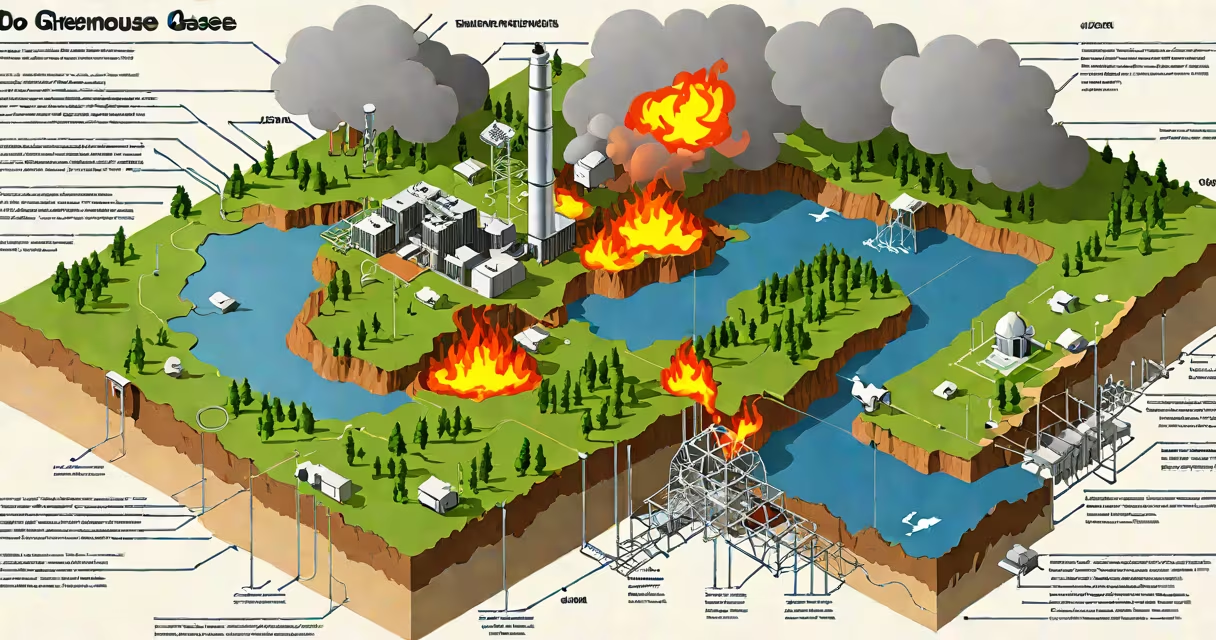
Yes, greenhouse gases cause global warming by absorbing infrared radiation emitted by Earth's surface and re-radiating it back, increasing the planet's average temperature. This process, known as the greenhouse effect, is amplified by human activities that release excess amounts of carbon dioxide, methane, and nitrous oxide into the atmosphere.
The greenhouse effect is a natural phenomenon essential for life. Without it, Earth's average temperature would be about -18°C (0°F), too cold to support most forms of life. However, since the Industrial Revolution, human activity has increased the concentration of greenhouse gases, intensifying the effect and leading to rapid global warming.
Carbon dioxide (CO₂) accounts for about 76% of global greenhouse gas emissions from human activities, according to the Intergovernmental Panel on Climate Change (IPCC). Methane (CH₄) contributes around 16%, and nitrous oxide (N₂O) adds another 6%. These gases absorb and re-emit thermal energy, trapping heat in the lower atmosphere and disrupting Earth's energy balance.
When sunlight reaches Earth, some is reflected back toward space, while the rest is absorbed by land and oceans, warming the surface. The warmed surface emits energy as infrared radiation. Greenhouse gases absorb this outgoing radiation and re-emit it in all directions, including back toward Earth's surface.
This process increases the amount of heat retained in the troposphere-the lowest layer of the atmosphere-raising global temperatures. The more greenhouse gases in the atmosphere, the more infrared radiation gets trapped, leading to higher average surface temperatures.
A 2021 study published in *Nature* confirmed that the enhanced greenhouse effect due to human-emitted CO₂ is responsible for approximately 90% of the observed increase in global surface temperature since the late 19th century. The remaining 10% stems from changes in solar output and volcanic activity, both of which have had minimal impact compared to anthropogenic emissions.
Each major greenhouse gas has distinct properties and emission sources:
| Gas | Global Warming Potential (GWP) | Main Sources | Atmospheric Lifetime |
|---|---|---|---|
| Carbon dioxide (CO₂) | 1 (baseline) | Fossil fuel combustion, deforestation | 300-1,000 years |
| Methane (CH₄) | 28-36 over 100 years | Cattle farming, landfills, oil/gas extraction | 12 years |
| Nitrous oxide (N₂O) | 265-298 over 100 years | Fertilizer use, industrial processes | 114 years |
CO₂ remains in the atmosphere for centuries, making its effects long-lasting. Methane, though shorter-lived, is far more effective at trapping heat per molecule-28 times stronger than CO₂ over a 100-year period, according to the U.S. Environmental Protection Agency (EPA).
Deforestation reduces the planet's capacity to absorb CO₂, compounding the problem. For example, the Amazon rainforest, once a net carbon sink, now emits more CO₂ than it absorbs due to widespread logging and fires, as reported by the World Resources Institute in 2023.
Some claim that water vapor is the dominant greenhouse gas and therefore the primary driver of warming. While water vapor does contribute to the natural greenhouse effect, it is not a direct driver of current global warming. Its concentration in the atmosphere is controlled by temperature-warmer air holds more moisture, creating a feedback loop, but it cannot initiate warming on its own.
Another misconception is that natural cycles, such as solar variation or volcanic eruptions, explain recent warming trends. Satellite measurements show that solar irradiance has remained stable since the 1970s, while global temperatures have risen sharply. Volcanic activity releases CO₂, but at a rate less than 1% of annual human emissions, according to NASA's Goddard Institute for Space Studies.
The current rate of warming-about 1.2°C above pre-industrial levels-is new in at least the last 2,000 years. Ice core data from Antarctica reveal that CO₂ levels have never exceeded 300 parts per million (ppm) in that time. Today, they exceed 420 ppm, a level not seen in at least 800,000 years, based on data from the National Oceanic and Atmospheric Administration (NOAA).
In 2023, the World Meteorological Organization (WMO) declared it the hottest year on record. Global average temperatures reached 1.45°C above pre-industrial levels. Scientists attribute this to sustained high emissions of CO₂ and CH₄, particularly from coal-fired power plants, transportation, and industrial agriculture.
For instance, methane emissions from livestock in Brazil rose 12% between 2020 and 2022, contributing to regional warming. Simultaneously, CO₂ emissions from fossil fuels hit a record 36.8 billion metric tons globally, according to the Global Carbon Project.
These numbers confirm that greenhouse gas concentrations correlate directly with rising temperatures. When CO₂ levels rise, so does the planet's heat retention. The physics behind this relationship is well-established and repeatedly validated through satellite observations, ground-based monitoring, and climate models.
Understanding that greenhouse gases cause global warming is not theoretical-it is supported by decades of observational data and peer-reviewed science. The IPCC's Sixth Assessment Report (2021) states with 95% confidence that human influence is the dominant cause of observed warming since the mid-20th century.
If emissions continue unchecked, global temperatures could rise by 2.5°C to 4.5°C by 2100, triggering irreversible impacts like sea-level rise, extreme weather events, and biodiversity collapse. Reducing emissions requires systemic changes in energy, transport, and food systems.
Every 0.1°C of warming increases the risk of extreme heat, droughts, and floods. Stabilizing the climate demands immediate action to reduce emissions and transition to renewable energy sources. The science is clear: greenhouse gases drive global warming, and reversing the trend depends on deliberate, large-scale mitigation efforts.