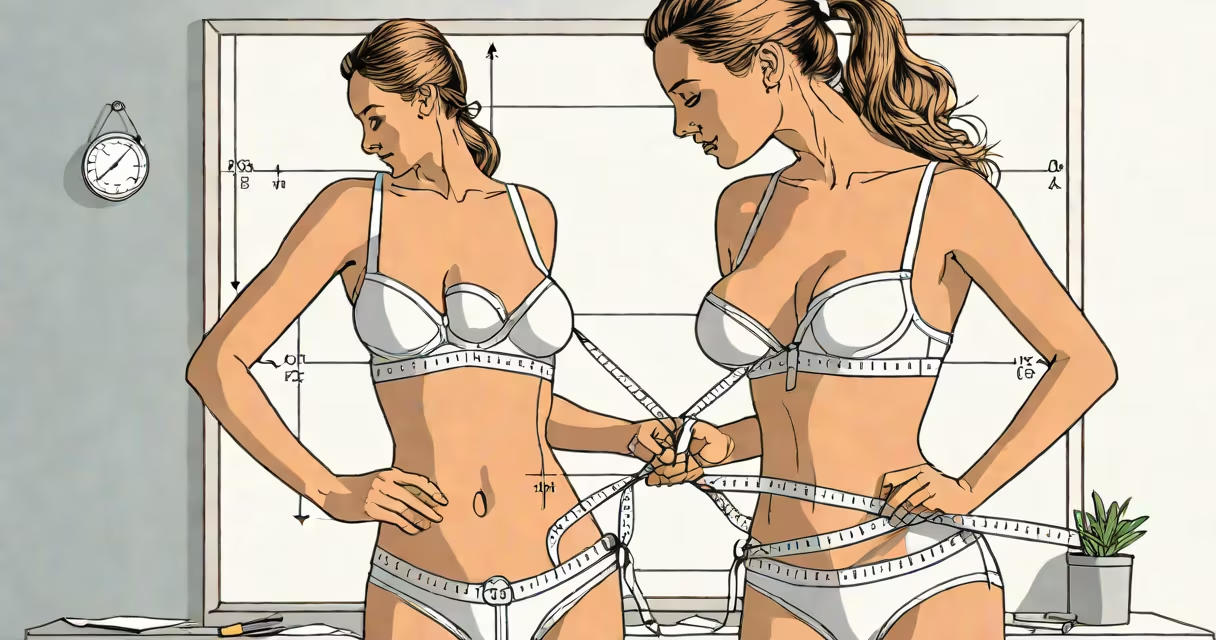
Your correct bra size is determined by your band measurement (around the ribcage just under the bust) and your cup size (the difference between your bust and band measurements). A properly fitted bra supports your breasts evenly and prevents discomfort, back pain, and long-term posture issues.
Bra sizing uses two numbers: the band size (e.g., 34, 36) and the cup size (A, B, C, etc.). The band size is the circumference around your ribcage, measured snugly but not tight. The cup size reflects how much volume your breasts take up beyond the band. For example, a 36C bra has a 36-inch band and a cup that holds approximately 3 inches more volume than the band.
Many people wear the wrong size. According to the American Society of Plastic Surgeons, up to 85% of women wear bras that don't fit properly. Common errors include assuming your size is based on clothing size or guessing from online quizzes. Accurate measurement is essential.
Bra bands are sized in whole numbers, typically in 2-inch increments (32, 34, 36, etc.). You measure around your ribcage, just below the bust, while wearing a non-padded bra or no bra at all. If the measurement rounds to an odd number, round up to the nearest even number. So a 33-inch measurement becomes a 34-band size.
Cup sizes are assigned based on the difference between your bust and band measurements. A 1-inch difference is an A cup, 2 inches is a B, 3 inches is a C, and so on. This system applies consistently across brands, though actual fit can vary due to differences in shaping and materials.
For example, someone with a 32-inch band and a 35-inch bust has a 3-inch difference. That's a 32C bra. Another person with a 36-inch band and a 39-inch bust also wears a 36C. The cup size doesn't change based on band size-it's purely about volume difference.
Use a soft, flexible measuring tape. Stand upright with arms relaxed at your sides. Measure around your ribcage, just below the bust, keeping the tape level and snug-not tight. Record the number in inches.
Next, measure around the fullest part of your bust, keeping the tape horizontal and not compressing the tissue. Again, record the number in inches.
Subtract the band measurement from the bust measurement. Use the result to determine your cup size:
| Difference (inches) | Cup Size |
|---|---|
| 1 | A |
| 2 | B |
| 3 | C |
| 4 | D |
| 5 | DD/E |
| 6 | DDD/F |
Some brands extend past DD to G, H, or larger. Always check the brand's specific size chart.
Assuming your size is based on your clothing size is a frequent error. A woman who wears a size 10 in jeans may have a 34C bra size-but that's not guaranteed. Clothing sizes are inconsistent across brands and don't reflect body proportions.
Another mistake is relying solely on online bra size calculators. These tools often ask for height, weight, and clothing size, which don't correlate reliably with actual breast volume. They may give a reasonable estimate, but they're not a substitute for physical measurement.
Many people think "C" cups are average. In reality, the average American woman wears a 34C, according to the National Breast Cancer Foundation. But this varies widely by region and age group. A 34C is not standard for everyone.
Take Sarah, a 32-year-old woman who measures 30 inches around her ribcage and 34 inches at her bust. Her band size is 30, which rounds up to 32 (since band sizes are even numbers). The difference is 4 inches-she needs a D cup. Her correct size is 32D.
Now consider Maria, who measures 36 inches around her ribcage and 40 inches at her bust. Her band size is 36. The difference is 4 inches-again, a D cup. She wears a 36D. Same cup size, different band-both fit correctly.
These examples show that cup size depends only on the difference, not on the absolute measurement. A 32D and a 36D both hold the same volume of breast tissue relative to their band size.
An ill-fitting bra causes visible issues: straps dig into shoulders, the band rides up, and the cup spills over. Over time, poor support contributes to back and neck strain. The American Academy of Orthopaedic Surgeons notes that improper bra fit is linked to chronic upper back pain in women aged 25-45.
Properly fitted bras reduce pressure on ligaments and improve posture. A study published in the Journal of Women's Health found that women who wore well-fitted bras reported 30% less shoulder fatigue during daily activities.
When shopping, try on multiple styles. Underwire bras require precise fit. Soft-cup bras allow more flexibility but still need accurate sizing. Always check the band and cup separately.
If your bra feels too tight across the back or the band rides up, you may need a larger band size. If the cups stretch or the fabric wrinkles, you may need a smaller cup. Some brands offer half-sizes (e.g., 34.5C).
After trying on a bra, stand in front of a mirror. Look for gaps between the cup and breast tissue. If you see space, the cup is too big. If the breast tissue bulges out the side or top, the cup is too small.
I once tried on a 36B bra that looked perfect on the rack. When I put it on, the band was loose and the cups were empty. Switching to a 34C eliminated the gap and lifted my bust properly. The difference was 2 inches in band size and one cup size-small changes, big impact.
Check the size chart on the brand's website. Most major retailers provide detailed charts with instructions. Brands like Panache, Wacoal, and Elomi offer size guides with diagrams showing where to measure.
If you're unsure, visit a specialty lingerie store. Fitters use standardized methods and can adjust for body shape. Many stores offer free fittings and return policies.
Always measure yourself in the afternoon. Breast volume increases slightly throughout the day due to fluid retention. Measuring in the morning may lead to a size that's too small.
Never assume your size stays the same. Weight gain, pregnancy, menopause, and hormonal shifts all affect breast size. Re-measure every 6-12 months or when you notice changes in fit.
Remember: what size bra do I need? It's not a guess. It's a measurement. Use the steps above, verify with a fitting, and choose a size that supports your body-not just your current wardrobe.