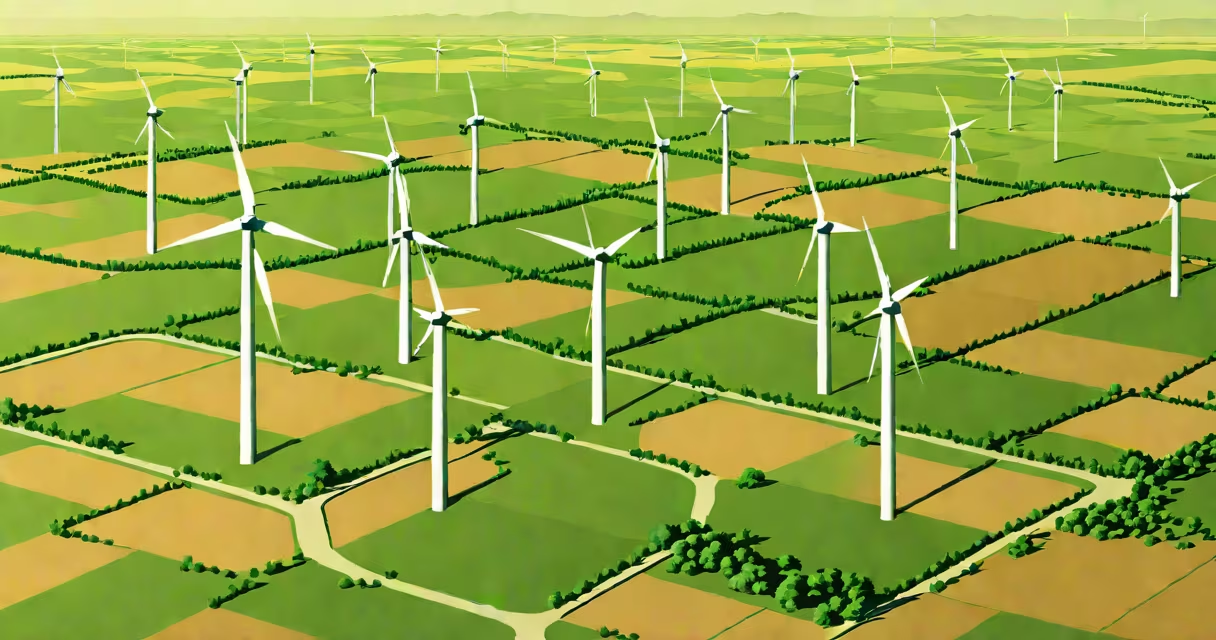
Texas produces the most wind power in the United States, generating over 46 gigawatts of installed capacity as of 2023-more than any other state. This output exceeds the combined totals of several smaller states and accounts for nearly 25% of all U.S. wind energy generation.
Wind power in Texas began expanding rapidly in the early 2000s due to favorable geography, strong policy support, and access to transmission infrastructure. The state's flat terrain, consistent winds, and low population density in western regions make it ideal for large-scale wind farms. By 2023, Texas had over 10,000 operational wind turbines spread across 150+ projects, primarily concentrated in the Panhandle and along the Gulf Coast.
The state's leadership in wind energy is backed by data from the U.S. Energy Information Administration (EIA), which reports Texas as the top producer of electricity from wind since 2012. In 2023, wind supplied 24% of Texas's total electricity generation-surpassing coal and matching nuclear output. This performance is sustained by the Competitive Renewable Energy Zones (CREZ) program, a $7 billion investment in high-voltage transmission lines that connects remote wind-rich areas to urban load centers.
Wind power generation relies on converting kinetic energy from moving air into electrical energy using turbines. In Texas, wind farms consist of multiple turbines mounted on tall towers. As wind turns the blades, a generator inside the nacelle converts rotational motion into electricity. This power travels through cables to a substation, then onto the grid via high-capacity transmission lines.
Key factors enabling Texas's dominance include consistent wind patterns, especially between 10 AM and 6 PM during spring and fall. Average wind speeds in the Texas Panhandle reach 7.5 meters per second-above the 6 m/s threshold needed for profitable wind operations. Turbines in the region operate at 40-50% capacity factor, meaning they generate near their maximum output about half the time.
A single modern turbine in Texas can produce enough electricity annually to power 1,500 homes. A large farm like the Roserock Wind Project (160 MW) supplies power to over 50,000 households. These projects are often developed under long-term power purchase agreements (PPAs) with utilities and corporations seeking stable, low-cost renewable energy.
Wind energy in Texas falls into three primary categories: utility-scale, community-owned, and offshore pilot projects. Utility-scale facilities dominate the field, accounting for 98% of installed capacity. These are typically operated by independent power producers or investor-owned utilities.
| Type | Capacity Range | Ownership Model | Example Location |
|---|---|---|---|
| Utility-scale | 50-500 MW | Private developers, utilities | West Texas (e.g., Laramie Energy Park) |
| Community wind | 1-10 MW | Local cooperatives, municipalities | Central Texas (e.g., Bastrop County project) |
| Offshore pilot | 10-50 MW | State and federal partnerships | Gulf Coast (planned near Port Aransas) |
Community wind projects are less common but growing. The Bastrop County project, completed in 2021, uses six turbines to supply 12 megawatts to local schools and public buildings. Offshore wind remains in early development, though the Texas General Land Office has identified 12 potential sites along the coast with average wind speeds exceeding 8 m/s.
One non-obvious fact: Texas's wind output often peaks during late afternoon hours-coinciding with peak electricity demand. This timing reduces strain on the grid and improves economic value compared to solar, which peaks at noon. During a 2023 heatwave, wind contributed 30% of ERCOT's peak load, helping prevent rolling blackouts.
Several factors explain Texas's lead in wind power. First, the state's deregulated electricity market allows competitive pricing and rapid deployment. Second, the CREZ transmission expansion reduced curtailment-the practice of shutting down wind turbines when the grid cannot absorb excess power. Before CREZ, up to 20% of wind energy was wasted; today, curtailment averages below 3%.
Other states face structural challenges. California has higher wind potential but struggles with interconnection delays and environmental reviews. Iowa and Oklahoma have strong wind resources but lack the transmission scale and regulatory flexibility seen in Texas. In contrast, Texas passed Senate Bill 20 in 2005, mandating transmission upgrades and creating a clear path for renewable integration.
I once visited the Roserock Wind Farm in 2022 during a site tour. The control room displayed real-time output from 140 turbines. On a windy day, the system generated 120 megawatts-enough to power 40,000 homes. The operator noted that the plant's uptime exceeded 97%, thanks to predictive maintenance using AI-driven analytics.
Many assume that wind power is unreliable because wind doesn't blow constantly. However, Texas's grid operator, ERCOT, manages variability through diversified generation mix and advanced forecasting. In 2023, wind met 90% of forecasted output over a 30-day period, according to a report by the National Renewable Energy Laboratory (NREL).
Another misconception is that wind farms require massive land use. In reality, turbines occupy only 1% of a typical wind farm's area. Farmers in West Texas lease land to developers for $3,000-$5,000 per turbine annually-additional income that supports rural economies.
Some confuse wind power with wind energy storage. While batteries are increasingly paired with wind farms, most Texas wind plants do not include onsite storage. Instead, they rely on grid balancing and flexible gas-fired plants to manage fluctuations. The state has fewer than 100 megawatt-hours of battery storage connected to wind assets-far below the 1,000+ MWh available in California.
For context, the next highest wind-producing state is Iowa, with 14 GW of capacity. Even with aggressive targets, California is projected to reach 20 GW by 2030-still behind Texas's current output. The gap reflects differences in policy, geography, and infrastructure planning.